THE SKY BEHAVED on Thursday, Dec. 14, 2023. We had a seasonably warm (47 degrees) sunny day here on the west coast of Lake Winnebago, and when the sun quit the sky at 4:16 p.m., the temps were still in the mid-30s. I am fond of this time of year because the canopy of stars appear so early in the evening. By 5:30 p.m., the SeeStar was set up on our north driveway.
I used the tripod that came with the scope tonight; a first-time event. I wanted to see if this smaller tripod would be easier to level, and keep level, as the scope searched for and tracked objects. It’s a little tripod, well made but it only extends to 18 to 20 inches high. I did not use the bubble level before I mated the SeeStar to it. Perhaps I should have.
On we go.
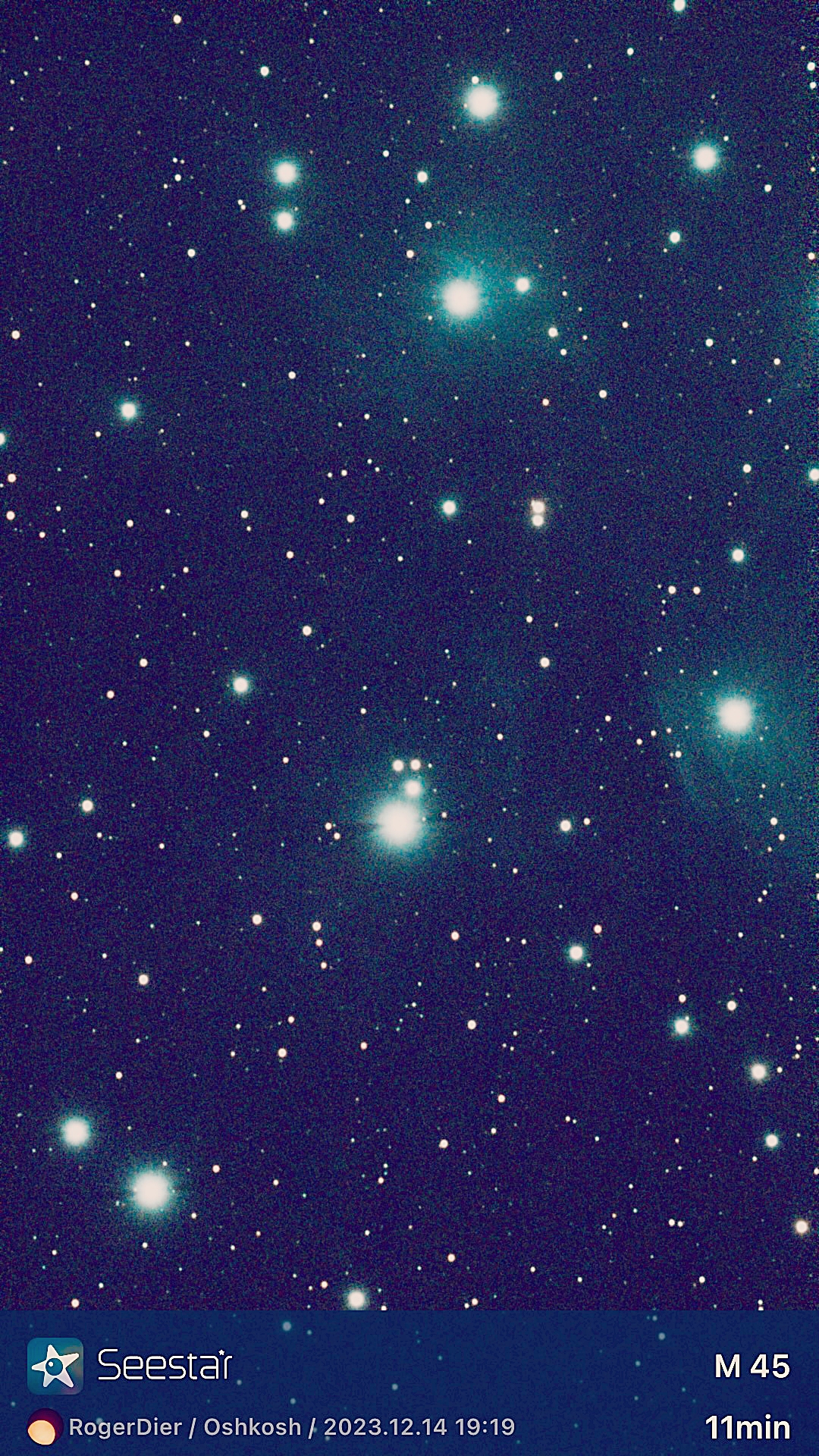
M45
The Pleiades, the Greek name for this famous open cluster, was recorded first in 750 BC in Homer’s Iliad. Undoubtedly, people saw this group of stars for thousands of years before that. Most people can see six of the so-called “Seven Sisters.” The Japanese know this two degrees wide asterism as “Subaru.” The Persians, who studied the stars for centuries under dry desert air, call the cluster “Soraya.” Subaru. Soraya. The ears are happy.
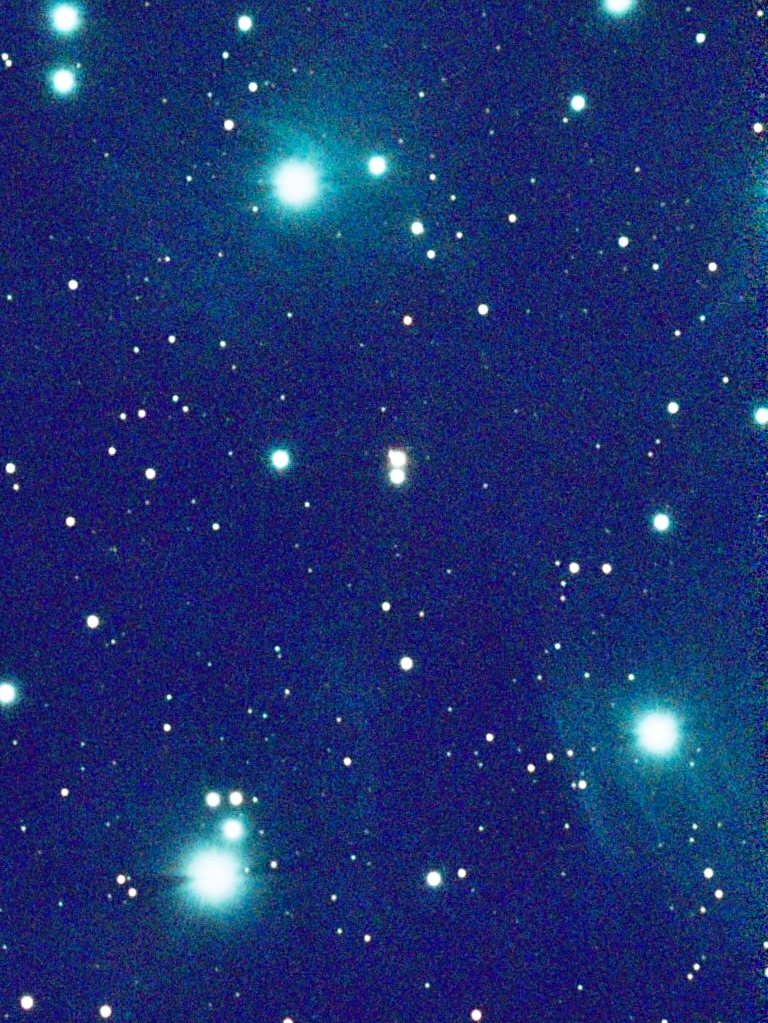
This is what we know of the Pleiades: It’s 439 light years away, so the photos taken last night and which you are seeing here was the Pleiades as it existed in on a December night in 1584. The visible magnitude of the open cluster is 1.6, very bright (to us) as clusters go. Most people can see six stars under moderately dark skies. Those living far away from artificial light count seven, hence the Seven Sisters nickname. Kepler, who gave us the three laws of motion, catalogued 14 without optical aid.
The nebula associated with the Pleiades isn’t of the grouping. It’s a light years-wide cloud of molecules (or star stuff, as Carl Sagan might say) that floats between us and the cluster. Energy from the stars in cluster illuminate the nebula in a silhouette. M45 is a stunning example of reflection nebula. The two photos here, one on the right is cropped to highlight nebula, are 11 minutes worth of 10-second exposures, or 66 stacked images.
The Outer Limits Galaxy
The photo of the edge-on galaxy known as NGC 891 is 30 million light years from our Milky Way gang and is one of the “Local Group” of star cities in our part of the cosmos. William Herschel first noted it on Oct. 6, 1784. It’s faint at magnitude 10.8, and anyone looking directly at it with a two-inch refractor likely would not see it because it’s at the edge (11.1 mag) of light that a two-inch refractor brings to the human eye. Fortunately, the SeeStar can photograph it and pile those images on top of each other to make it bright enough to capture on an electronic sensor.
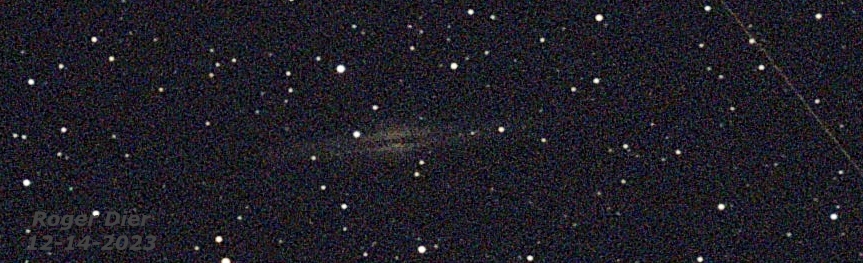
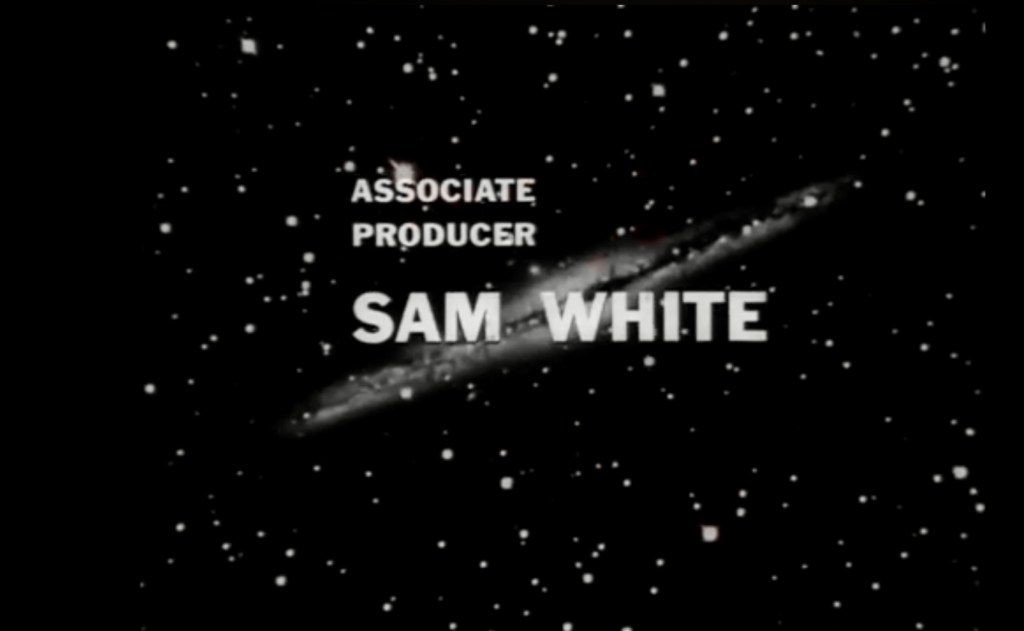
In popular lore of modern amateurs, it’s known as the Silver Sliver. Because we see it edge on, we get the full length of it and an appreciation of the endless clouds of dark matter in and around it. Hollywood noticed too, because NGC 891 appears in the end credits of The Outer Limits episodes.
This galaxy is not easy to see, but there it is, a flying saucer-shaped object in the middle of this cropped, two-minute exposure and to the left of the satellite the camera captured during exposure.
NGC 1545
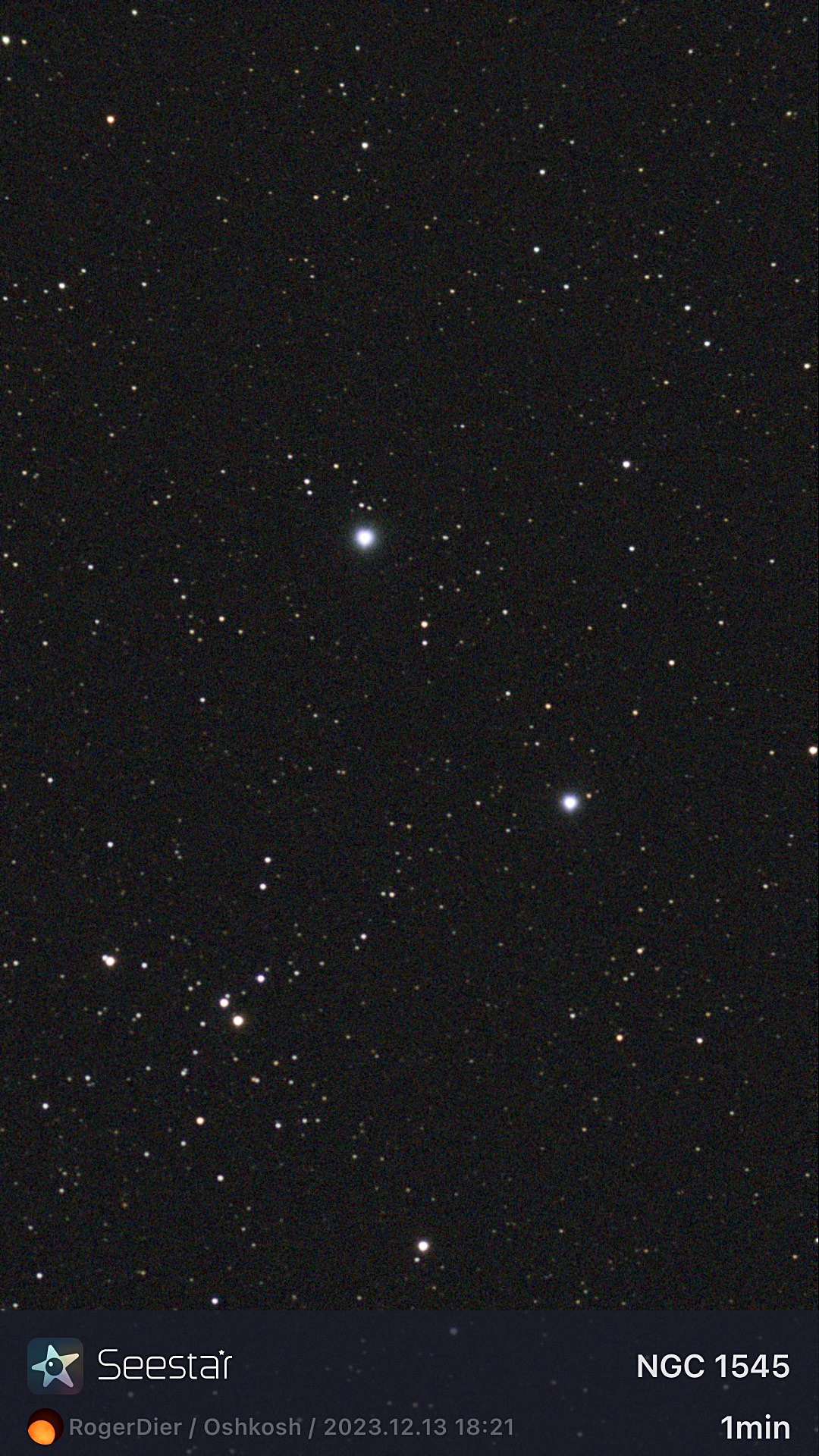
Two nights ago on the right I came upon an open cluster in the constellation Perseus. It’s estimated to be 2,320 light years away. Some amateurs know it as the “triangle cluster.”
Of Note
NGC is an abbreviation for New General Catalog of stars. The “M” in M45 is shorthand for Charles Messier’s 18th century list of objects he made that looked like comets in his telescope but really were not. Orion rises on its back in these parts about 7 p.m., makes a long overnight journey across the sky and does a header on the western horizon about 12 hours later. The Pleiades is about three fist widths above the northeast horizon after sunset. Jupiter is high in the southeast when the sun sets. Venus rises in the east about two hours before sunrise. The winter solstice arrives here on Thursday Dec. 21 at 9:27 p.m., one week from this posting. The solstice signals the astronomical start of winter in the northern hemisphere.
Thank you for visiting Rogerdier.com. I wish you clear skies and good health.
 Cosmic