WE HAD TWO days of mostly clear skies earlier this week. I took advantage of those back-to-back days to use the SeeStar S50 and photograph the sun and the moon. The photographs show how fast each body is spinning, and in the sun’s case, how often sunspots change during their magnetic minuets.
SUN DANCE
As discussed in previous posts, sunspots are really electromagnetic dams that plug the normal convection of energy from reaching the sun’s surface. This electromagnetic constipation means the blocked areas are cooler than the surrounding photosphere, and because they are, they appear dark.
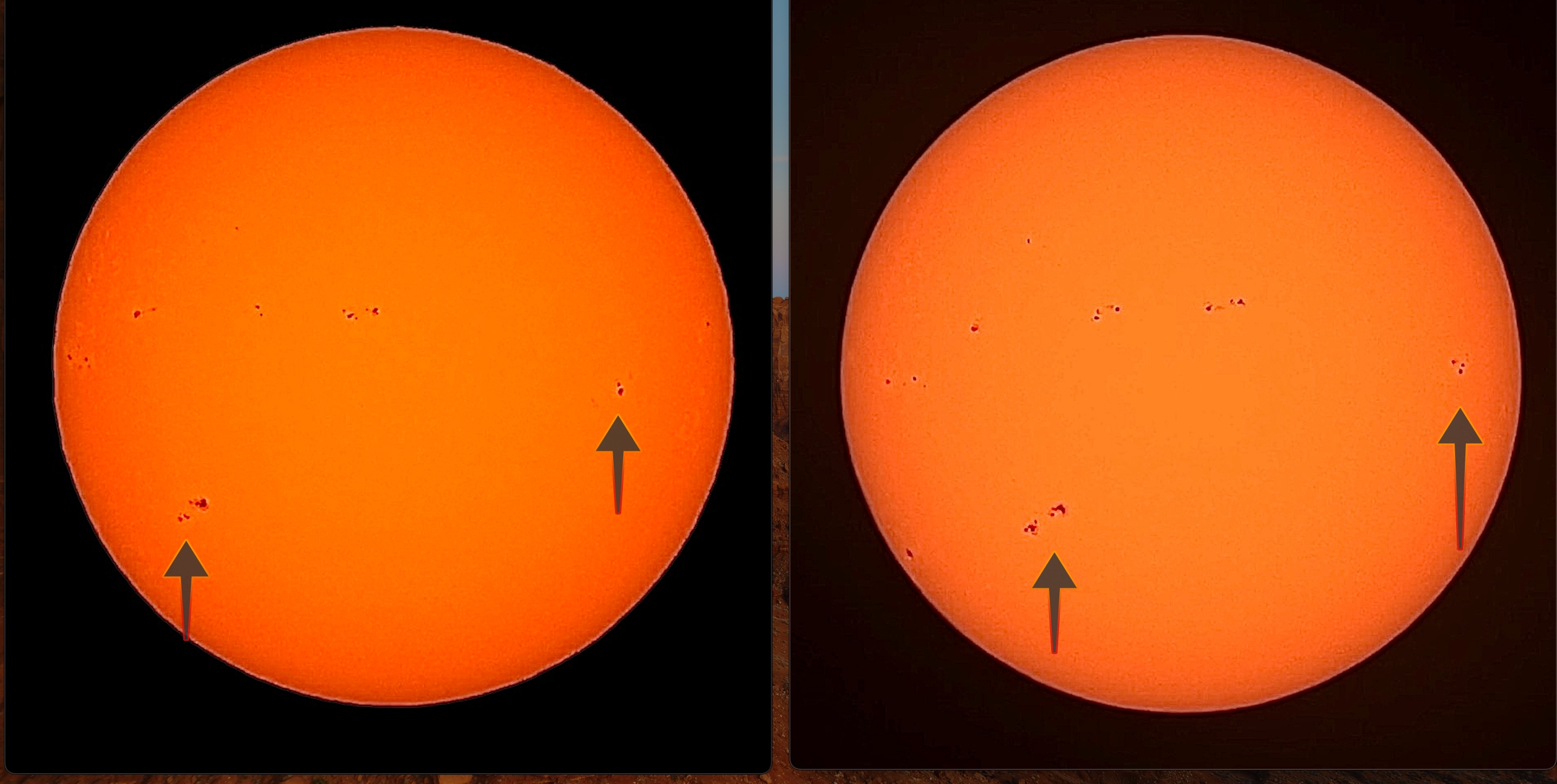
Sunspots first appear as tiny dots on the surface. Solar physicists call those early stage sunspots pores and they range in size from 10 to 100,000 miles wide. Solar pores often grow into serious magnetic events and if they grow large enough, they develop an umbra with a penumbra; The umbra is darker because it is cooler. The photo below shows both development of pores from one day to the next, and the speed with which they travel across the surface. If a sunspot appeared on the left limb of the sun and survived long enough, we’d see it reemerging where it first appeared, 27 days later. At its equator, sunspots move at 4,400 miles per hour (6,875 kilometers per hour). On the poles and higher latitudes, not so fast.
Off the left rim, we see the sun as it was on Dec. 19, 2023 at 11:29 a.m. CST. On the right is the sun a day later, Dec. 20 at 11:47 a.m. CST. The arrows on each picture shows the evolution of sunspot groupings. Both highlighted groupings have changed size and developed more complexity. The sun is always in high magnetic boil, except when it isn’t during solar minimums, when sunspots are as scarce as mosquitos in arctic winter.
New to this writer is Spörer’s law, which illustrates that early in a solar cycle, sunspots first appear at higher latitudes in the photosphere, from 30 to 45 degrees. As the sunspot maximum approaches, sunspots squeeze to within 15 degrees of the equator. They continue congregating within seven degrees of the equator as the maximum fades, when they disappear for months at a time. When the new cycle begins, we first notice sunspots in the high latitudes. The slow skew of sunspots toward the equator was discovered by the English astronomer Richard Christopher Carrington around 1861. Carrington’s work was refined by the German astronomer Gustav Spörer, who obviously slapped his name on Carrington’s work and grabbed all the credit.
Moon Dance
From night to night, the moon travels east across the sky at an average of 13.18 degrees per day. A different way to calculate the rising and setting of the moon is the knowledge that on average, it rises 40 minutes later each day. We also know it spins a lot slower than most of the planets, taking about 27 days to rotate once, which coincides with its orbit around earth. As a result, we earthbound slugs can only see 59% of the moon’s surface at one time or another. There really is no dark side of the moon, though that didn’t stop Pink Floyd.
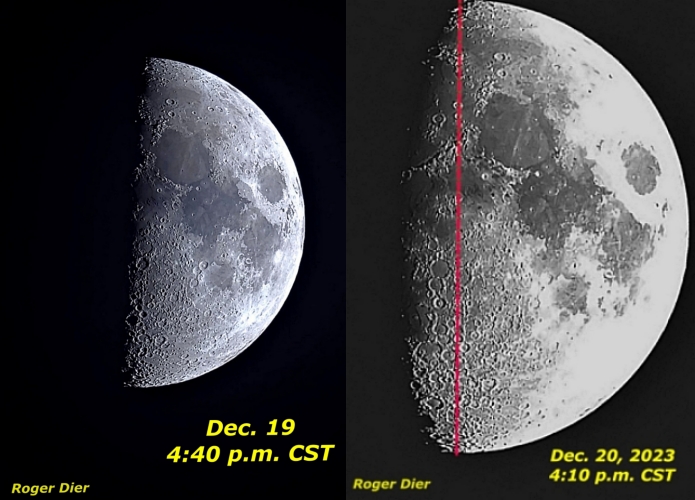
The speed at which the terminator moves across the lunar surface varies and like the sun, it moves faster on the equator. At the equator, the shadow moves at 9.6 mph (15.4 kpm), about as fast as cars entering a Target parking lot. Over the course of a day on Earth that’s 230 miles or 369.9 kilometers.
The two photos of the moon below show a comparison of one evening to the next, a line has been drawn on the Dec. 20 to show where the terminator was the day before.
the sun is perfect
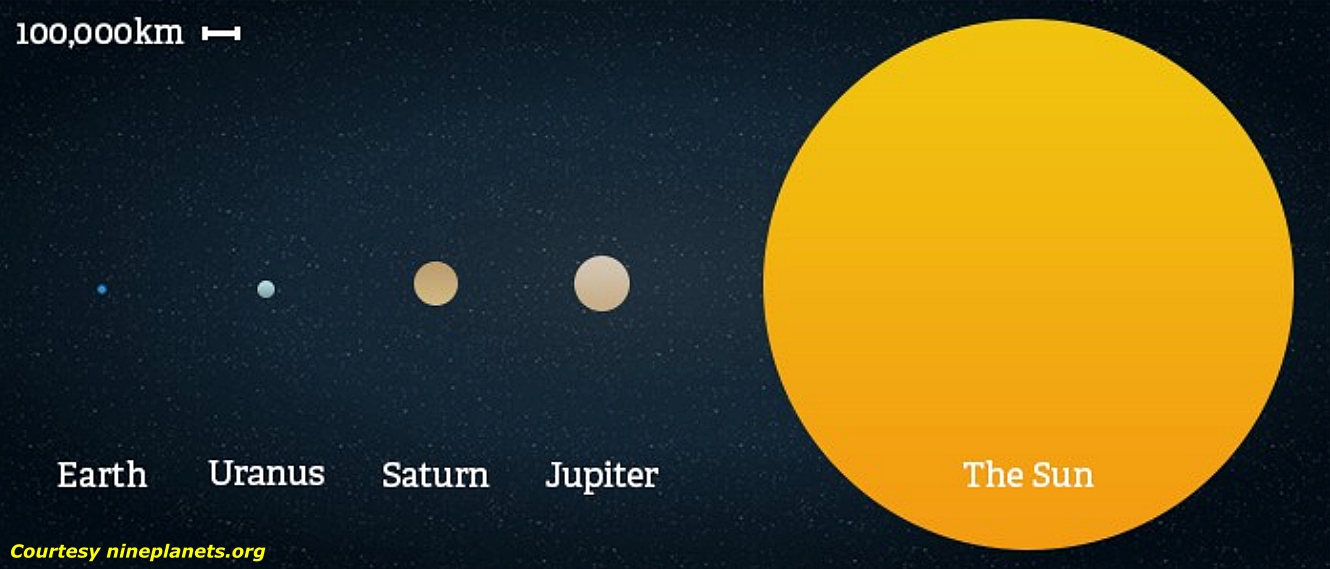
Compared with other massive furnaces in the cosmos, like the supergiant Antares (621 billion miles in diameter) our small sun (865,000 miles in diameter) is a like a gnat on a beach ball. But for our purposes, the sun is perfect: A steady, boring little nuclear bulb with an interesting 11-year cycle of acne. Life on Earth would not exist without our yellow dwarf star and for that, we are thankful.
If you’d like to subscribe for free, tap the box at the bottom of the page and fill out the necessary information. Your email is secure.
Thank you for making a cosmic visit to Rogerdier.com. Our staff wishes you happy holidays and good health to you and the people you care about.
Roger Dier
 Cosmic