Before we discuss her horse head, let’s meet Williamina Paton Stevens Fleming.
Born in Dundee, Scotland in 1857, Williamina’s intellect shimmered like the Venus over the horizon. Her father died when she was seven. At age 14, to help support her mother and eight siblings, she worked as a teacher. When she was 20, Williamina (pronounced William-eye-nah, her friends called her “Mina”) married a widower who was 16 years her senior. Two years later, the couple emigrated to Boston, Massachusetts. Shortly after arriving in Boston, Williamina’s husband abandoned her and their unborn child, never to return. Desperate to support her child, she found work as a maid in the home of Professor Edward Charles Pickering, the director of the Harvard College Observatory.
Working for the Pickerings proved to be the pivot point of Williamina’s life.
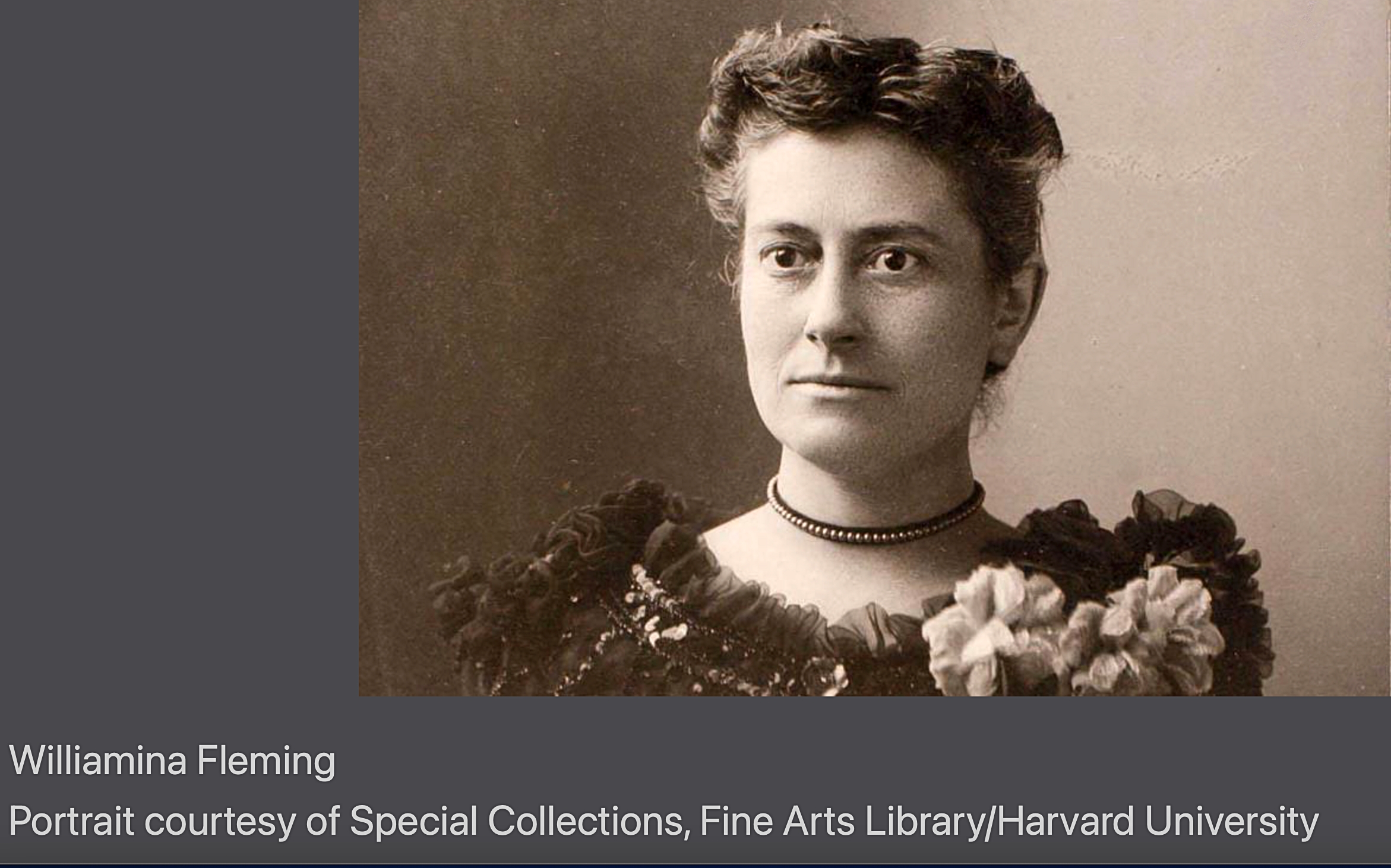
Tired of the attitude and shoddy work of a male graduate student, Prof. Pickering shared his frustration with Elizabeth, his wife. Wifey knew the solution to her husband’s problems was under their very roof. Elizabeth sensed her maid’s mind was starving for stimulation, and suggested her husband give Williamina a try. Prof. Pickering hired Williamina to conduct part-time administrative work at the observatory. Four years later, she was on staff full time at the most prestigious university in America.
When she took the job, Williamina knew little of the stars, other than they were up there. She knew less about physics, but she discovered Pickering’s work was fascinating, and she threw herself into it. By the time she died of pneumonia at age 54, Williamina had created an historical CV. Her curriculum vitae included invention of a simplified method of classifying the spectrum of stars; she analyzed thousands of photometric images of dark, deep space phenomena and developed a system to organize them by class; Ms. Fleming discovered 59 gaseous nebulae; more than 300 variable stars; and 10 novae. She also helped identify a new kind of star—a white dwarf.
Not only did Williamina rise to a prestigious position at Harvard, she earned a reputation as the nation’s preeminent woman astronomer.
WILLIAMINA’S HORSEHEAD
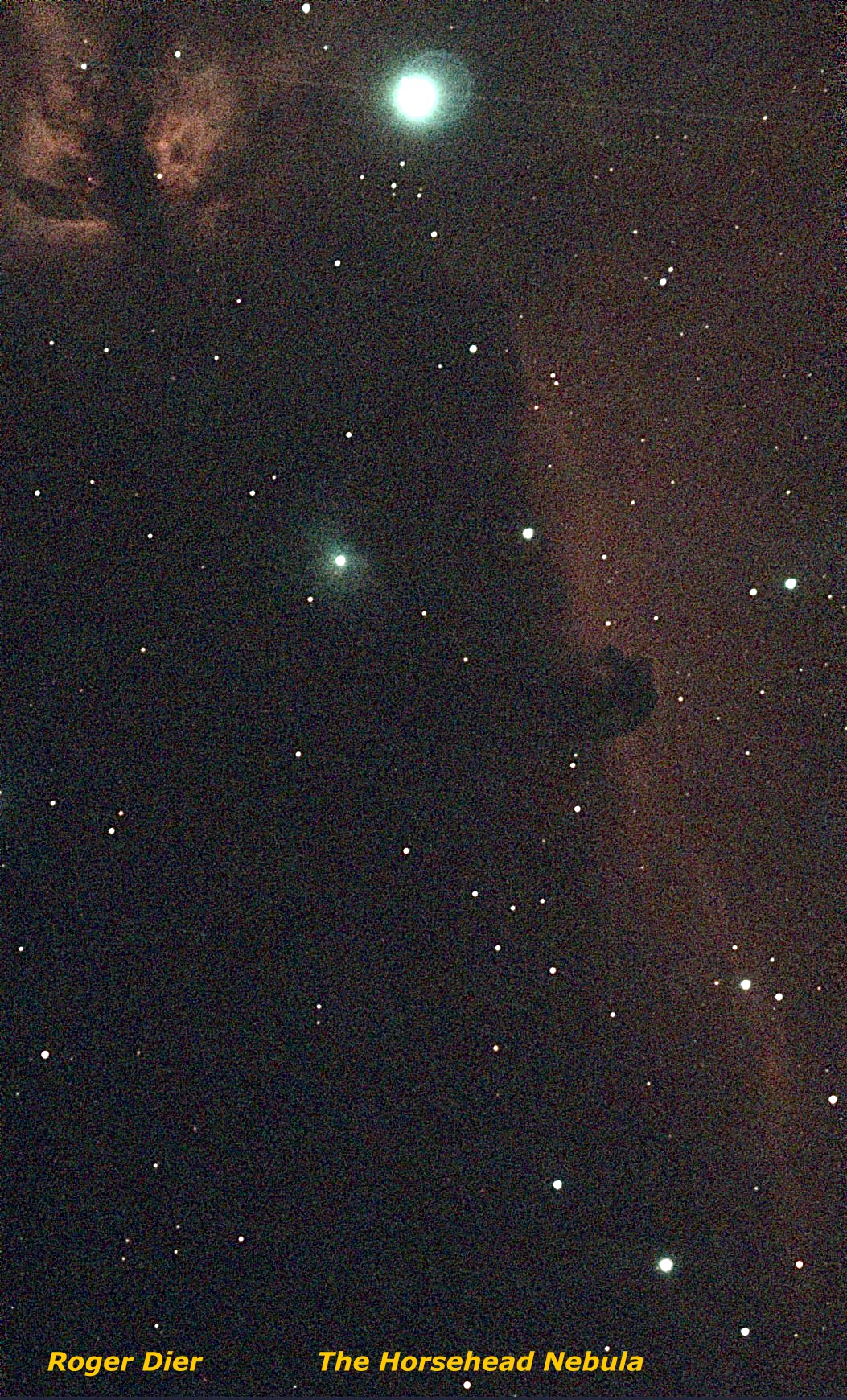
In 1888, Ms. Fleming discovered the Horsehead Nebula on a telescope-photogrammetry plate made by astronomer William H. Pickering, Prof. Edward Pickering’s brother. She described the bright nebula as having “a semicircular indentation 5 minutes in diameter 30 minutes south of Zeta Orionis.”
In the later part of Williamina’s life, the male-dominated astronomical community ignored her discovery of the Horse head. Despite unproven claims of, “I saw it first,” Ms. Williamina Fleming is the first person to analyze what she was seeing, assign it to a category and put her findings to paper and publish them. The men of her time were out-hustled and outsmarted by a dogged and superior intellect.
CURIOUS KID CRACKS A BOOK
When I first opened an astronomy book during the winter of 1965-66, there’s a strong probability that an image of the Horsehead Nebula was among the book’s first images. Until recently, I had neither seen the Horsehead through a telescope, nor had I photographed it. Last week, under a dark Bortle 5 sky—an astronomical oxymoron—I programmed my SeeStar S50 to corral the Horsehead. It took the two-inch lens four minutes to pile enough images on top of one another to produce what you see now.
The Horsehead Nebula is backlit by the stars beyond it. To the upper left is a very bright nebula known as the Flame Nebula. Had I known the Flame Nebula would burst onto the image the way it did, I would have framed it better. Next time. On clearer images taken from earth orbit and beyond, the light of newborn stars beyond the Horsehead is so intense that the dark nebula casts a shadow on the rest of the cloud.
The dark cloud is tall (four light years high), wide (three light years wide) and so thick that the stars behind it—the same stars silhouetting the Horsehead Nebula—can’t be seen. As the newborn stars in this part of the Orion Molecular Cloud Complex mature, the relentless blast of electromagnetic energy of those stars will drive the glob of hydrogen and dust together, possibly creating more stars, or blow the Horsehead Nebula into oblivion. See it while you can.
M41
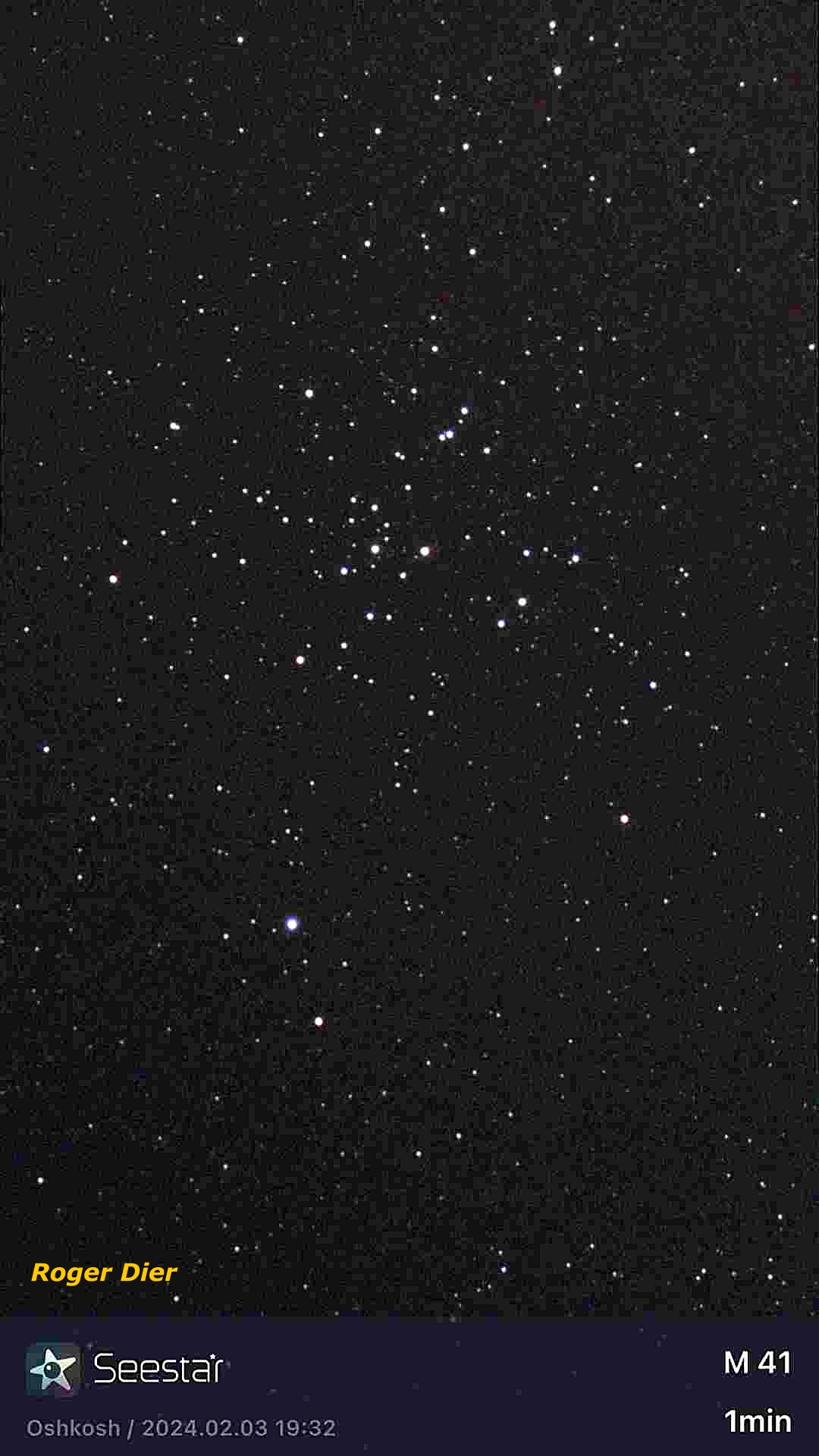
A week or so ago, the sky was clear enough to shoot images of M42 and M43. That same night, I explored another Messier object. I have seen M41 through various telescopes. South of Sirius in Canis Major, M41, known by some as the little beehive cluster, never creeps high enough in the middle-north latitudes. The real beehive cluster in Cancer holds more than 1,000 stars. The little beehive contains around 100. I have never gotten the little beehive buzz.
Thank you for visiting rogerdier.com. If your spirit moves, share this site with your friends and relatives. If you sign up for a free subscription, you (and they) can receive posts directly in their email.
—Roger Dier
Feb. 8, 2024
 Cosmic
One response to “Williamina’s Horsehead”
“See it while you can” LOL
LikeLike