If you’re reading this on Monday, April 1, we’re one week away from a potentially spectacular celestial event. Whether you are able to see the solar eclipse on April 8 depends on where you are and what portions of earth are covered by clouds on the afternoon of the day. The path of totality sweeps diagonally across the U.S. from the southwest to the northeast.
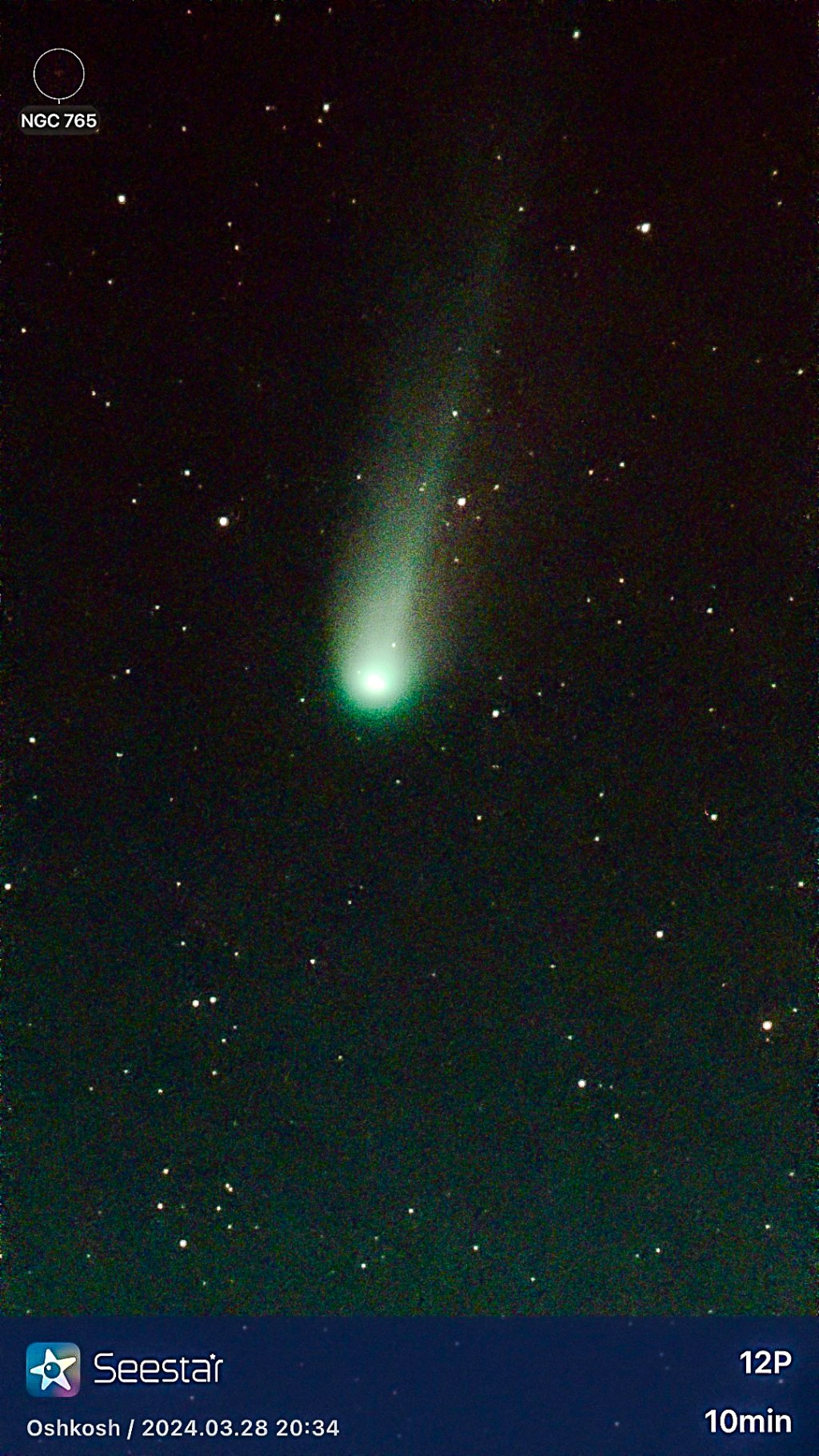
Coincidentally, Comet Pons-Brooks will make its closest approach to the sun during eclipse week. A few nights ago, I traveled a few miles out of town to shoot it with my SeeStar S50. The comet was much lower in the sky at sunset than early in March when I first shot it. Under a darker sky, the tail is about 30 degrees long. Electromagnetic energy from the sun creates the tail through sublimation; changing the comet’s surface from solid to gas.
The comet has become more challenging to shoot because everything is moving. The lengthening days (we gain 20 minutes of sunlight per week in March), the arrival of daylight savings time drove the comet lower toward the horizon at sunset, and the comet itself drew closer to the sun between March 10 and March 28.
Despite shooting the comet through more atmosphere, 65 minutes after sunset Pons-Brooks made for an arresting image.
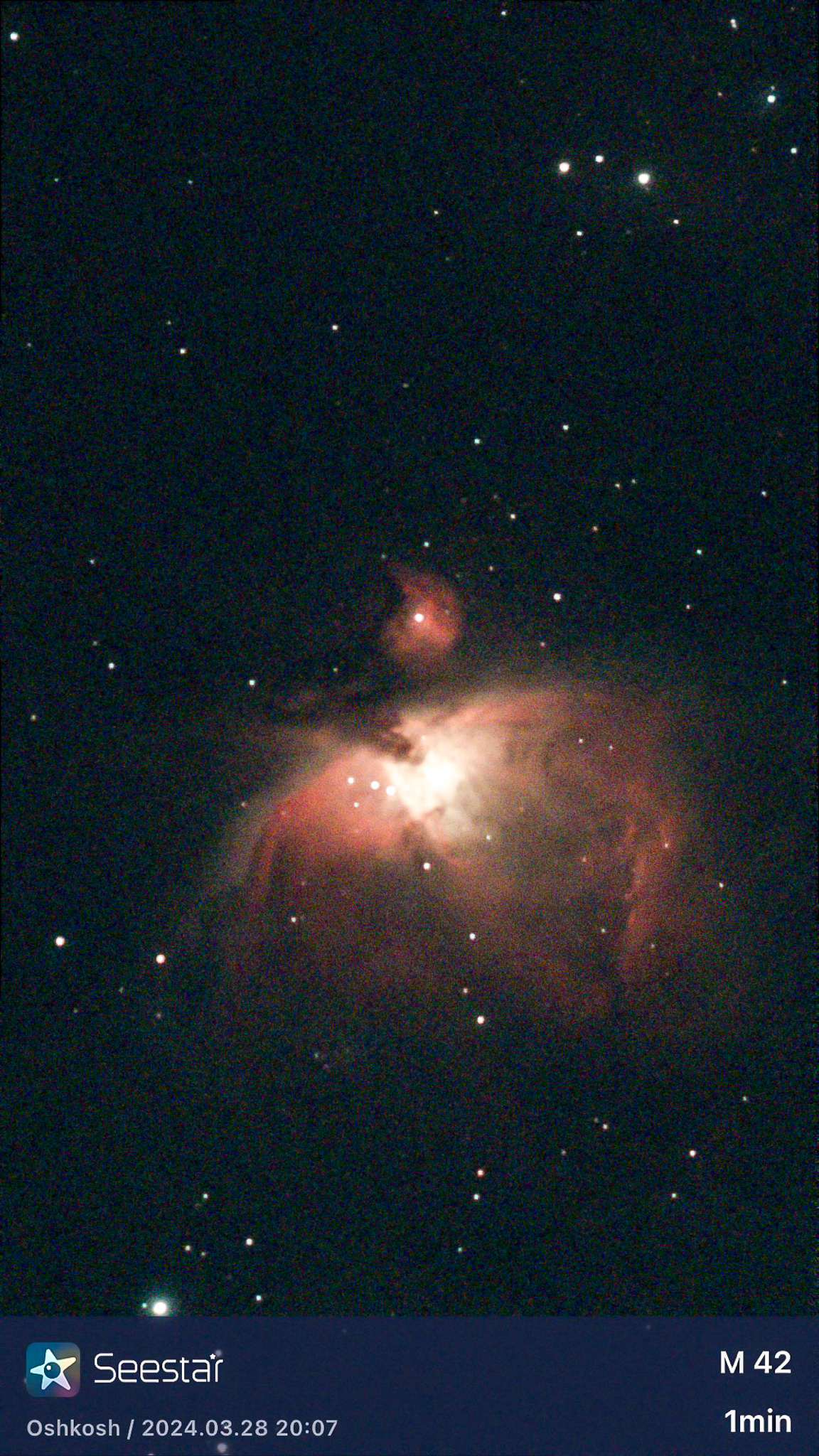
While waiting for the sky to deepen, I shot a one-minute exposure of the great Orion Nebula, M42. Hydrogen gives off a red color in the visible parts of the spectrum, and hydrogen is everywhere in M42, and throughout the cosmos. Hydrogen is the main compound (62%) in our bodies. There are other life forms beyond Earth. If those life forms make themselves known to us, hydrogen will be the primary building block in their bodies, too.
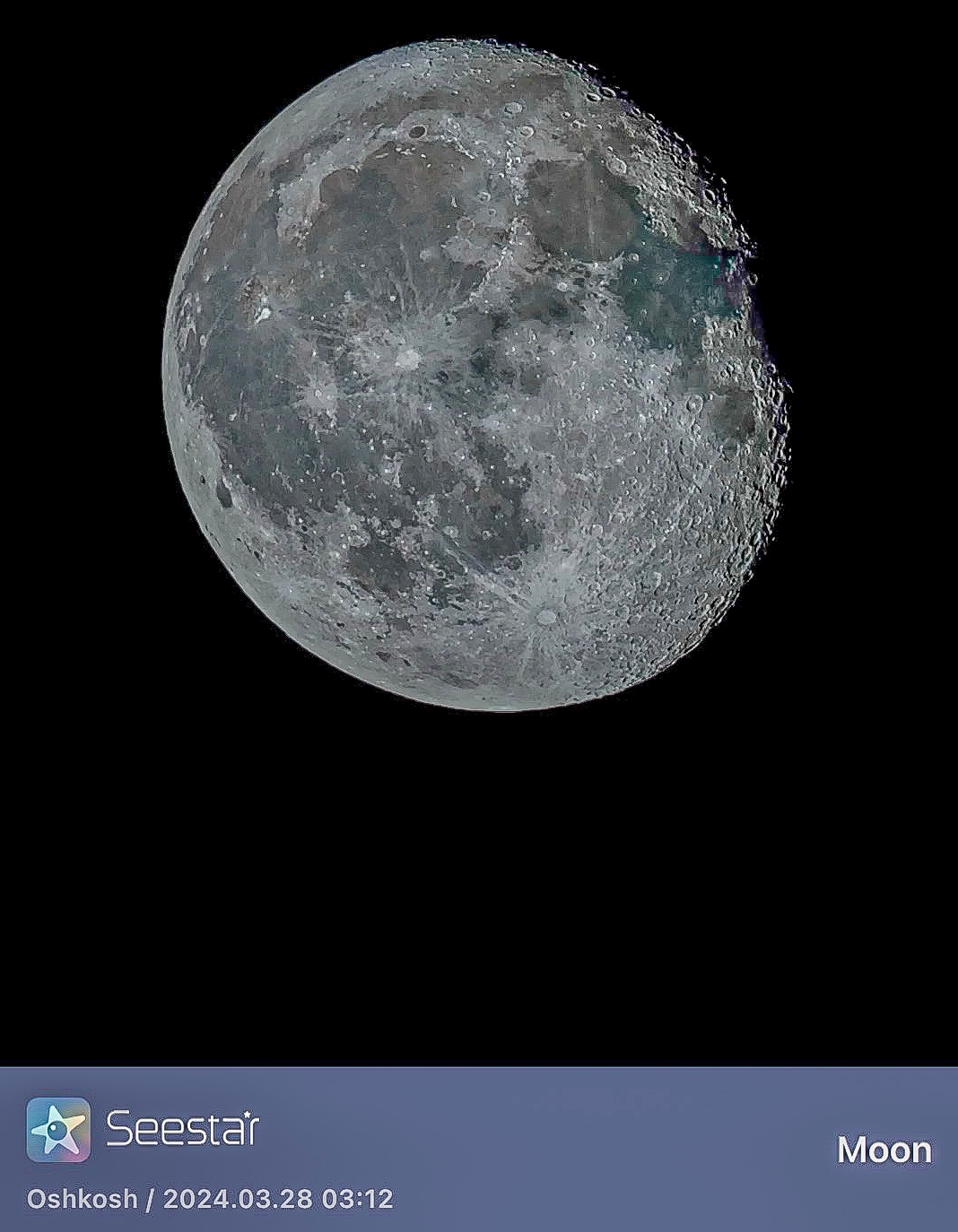
On the same day I shot Comet Pons-Brooks, insomnia drove me from my bed and out to the south side of the house. The moon was in its third quarter, the sky was clear, the neighborhood quiet as church. I took a few photos of our neighboring orb. All the streams of ejected matter out of the crater Tycho–center bottom– are fully displayed. During the eclipse, the part of the moon in this picture will be shrouded in shadow, and invisible. By covering the sun completely, the moon will allow us to see the sun’s shimmering atmosphere (the corona), ejections of solar plasma jetting out from the sun (prominences), and perhaps the brighter planets like Jupiter and Venus. Some astronomers suggest that Comet Pons-Brooks will be visible during totality. I am not one of them.
I’ll check back with you after the total eclipse.
Thank you for reading and don’t forget to sign up for a free subscription at the bottom of this page.
 Cosmic