Friday night on May 3rd revealed mostly brighter stars in the sky over our home on the south side of Oshkosh, Wisconsin.
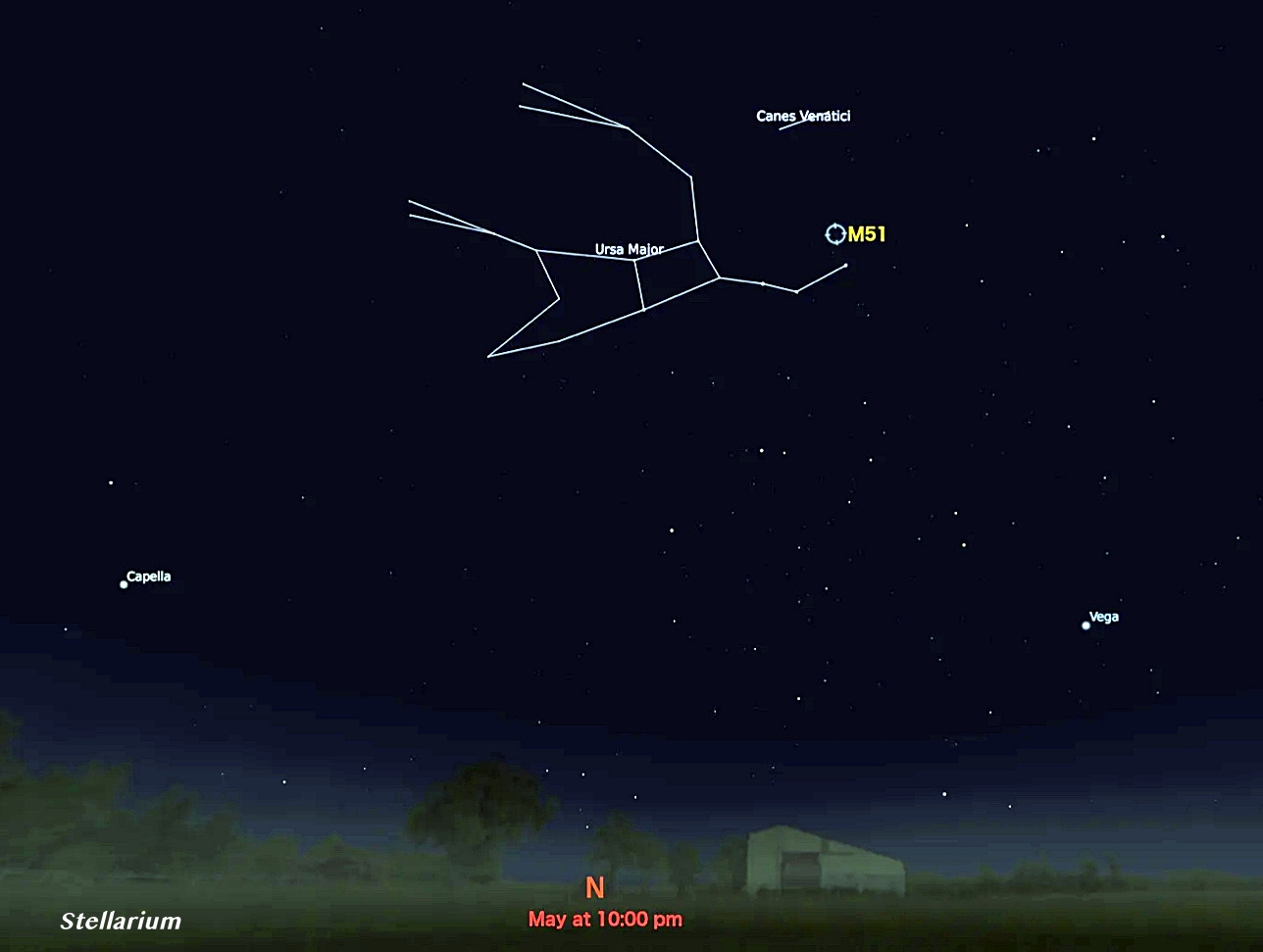
At this time of year, viewed from 44 degrees north latitude, Ursa Major, aka the Big Dipper, is virtually overhead. I took advantage of the clear night and set up the SeeStar S50 in the shadow of a pine tree. After calibrating and leveling the instrument, I asked the SeeStar to find M51. Away she went.
Messier 51, aka the Whirlpool Galaxy, is an 8.4 magnitude object in the minor constellation Canes Venaciti, which abuts Ursa Major. The galaxy is near the end star of the handle of the Big Dipper.
Back in the Day
In a different life living on Shag Road southeast of New Ulm, Minnesota, I glimpsed M51 under a darker ceiling. Besides Willy Groebner, I had an Edmund Scientific eight-inch reflector for an astronomical friend. Once in a great while, the spiral arms would flash and then disappear. On those nights, the sky had to be transparent and the seeing still as a statue to see M51 in the eight inch; It was not an easy object to study. Robert Burnham Jr., who was on staff at Lowell Observatory from 1958 to 1979, published a three-volume celestial handbook in 1966; revised in 1978. He wrote about what it took to see M51 optically:
A good pair of binoculars will show the object on a clear dark night, and a 2-inch glass will reveal a hazy patch of light with a brighter center … The spiral form may be glimpsed, under the best conditions, and with some uncertainty, in an 8-inch telescope. In a 10-inch it may be held unmistakably when atmospheric conditions allow, and in a 12-inch the spiral coils begin to resemble the familiar photographs that have graced countless astronomy texts.
Much More Than A Smudge
I was curious to what I’d see when the SeeStar found its mark. I live under the glow of a town of 70,000 people. Light pollution maps shows my address suffers under Bortle 5 light pollution—Bortle 6 pollution begins a quarter mile to my north. Manmade light whitewashes my sky at night. The night sky is a lot brighter today than when Burnham created his anthology nearly 60 years ago. Before I asked the 2-inch telescope to start taking and stacking pictures, I studied what the SeeStar saw: There may have been a smudge of starlight. Maybe not.
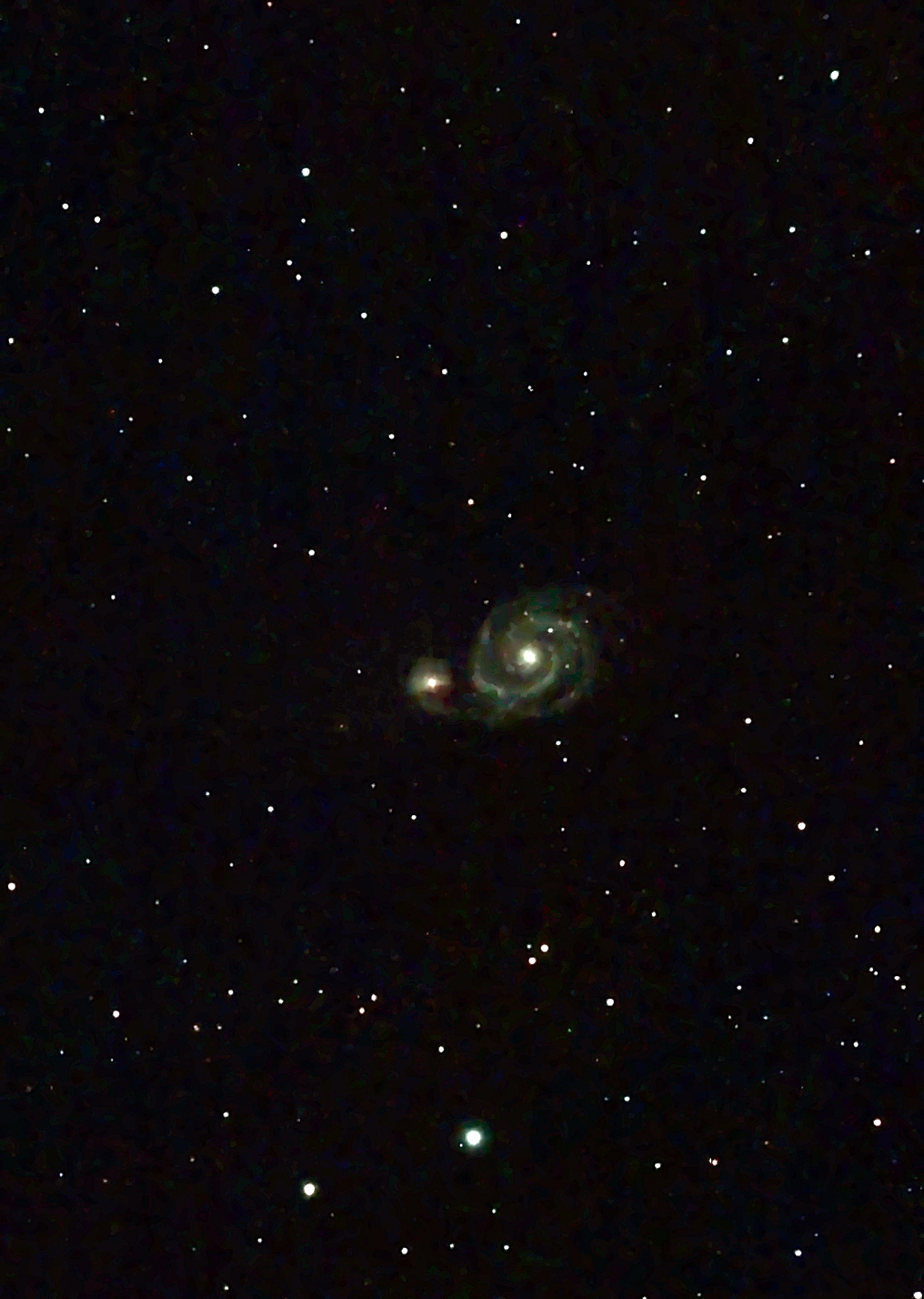
A few minutes in, the SeeStar announced that stacking had failed because the tracking was off. I checked the leveling function of the tripod, which always seems to shift when the scope seeks the targeted object. It took me mere moments to re-establish a level platform. I asked the scope to find M51 again. It did so quickly, as the galaxy was still in the field of view. Once centered, I instructed it to begin photographing again. The SeeStar asked me if I wanted to start over or continue with the image it had already assembled. I tapped on “Continue.” Nine minutes later, and 12 minutes total, I had the images you see on this site.
All this with a two-inch lens and modern technology. Marvelous.
An Overhead View
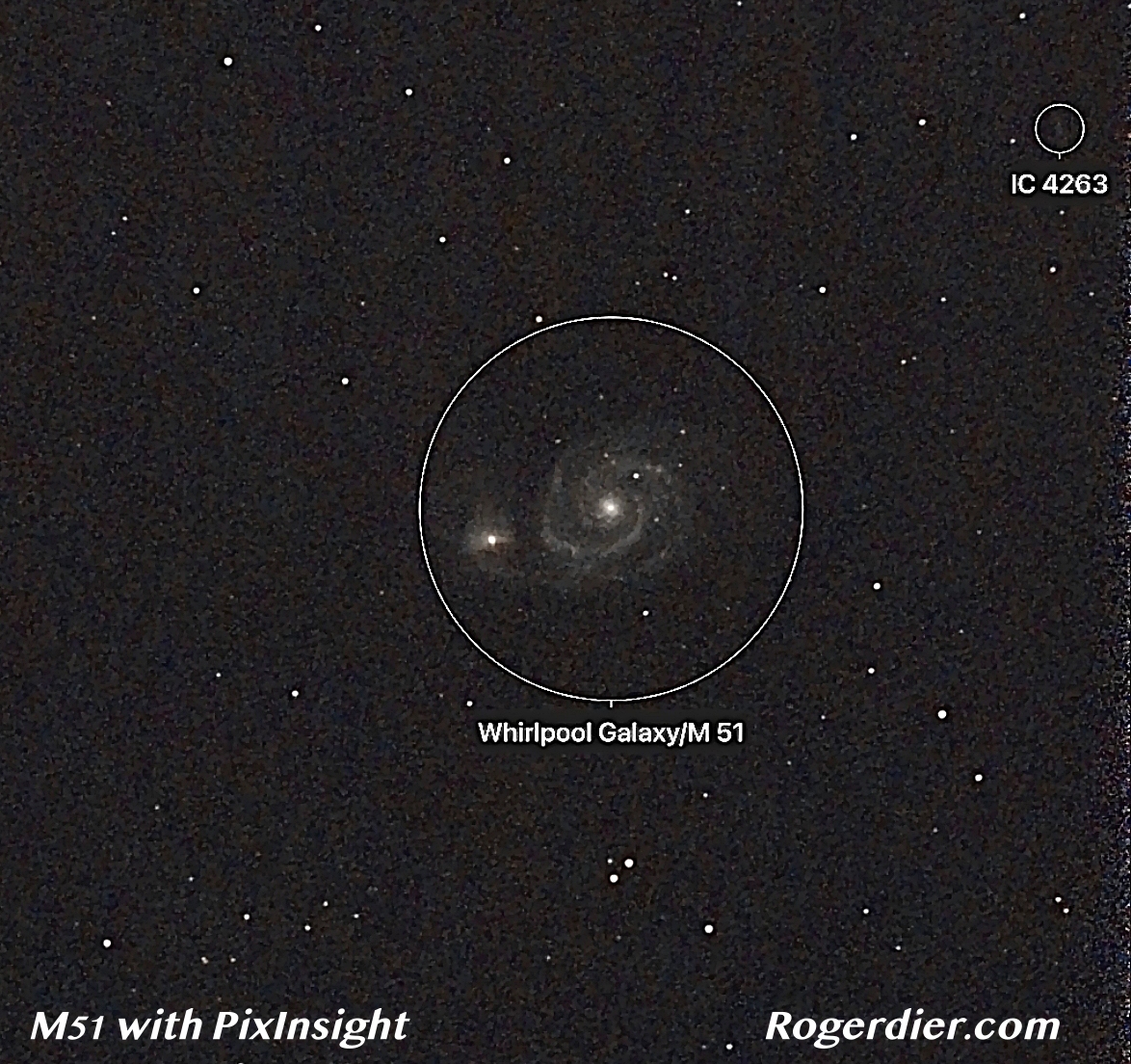
From 23.5 million light years away, we see a star city than contains 160 billion stars, which are spread across 76,900 light years. It spins clockwise. Once upon a time, it was thought that M51 was sucking the life (and substance) out of the smaller galaxy to the north of M51 known as NGC 5195. Not so, as M51’s arms extend in front of NGC 5195, and the galaxies are moving away from us at different speeds (340 miles per second for M51 and 390 miles per second for NGC 5195). Professional astronomers are sure that M51 and NGC 5195 have moved behind and in front of each other often during their existence. Like two lovers in a stormy relationship, they can’t seem to say good-bye for good.
I used PixInsight software to bring out detail. Other software like Lighthouse and PhotoScape X also improved the image. I’ve included a raw, straight-from-the-SeeStar image in this collage.
Thank you for reading. Subscribe for free at the bottom of this page. Good health and clear skies to you and the people you care about.

