After two weeks dominated either by the moon or wet weather, it cleared up during the week of May 26. I was able to get outside on the evenings of May 29-30 to do some photography with the SeeStar S50, the little two-inch trumpet of discovery that I’ve had a crush on for the last six months.
I sat outside our door facing north on Wednesday night. At this time of year at 44 degrees north latitude, the sky doesn’t seriously darken until after 10:30 p.m. Dark sky-wise, it will get worse until June 20, the summer solstice, and then ever so slowly, the cosmic pendulum will swing toward shorter days and longer nights, which notable English amateur astronomer Billy Shakespeare described as a time when “. . . all the world will be in love with night and pay no worship to the garish sun.”
I shouldn’t complain. For amateur astronomers in the northern hemisphere, the summer night sky shrinks the farther north you go. Shane and Chris, two dudes who staff the actual astronomy podcast, live in undisclosed locations in Alberta, Canada. Soon, those fellows will enter perpetual twilight, a window which lasts five or six weeks on either side of the solstice. From their points of view, this is the time of year when the sky never darkens enough to see much of anything that twinkles or shines, other than the moon and sun.
Hail Hercules!
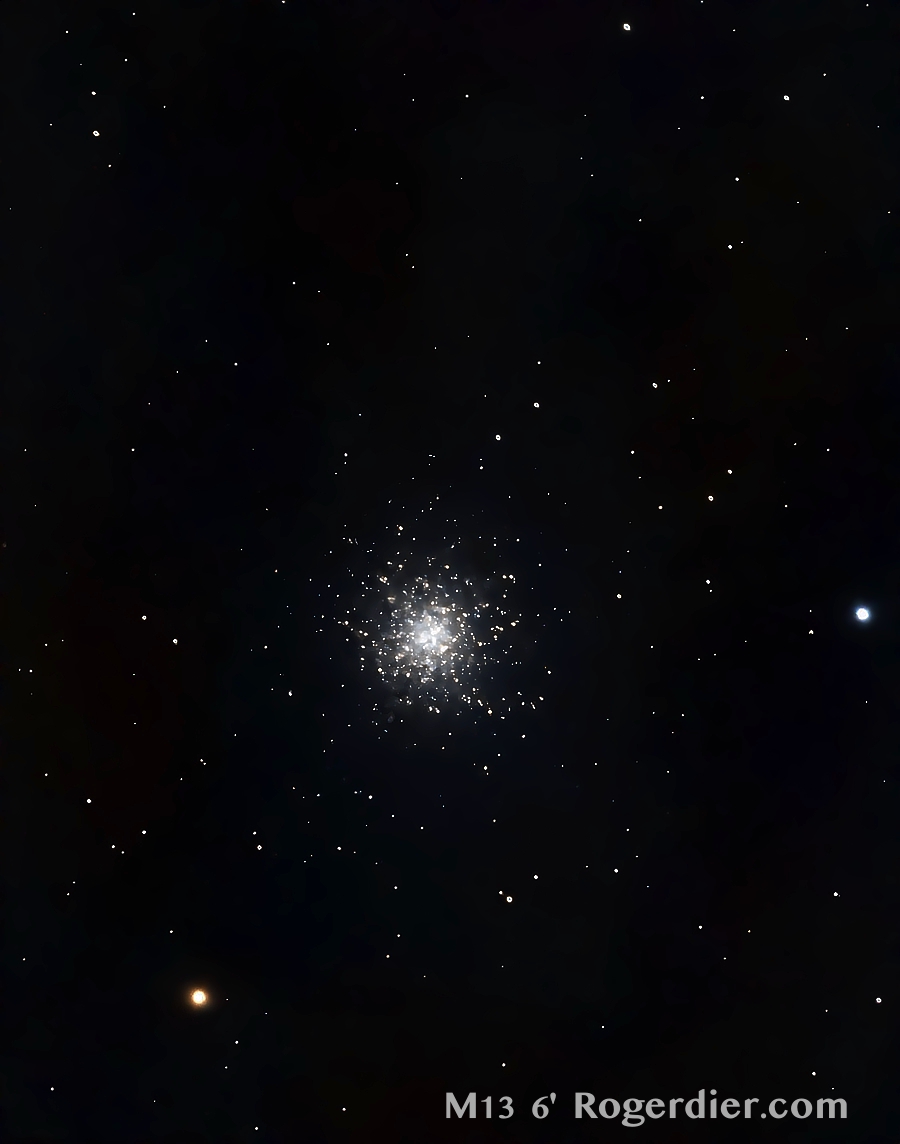
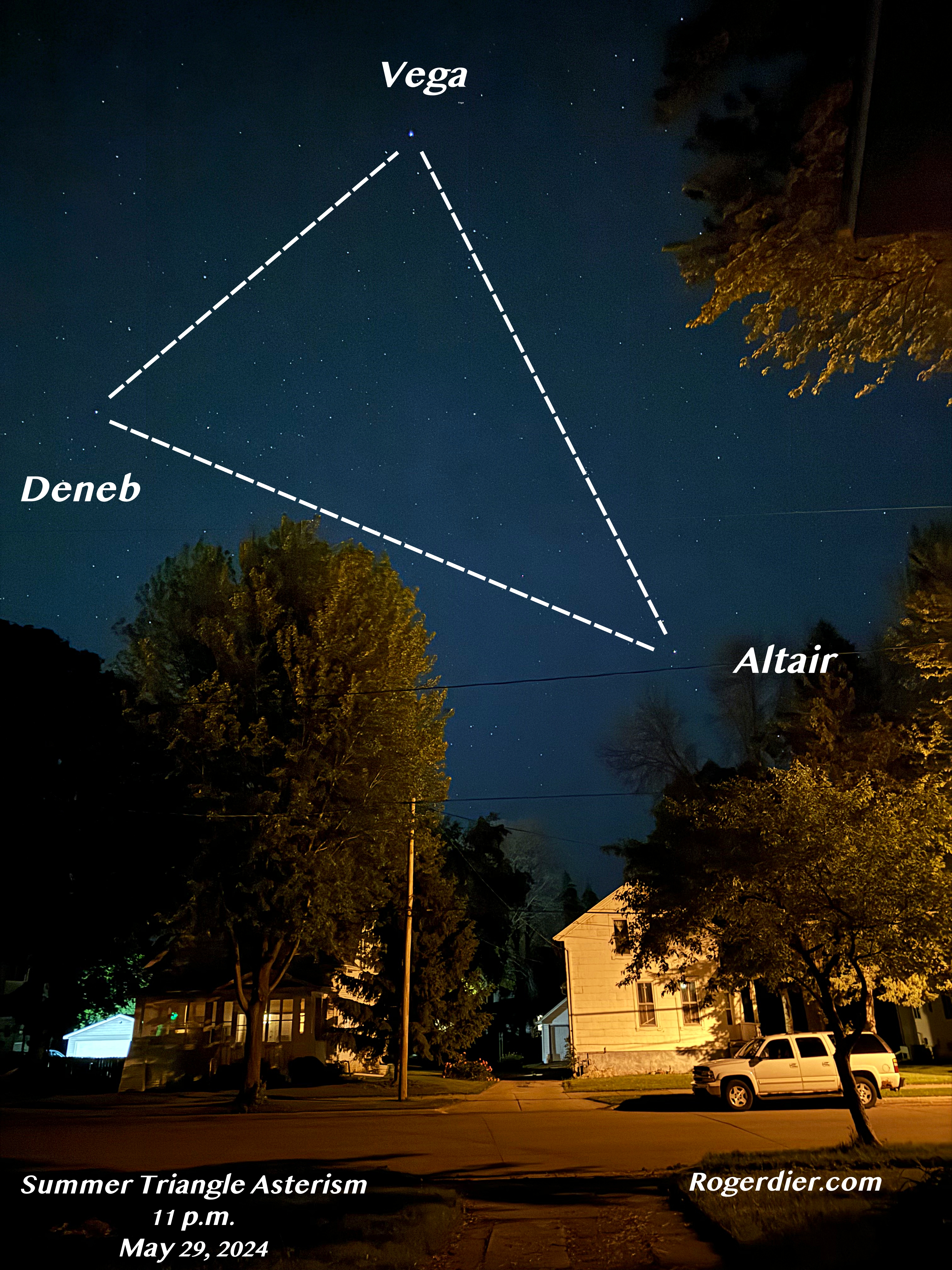
From where I sat Wednesday night, objects in the summer constellations are ascendent. So is the famous Summer Triangle of first magnitude stars Vega, Altair, and Deneb. The constellation Hercules leads the stars of summer, and it boasts one of the best globular clusters in the galaxy, M13. It is a bright cluster, even beneath this Bortle 5 light dome that keeps me squinting to see even third magnitude stars. The the five-minute exposure of M13 shows how condensed the stars are. But looks are deceiving
From a distances of 22,180 light years the stars in M13 are tightly packed, but not like sardines entombed in tin. Composed of more than 100,000 stars, the average distance between stars of M13 is one-half a light year, which is equivalent to the distance of a three-month wagon ride behind two disinterested mules. Near the center of M13, it’s a tighter fit. At the core of the M13 cluster, it’s estimated that there are six to 10 stars per cubic light year. NASA’s Hubble telescope site claims star collisions occur within M13: “These stars are so crowded that they can, at times, slam into each other and even form a new star, called a ‘blue straggler.’”
Human stragglers? Sure. Blue stragglers? Maybe.
The Ring Nebula
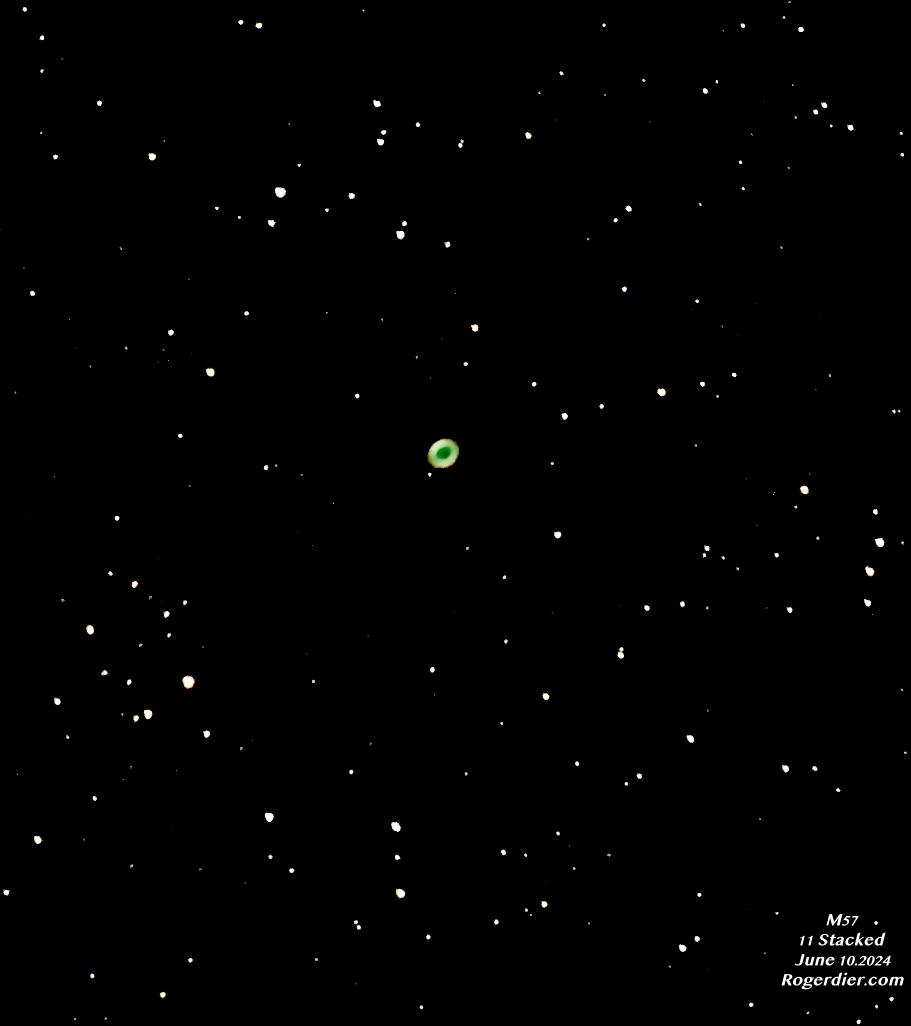
In Lyra, which features the summer diamond Vega, there is a remnant of an average star that grew old enough to devolve into a planetary nebula. At 2,380 light years distant, the ring nebula is almost next door. Though dim at 8.8 magnitude, the shape of M57 makes it an easy find. After all, who hasn’t stared down at a bowl of Cheerios at least once in their lifetime?
If we want to know what two light years looks like from 2,380 light years away, the width of the ring nebula shows us. If we want to know what our sun could look like when it uses up all of its hydrogen and becomes a red giant, M57 might model the sun’s end. It’s believed that charged particles (the stellar wind) blew off the outer layers of this dying star and created this cosmic smoke ring. The central star or the nebula, invisible on this photo, varies between 14.2 and 16.1 magnitude; Its variability is attributed to cosmic winds blowing ionized gases across the face of the white dwarf.
Pinwheel Schimwheel
The last object I photographed Wednesday night was a massive star city in Ursa Major. I sent the SeeStar to see M101, a faint pinwheel 22.5 million light years away and 170,000 light years across. The experts say M101 is 70% larger than our milky way. With Ursa Major straight overhead in late May, M101 is perfectly placed for a photo. I spent 25 minutes of my life to shoot this photo of M101, and truth be told, I’d like those 25 minutes back. The objective of the SeeStar is too small, the light inside a Bortle 5 bubble is too bright, and the atmosphere that night resembled a river after six days of Biblical rain.
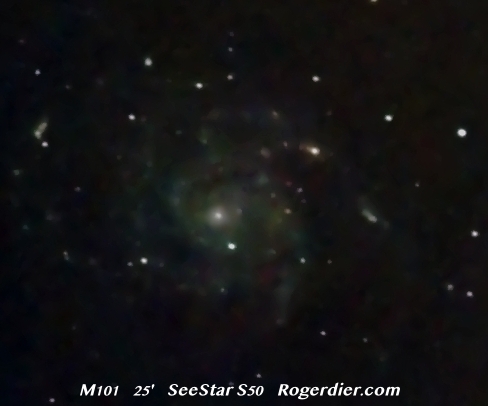
The following evening the atmosphere was supposed to be clear, moderately transparent and sedated. Your intrepid astronomer gave M101 another shot. I was 10 minutes into another photo of M101 when a thin film of clouds strolled across the zenith, right in front of the great bear. A better look at M101 was not to be. End of observing session.
Thank you for reading. Share with your friends (or enemies) and please subscribe for free at this bottom of this page.
Here’s the show page of The Actual Astronomy podcast: https://actualastronomy.podbean.com/
- K-1 is Going Kaput
- Our Sweet Lemmon
- Winter is Coming
- M31: The Finest Fruit of the Autumn Sky
- Leo’s Trio Chase the Seven Sisters
- K-1 is Going Kaput
 A rare cosmic event, a comet breaking apart, is now visible to people living in the Northern Hemisphere.
 - Our Sweet Lemmon
 When I was a young lad, devoid of optical instrumentation and a lot of other things cerebral, I thumbed through astronomy books and gazed at magnificent drawings of ancient comets that lit up the night time sky, and could even… Read more: Our Sweet Lemmon
 - Winter is Coming
 Indeed, winter is coming. There’s no news in this headline, but for those of use who enjoy the expanding, wide windows of night sky, winter is the best time of the year. I’m clearing leftover photos off the screen of… Read more: Winter is Coming
 - M31: The Finest Fruit of the Autumn Sky
 It’s October 1, 2025, and I have finished my latest book, “John Mayasich—Immigration Roots to Olympic Gold.” It should be available on Amazon.com in a few weeks. It’s a compelling story about a truly remarkable family and their Croatian immigrant… Read more: M31: The Finest Fruit of the Autumn Sky
 - Leo’s Trio Chase the Seven Sisters
 Hi everyone. Glad you’re still here. Leo’s Trio is an arresting mix of galaxies which fit comfortably in the field of view of most small telescopes. On the evening of March 16, I had to slightly expand the roughly .75… Read more: Leo’s Trio Chase the Seven Sisters
 - Crabbing Around the Winter Nights
 This week, on a fairly transparent night, I drove our vehicle about a half-mile out from the western shoreline of Lake Winnebago to go fishing. No, not for the prehistoric sturgeon that humans in nearby area zip codes like to… Read more: Crabbing Around the Winter Nights
 - The Rosette Returns
 On a recent night that would chill emperor penguins of the Antarctic, the little wonder-scope that is the SeeStar S50 stood outside our frosty family room window and went to work. Grinding away in minus 8 Fahrenheit temperatures, the S50… Read more: The Rosette Returns
 - Tourist Stops in the Winter Night Sky
 Your intrepid astronomer visits more than a few astronomy sites during his infrequent online trekking. This time of year, nearly everyone who photographs the night sky has proof that they have visited popular winter sky tourists stops. Many of the… Read more: Tourist Stops in the Winter Night Sky
 - Seeing All Seven of the Sisters
 The weeks zip by, quick as meteors in the night. It’s been a while since your intrepid astronomer planted his sack of potatoes beneath the starry night. Clouds, travel, moon-washed evenings, and life all sometimes conspire to keep us from… Read more: Seeing All Seven of the Sisters
 - Nomads of the Night
 This Nomad of the Night is not the Comet of the Century. It’s the Comet of the Month, arriving before our eyes in late September and emerging in early October to give us a three-week visual thrill. As this modest ice-rock continues its quick fade into the cold, inky darkness, we now know that this trip may have kicked Comet Tsuchinshan-ATLAS out of its gravitational relationship with the sun; It may never pass his way again.
 - The Comet of the Century Arrives
 We are the only civilized society that will ever witness Comet Tsuchinshan-ATLAS. Comets are mysteries. We are more mysterious. Will humans evolve or devolve on our path up the stairway? It makes me wonder.
 - Who Really Named the Crab Nebula?
 William Parsons, the 3rd Earl of Rosse is credited for giving the Crab Nebula its forever nickname, but that’s not true. Rosse first thought M1 was a cluster, but once he built a larger speculum-mirrored telescope, he changed his mind. Two fellows who observed with Rosse on occasion get credit for naming the Crab Nebula. John Pringle Nichol of Scotland, who had observed with the 3rd Earl at Birr Castle, was the first to put the nickname on paper. Another Earl visitor at Birr Castle, Thomas Romney Robinson, also wrote that the nebula had “streams running out like claws in every direction.”
 - The Siren Call of a New Comet
 Every time your intrepid astronomer hears that a comet is coming, I get weak in the knees and head for a place where I think it will be visible. Comets have the same power over all of us who see, scan, observe and shoot photos of the sky. Comets are Sirens of the Solar System. In Greek mythology, Sirens were beautiful but dangerous bird-woman creatures who seduced sailors with their beguiling, mostly naked forms and seductive calls. Unable to resist the Sirens, sailors met their deaths when they steered their wooden ships over ship-splintering shoals, focused only on the Sirens’ lust-inducing forms and serenades.
 - Reflections of Venus
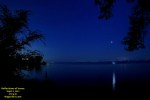 We have this image, but that is only part of this picture, or any picture. No one can present the pleasant odors the moment the photo was taken before that promising new day, nor can any photographer recreate the waking sounds of that end-of-night moment, gazing across the lake, amazed that the beam of Venus Light makes the water appear frozen.
 - Veil Discovered 240 Years Ago Today
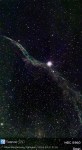 If you are reading this on Thursday, Sept. 5, 2024, William Herschel discovered the Veil Nebula 240 years ago today. Herschel, who sometimes spent 16 grueling hours a day grinding mirrors, lived at what he called Observatory House near Slough England, 20 miles west of London. His home was located at 52.88 degrees north latitude, and on that clear, late-summer evening near Slough, something caught Herschel’s eye as he swept across the great swan that is Cygnus
 Cosmic
6 responses to “Summer Delights on Late May Nights”
Good results from your Seestar.
I like your image of the Ring Nebula. Nice and sharp, it’s always an exciting object to view. I was surprised to see an image of it recently which picked out a very faint wispy outer ring which I had not seen before.
I hope you get another chance at shooting M101. It’s one of those northerly objects that I’d love to image but as it’s maximum elevation is only 2° above my theoretical horizon I’ll never get to see it.
LikeLike
Thank you, Roger, for your comments on the little ring nebula. I have seen a photo or two of the newly discovered outer ring of M57. Wouldn’t you just love to zip around the galaxy and see some of the familiar faces of the Milky Way up close? Have you been shooting any more shots of Comet Pons12-Brooks? I’m curious to see how it looks from Australia. Given the opportunity, I’ll drive out in the country to take another whack at M101. Clear skies to your island ;-).
LikeLike
I had a clear night a few days ago and snatched some quick frames of Pons-Brooks, nothing out of the ordinary but will post soon.
LikeLike
A couple of comments:
Note:
I noticed you subscribed to my blog. Be aware I have very little cosmic content. Once in a while I’ll post something, but it’s sporadic at best.
LikeLike
This is a first for me, not being able to expand the images. What kind of device are you using to read the posts? That would be helpful to know.
I’ll work on adding a search function. Thank you for your feedback.
LikeLike
I’m using a PC, two different browsers (Edge and Firefox).
That usually happens if the images are not linked to the source image.
If you know how to do that, that’s the first thing I would check. If you don’t know how to check, I can paste a couple of images about how to do it . . . presuming this message goes through.
Also, sorry for the slow response . . . because I couldn’t leave a message, I couldn’t subscribe to the reply.
LikeLike