The rain stopped. The sky cleared. I cheered.
I settled in for a few hours under Cygnus the Swan on the last day of June, 2024. The Northeast Wisconsin monsoon finally took a breather. Ours was a wet June, as it was for most states in the upper Midwest of the Lower 48. The prolonged absence of moonless and clear nights only whetted the appetite for their return.
The Swan
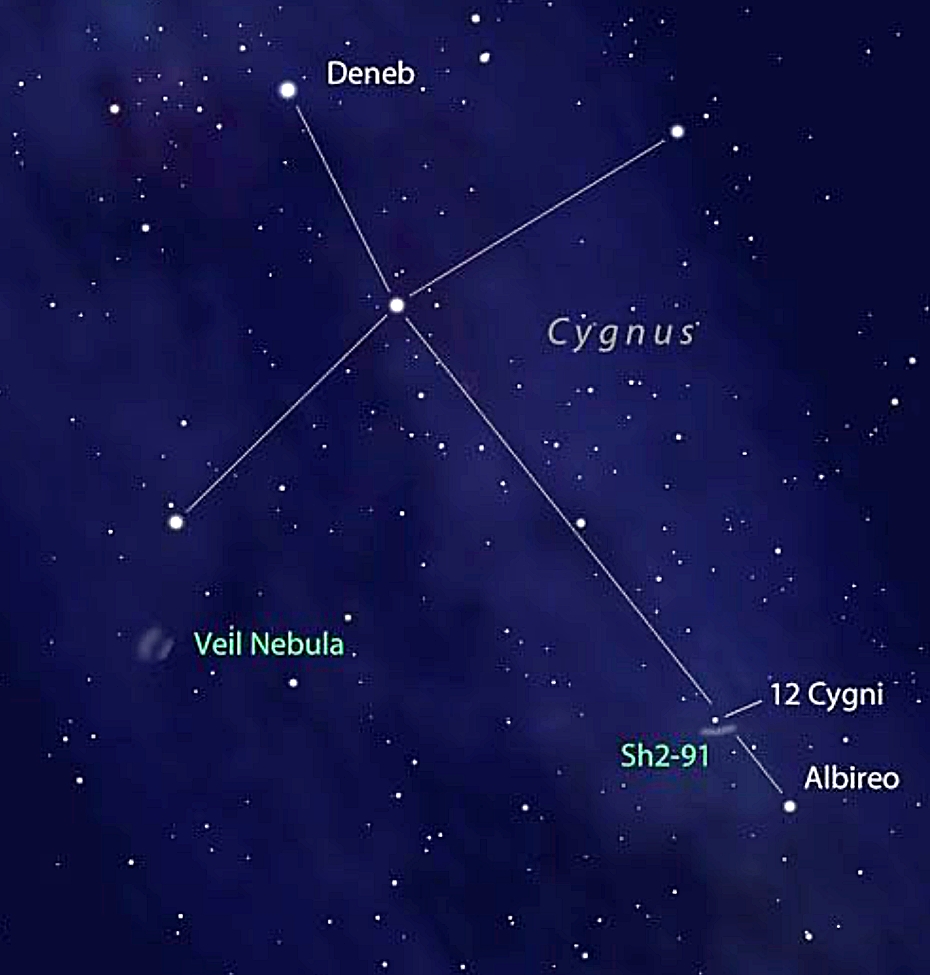
Cygnus was about 40 degrees above the eastern horizon when the sky finally darkened enough to be useful for astrophotography. The night was comfortable, about 65 degrees. It took 10 minutes of gentle persuasion to finally convince the SeeStar that it knew where the magnetic north was, and that it was completely level. The SeeStar will talk to you if you let it. That sterile, mechanical voice will blather endlessly. Under the stars, the last thing I want to hear is that metallic drone making chit chat asking, “So Rog. How ya been?”
I targeted two objects in the soaring swan of summer, Cygnus. Known by some as the Northern Cross, I prefer to know this constellation as a real swan, flying over the Milky Way. Like the graceful bird, Cygnus has an impressive wingspan. Stretching from Cepheus in the north and east to Draco in the north and west. The bill of the bird—the famous colorful double star Alberio—flies right into Vulpecula. The tip of the tale of Cygnus is the bright star Deneb, and regions surrounding Deneb bang up against the constellations of Pegasus and Lacerta.
In all, Cygnus is the 16th largest of 88 constellations. It claims 804 square degrees of sky that grinds soundlessly from east to west above us on summer nights.
UnVeiling the Witch’s Broom Nebula
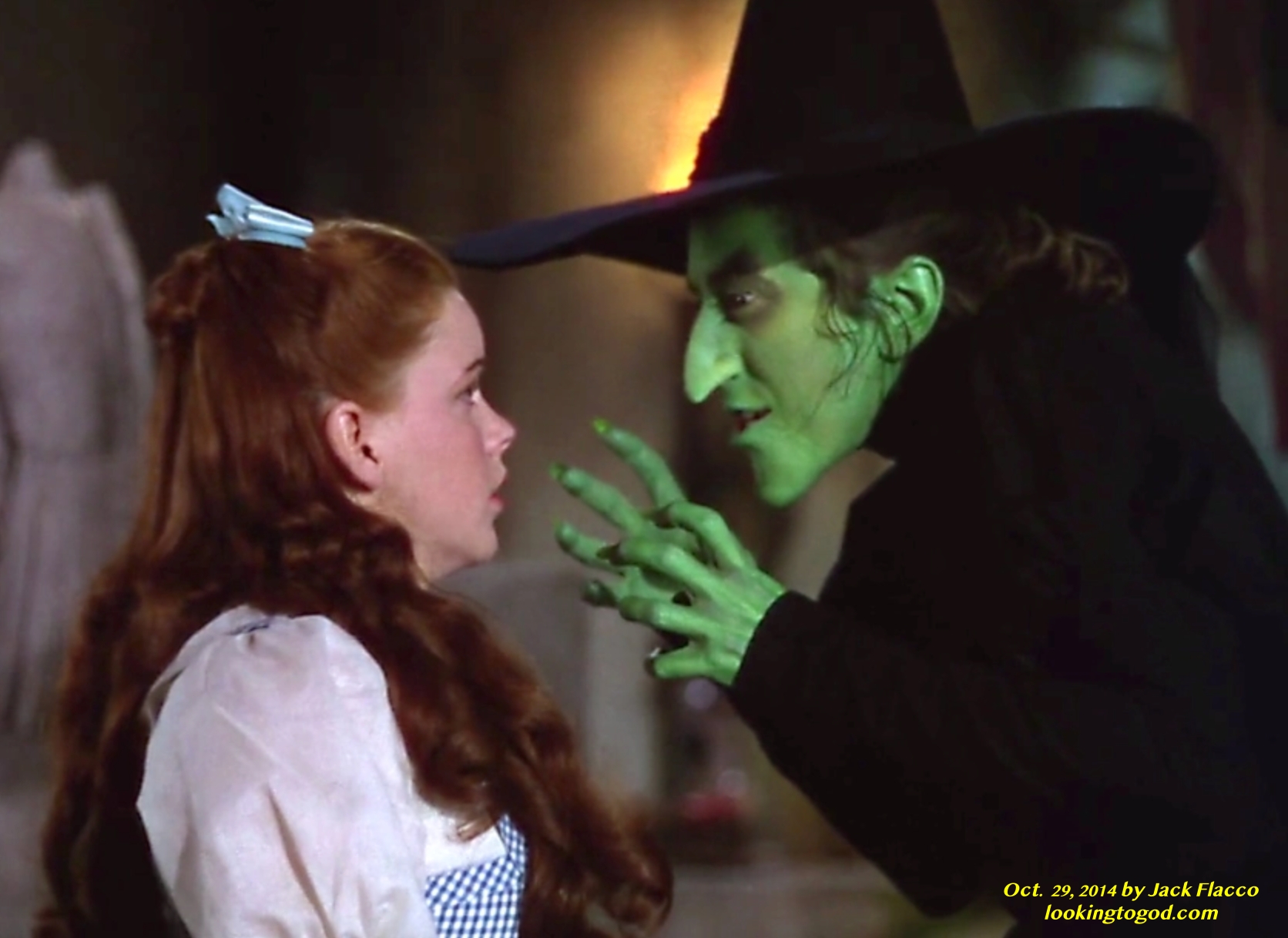
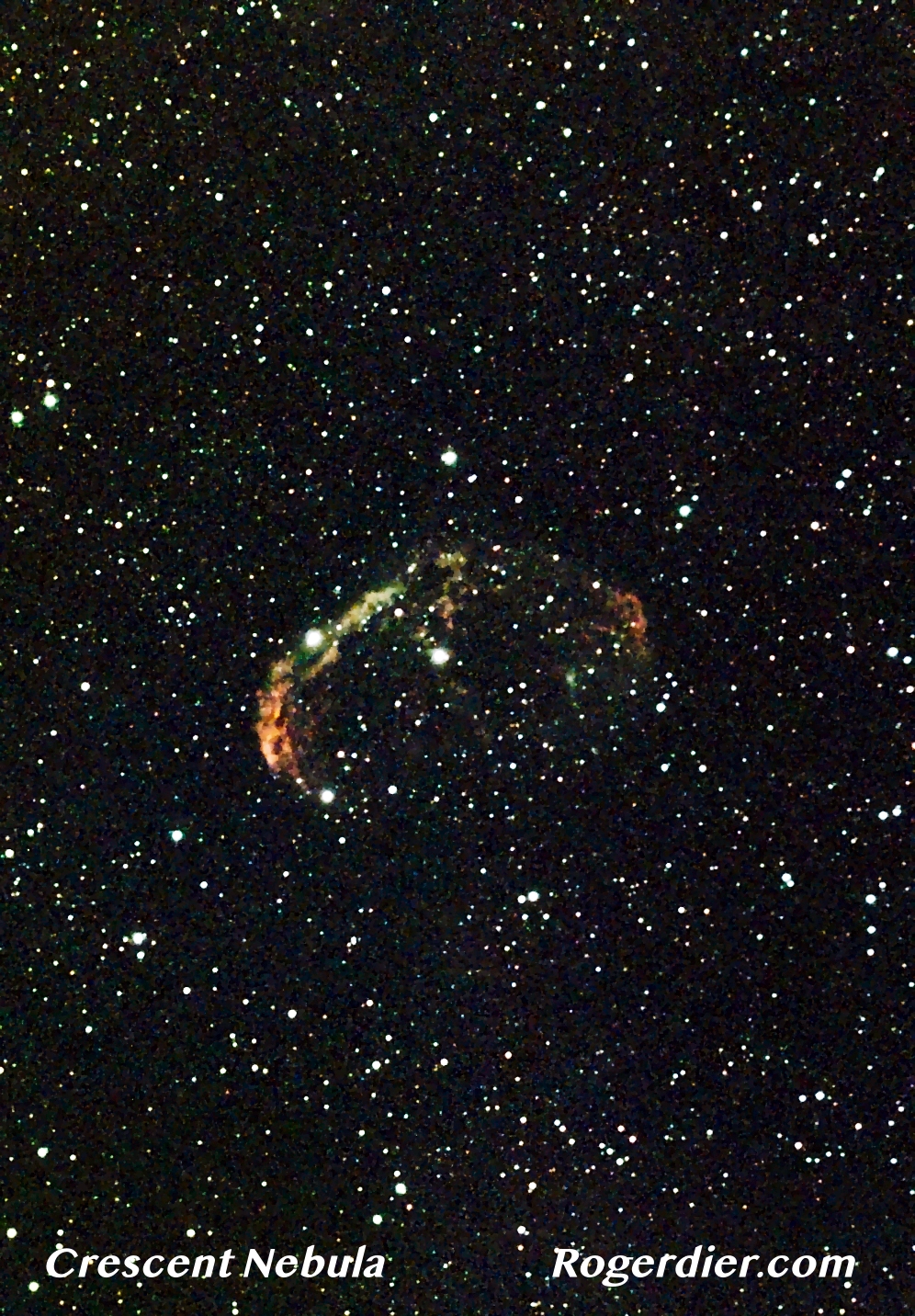
Let’s start with a prominent emission nebula in Cygnus, the Crescent Nebula, which is its most popular name. The Crescent is also known as the NGC 6888, Caldwell 27, Sharpless 105, the Euro Nebula and for a time this week, the author thought it was the Veil Nebula. Ooops. The Crescent Nebula has never been known as the Witch’s Broom Nebula, but I liked Margaret Hamilton’s portrayal so much, I’m going to talk about her a little.
Ms. Hamilton played the green-skinned Wicked Witch of the West with the pointed nose in the best picture not to win an Oscar for Best Picture, The Wizard of Oz. Her character continues to haunt the dreams of millions of children, including old-timers who were once children. Well done, Marge.
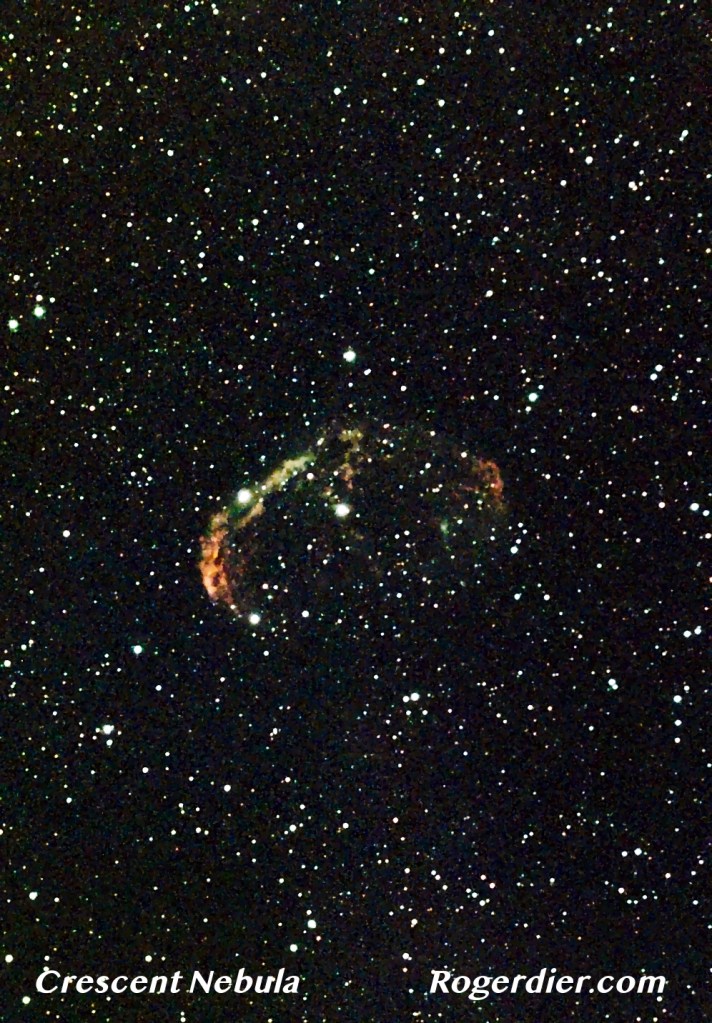
Pictured is a stacked composite of 13, 10-second photos. The Crescent nebula is about 5,000 light years from Earth, and if you want to see it, you’re probably going to need a UHC or a OIII filter to see it.
The Crescent stretches across 25 light years. It was created by a rare brand of star known as a Wolf-Rayet. The Wolf-Rayets are huge rapidly-aging furnaces that shed their mass at incredibly high rates; this Wolf-Rayet, numbered 136, sheds mass the size of the sun once every 10,000 years. Solar wind is sweeping this mass away from the central star to create this unique wonder. There’s a strong possibility that the star which created the Crescent may go supernova at some point.
Lost in the Cygnus Star Cloud
As Cygnus rose higher, I decided to take a whack at the North American Nebula, also known as NGC 7000, which I asked the SeeStar to find and shoot. That was kind of a mistake. The SeeStar collected more than 100 images of what you see; only 60 of the fittest images created this composite. The North American Nebula is buried in the famous Cygnus Star Cloud. Not visible without optical aid, I trusted the SeeStar knew where it was going when it locked down on the object and began taking images and stacking them in its tiny brain.
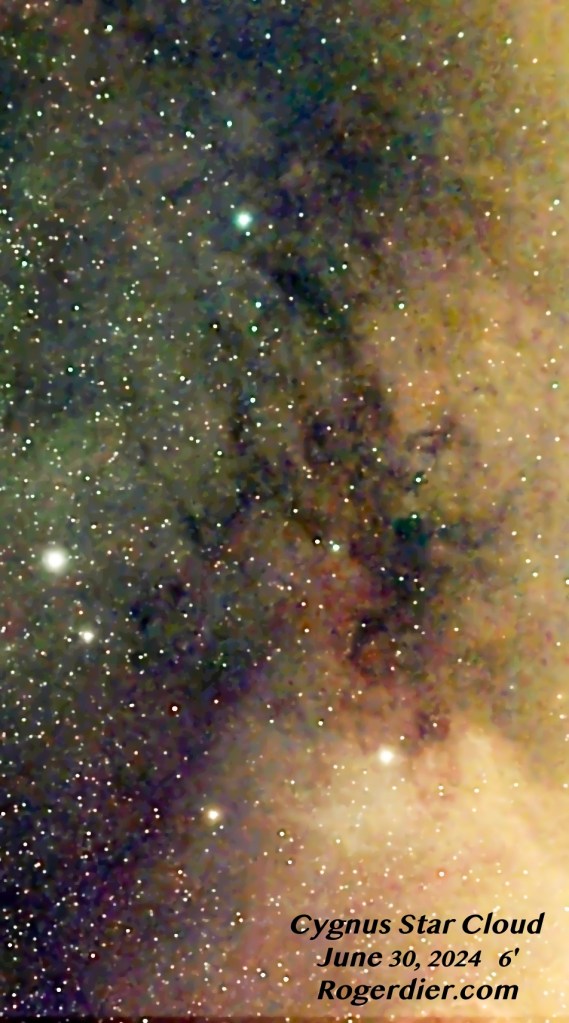
Turns out, I should have been more specific. Instead of asking it to show me the North American Nebula, I sent it to NGC 7000. What you see is what I got. I spent about two hours of July 2nd comparing parts of the Cygnus Star Cloud with this image. American frontier legend Daniel Boone was once asked if he ever got lost. “I have never been lost,” Boone said. “But I will admit to being confused for several weeks.”
Confused I was. Confused I remain. I didn’t want to spend several weeks trying to identify where I ended up in the star cloud. Maybe a reader who is more familiar with that part of the night sky can provide an idea of what we’re all seeing here. The image is about 3/4 of a degree wide and 1 and 1/4 degree high.
Breaking News … Rogerdier.com has learned from reader Tom Harnish where Roger’s camera was pointed during Roger’s visit to the Cygnus Star Cloud on June 30. Photo appears below text. Thank you, Tom.
Two forms of New World democracy—one in Canada and the other in the United States—celebrated their birthdays during the past few days. Dominion Day in Canada falls annually on July 1 and America celebrates its Independence Day—ironically when it freed itself from the Dominion of the United Kingdom—on July 4.
Both forms of Democracy are growing more precious by the moment.
Subscribe for free at the bottom of this post.
The staff of rogerdier.com thanks you for reading and we wish you clear skies and good health mixed with generous doses of happiness.
 Cosmic
3 responses to “Sailing Into Cygnus”
Roger, I have heard of Cygnus, and everything else is like a foreign language to me. But I enjoyed your explanations and a bit of history that I’m familiar with. Keep sharing your knowledge od the stars with us. Happy July 4h to you too. It’s the first time that I’ve felt Uncle Sam just might be too old to continue….. the rotten parts have affected his health and he is too sic to live on. Will we, or who will rescue him/her?
LikeLike
Thank you for reading, Sharo. I agree with all of your comments, even those that speak to what you/we don’t know about all things Cosmic.
LikeLike
From nova.astrometry.net
Center (RA, Dec):(314.413, 44.244)
Center (RA, hms):20h 57m 39.027s
Center (Dec, dms):+44° 14′ 36.722″
Size:37.7 x 67.8 arcmin
Radius:0.647 deg
Pixel scale:3.98 arcsec/pixel
Orientation:Up is 74.1 degrees E of N
Annotated image on the unofficialseestar.wiki
LikeLiked by 1 person