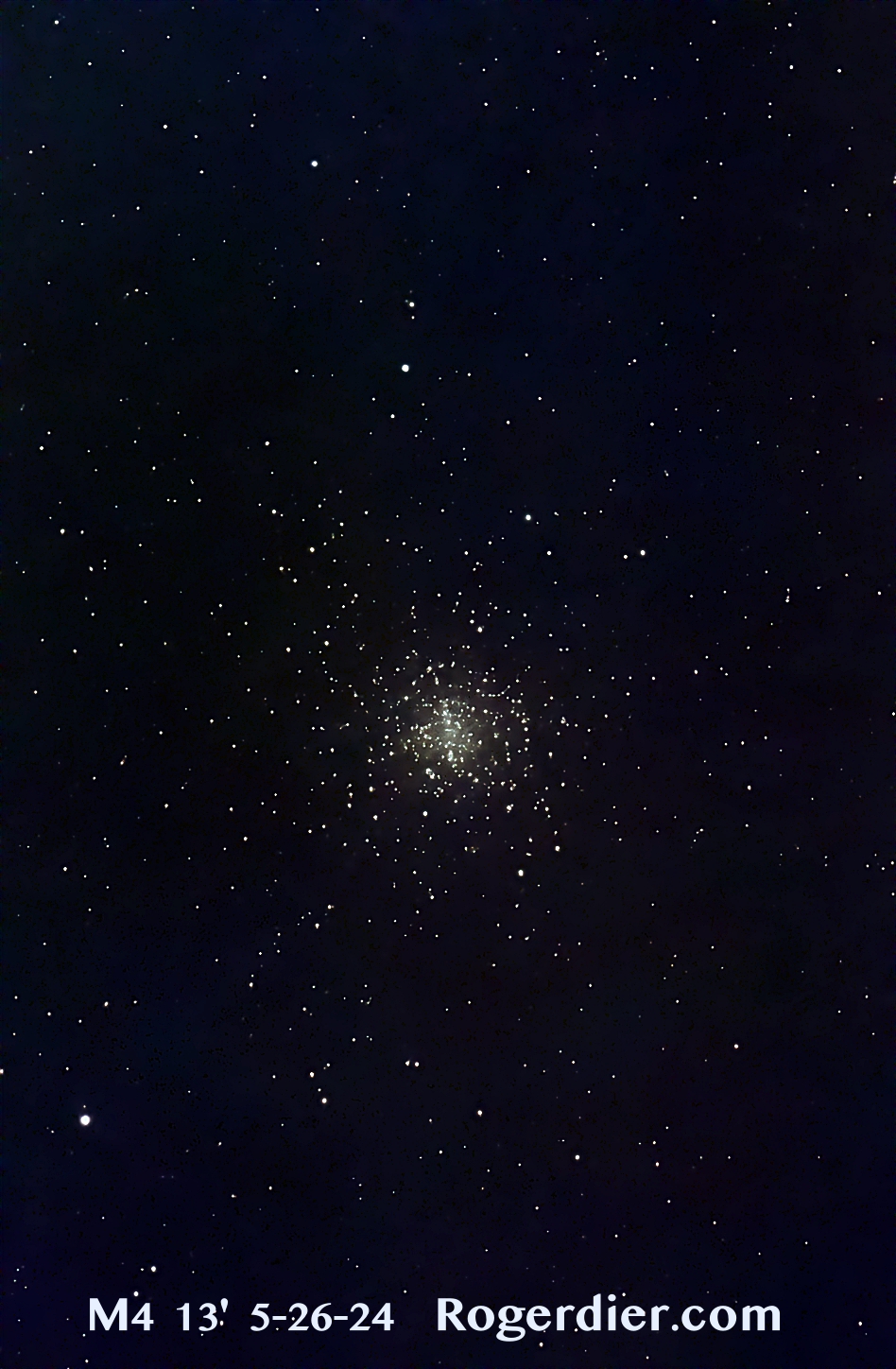

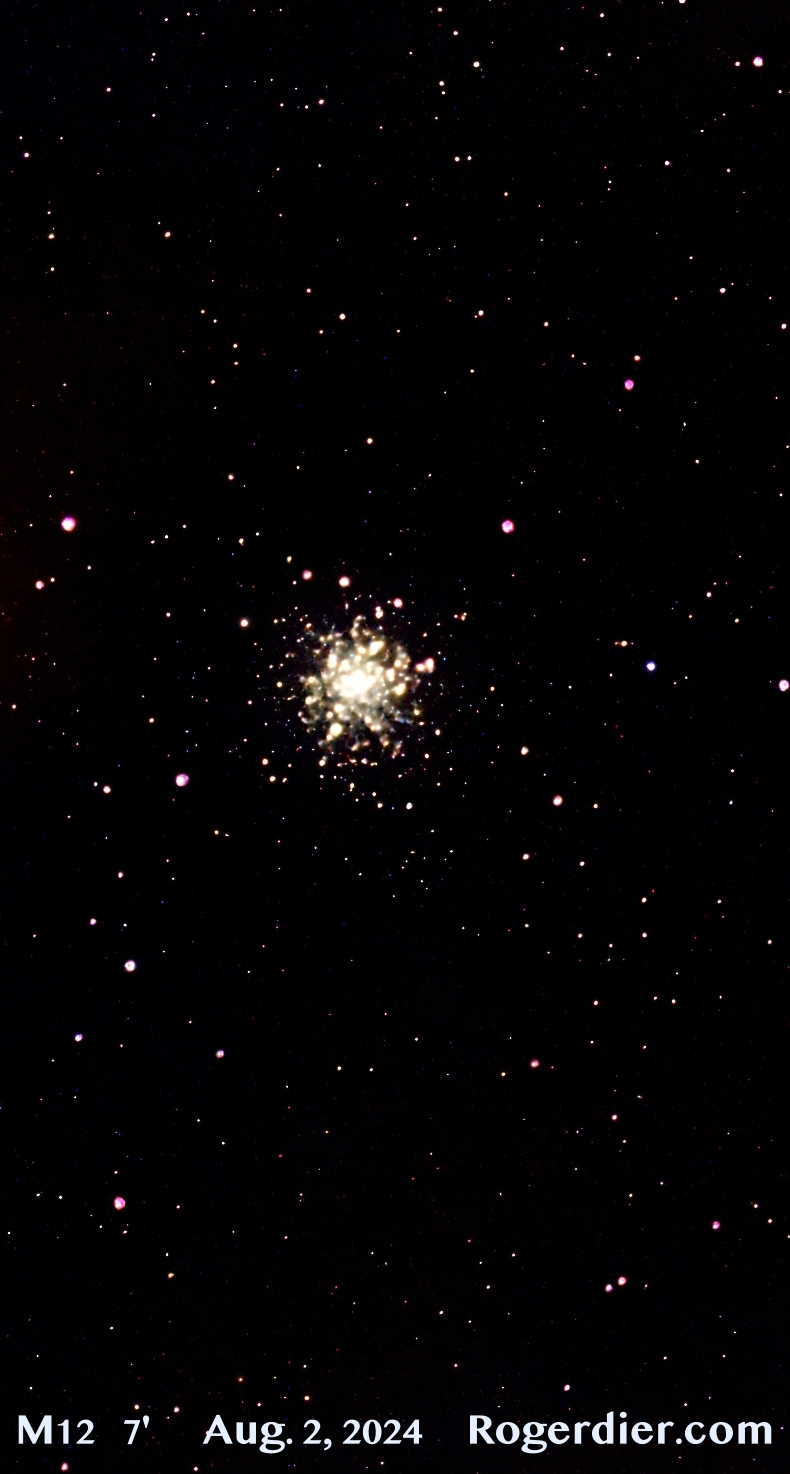
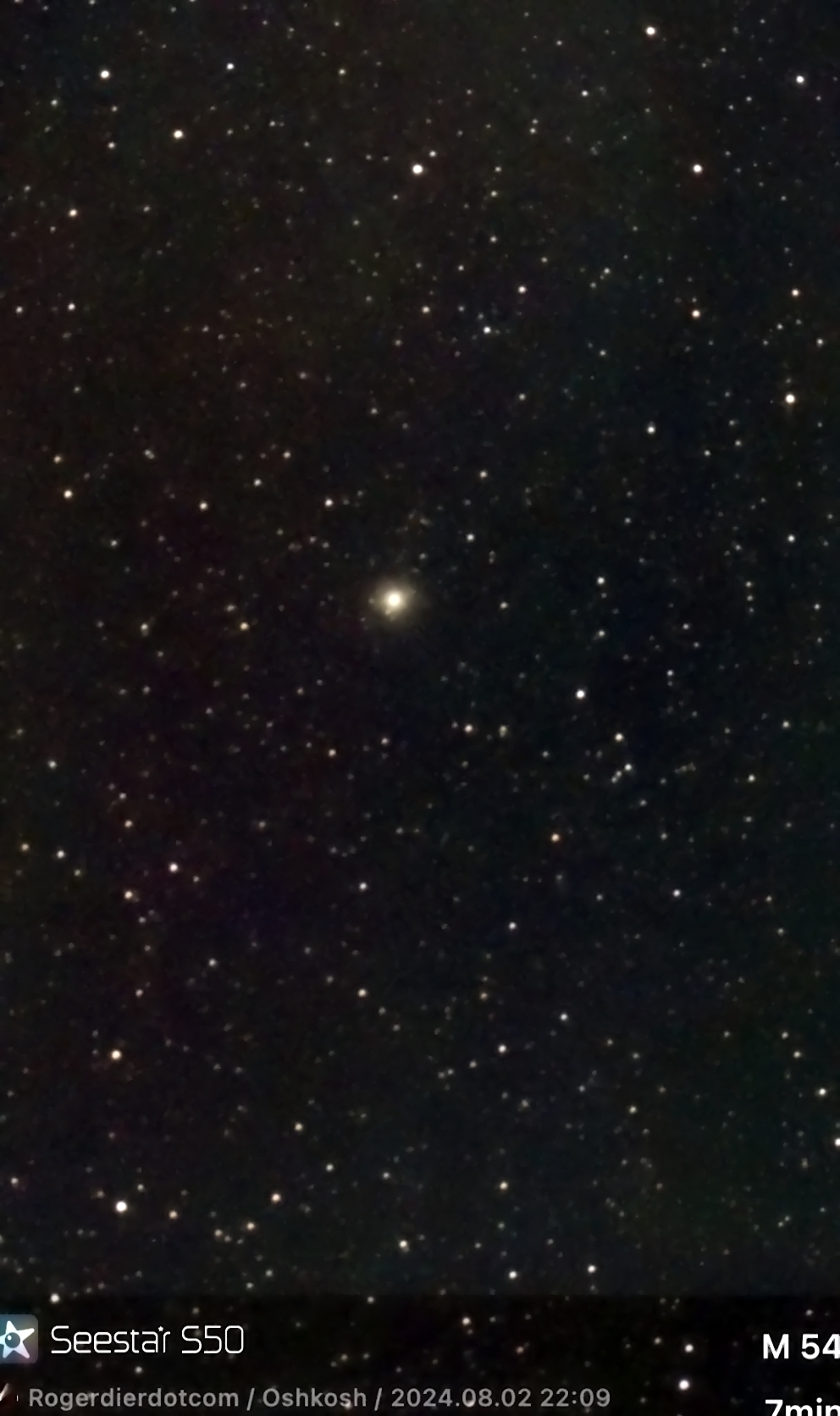
It was Globular Cluster Week as July turned into August. With the exception of M4, the cover photo and a cluster visible without optical aid under really dark skies, all of the clusters you see on this page were exposed for seven minutes in the SeeStar S50.
When we observe or photograph an object at sea level directly over our heads—the zenith—it’s the thinnest amount of air we can find. If we give the zenith an air mass factor of 1, then shooting an object just above the horizon multiplies the air mass through which we are photographing by a factor of 38.
Yikes!
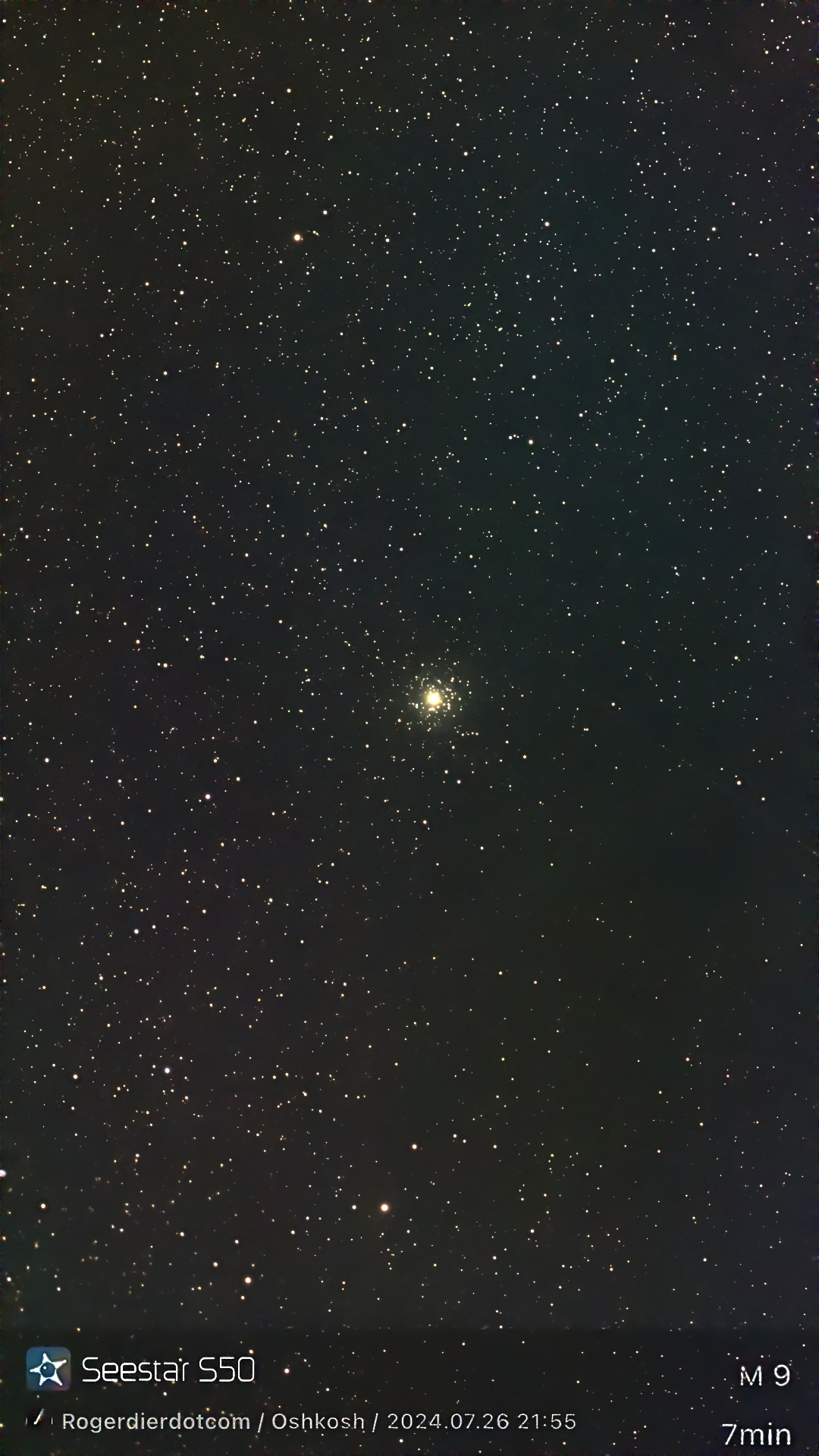
That’s where these globular clusters were shot; not at the horizon, but within 25 degrees of it. The light photons from these clusters traveled for thousands of years over tedious distances. Once arriving at Earth, their light still needs to squeeze past gobs of thick, moving air to make an imprint on silicon-covered sensors of digital cameras or electronic assisted astronomical telescopes. Taking photographs through really thick air masses distorts what we are shooting, and dims the light of the subject. When conditions are right, air mass even gets into refracting light close to the horizon.

Despite all that, these globulars turned out pretty well. I got my carcass chewed by a resurgent mosquito population. The pictures were taken on humid Wisconsin mid-summer nights, forcing your intrepid astronomer’s sweat glands into overdrive to cool his body under a sweatshirt hoody. But what’s the saying? The journey is the reward?
Globular clusters hover over the center bulge of our flying-saucer-shaped galaxy. Charles Messier, a name not unknown to readers of Rogerdier.com, was an 18th century comet searcher. To avoid confusing things like globular clusters for comets, he compiled a catalog of things that aren’t really comets. By the time he was finished, the Messier catalogue included 103 objects. Forty of the objects are galaxies—that’s the top category on his list—followed by globular clusters, which number 29.
Historians credit Messier as being the first human to lay eyes on 17 of the objects he catalogued. Messier published his first 45 objects in 1774 and was up to 103 by 1781. Messier-wannabes managed to add seven more objects by the time the This Messier List Closed For Business sign went up in 1967.
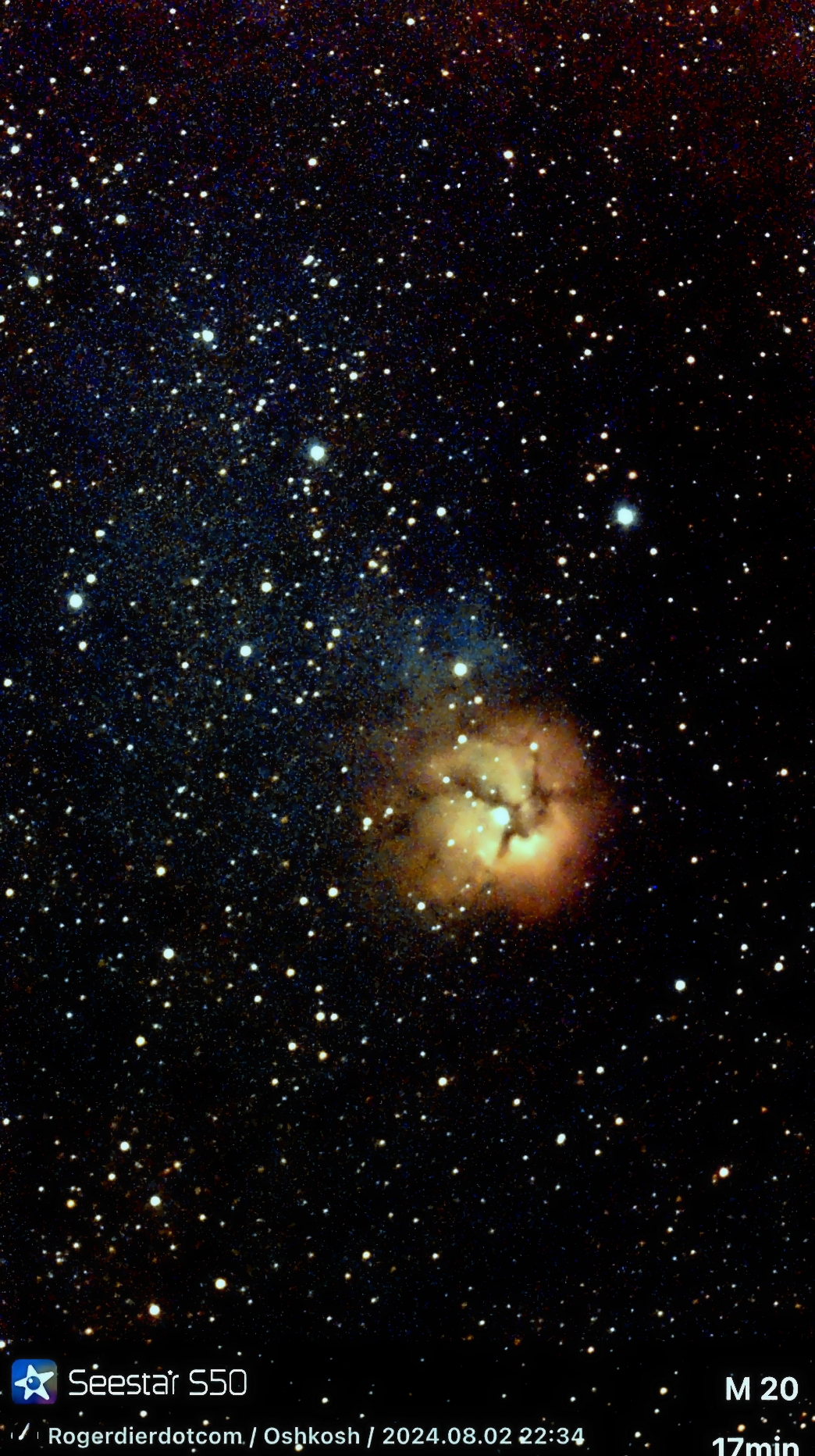
Here’s the skinny on the five pictured globular clusters. At the end of this post is a picture of M20, not a globular cluster but a nebulous star-birthing factory popularly known as the Trifid Nebula.

The Trifid was 22.7 degrees above the horizon when it was photographed. But let’s save the Trifid for next time.
Thank you for reading. Please subscribe (for free) at the bottom of this page. We wish you clear skies and good health.
 Cosmic
2 responses to “Gobs of Globs”
M54 is an intriguing glob, not being directly associated with the Milky Way but with Sagdeg, a nearby dwarf galaxy.
LikeLike
Thank you, Roger. The existence of Sagdeg is news to me, and I thank you for bringing it to my attention. It is interesting that Sagdeg is likely in the early stages of intersecting and being absorbed into the Milky Way.
LikeLike