There are three shouldn’t-miss nebula that sail across the summer skies over North America. The Lagoon, Trifid and Eagle nebulae are caldrons of creation, great masses of particulate and gaseous mass in various gravitational stages of star birth. These three nebulae are vast expanses of elements—light years wide, lights long and light years thick—where King Gravity squeezes gas and dust and all that is in-between into something more than it ever was.
HOW STARS FORM
When atoms accumulate, other atoms join the party, speeding toward their central, growing gravity. The wallop of these collisions create energy, and so begins an accelerating spin. The faster the growing mass spins, the more material is sucked into the vortex. Eventually the heating mass becomes a protostar. When the heat within the protostar becomes hot enough, the hydrogen atoms fuse into helium. No two stars are precisely the same, but in all stars, helium is the heartbeat of all that shines in the heavens. Some new stars are huge and hugely hot and live fast lives. Smaller stars tend to live longer. No matter what their size, the fledgling suns drift out of stellar nurseries—think Lagoon, Trifid and Eagle nebulae—and become new brilliant beacons in the dark, uncaring cosmos.
THE EAGLE
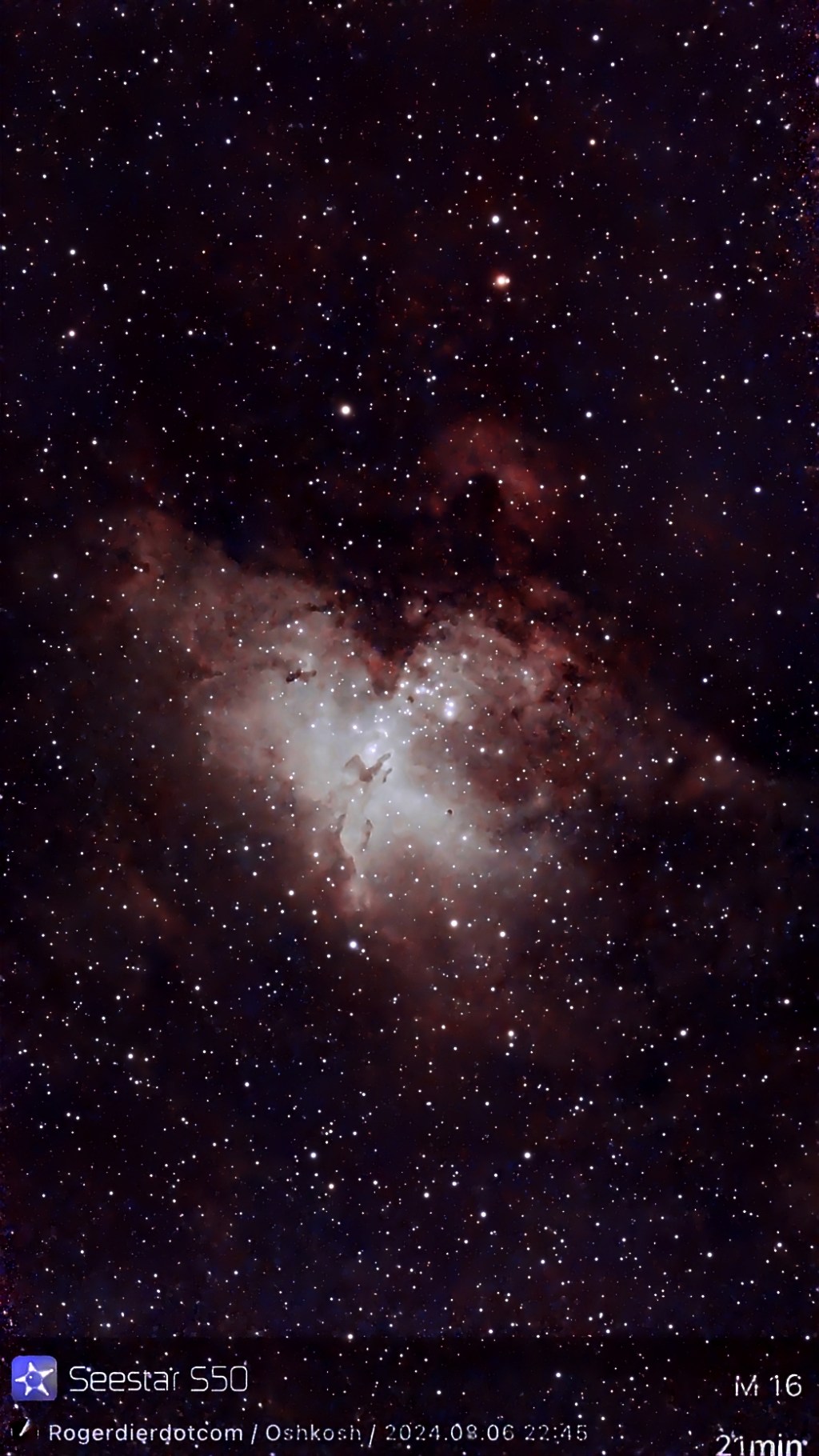
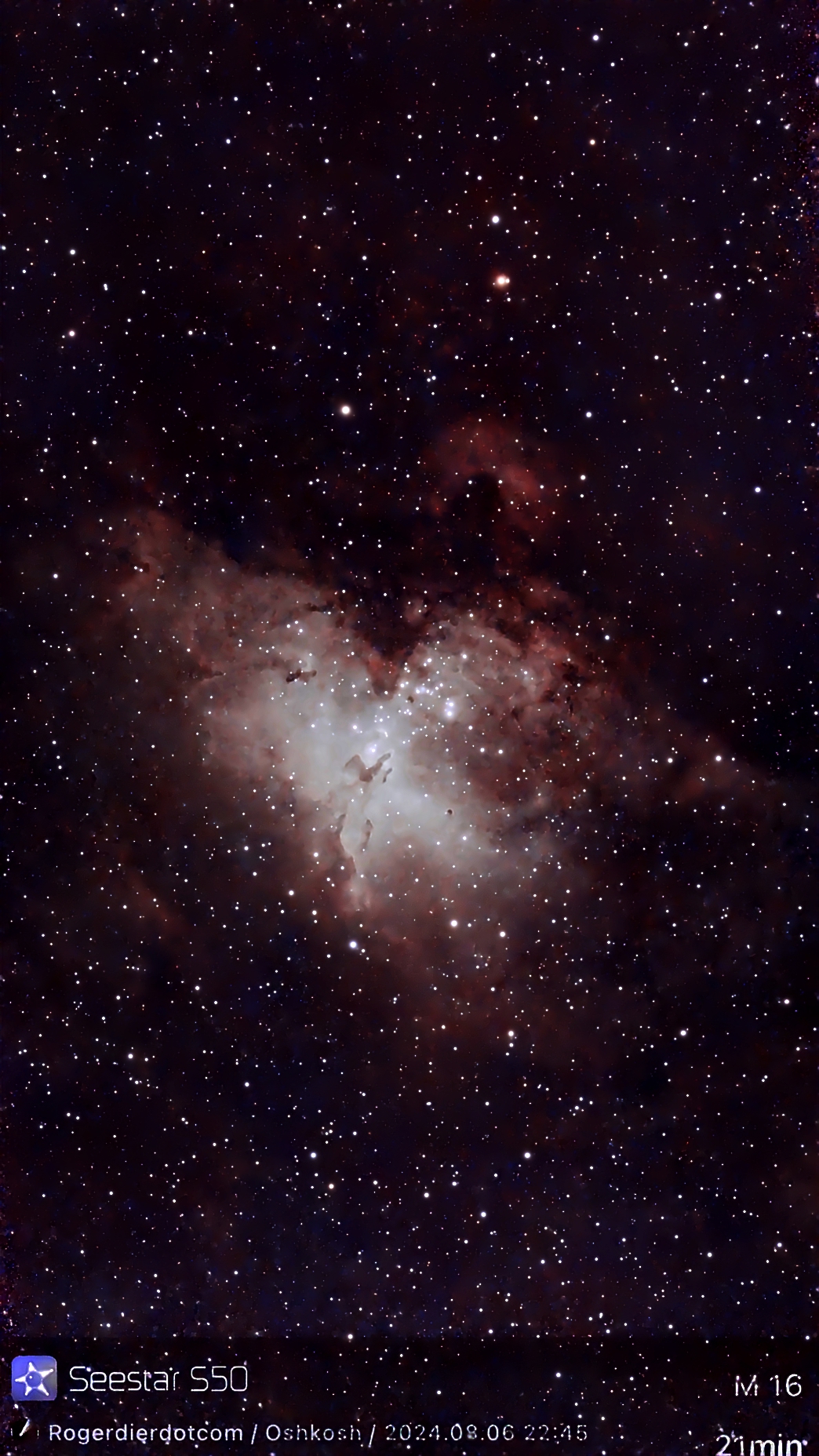
Charles Messier made this cloud of gas and dust the 16th item in his catalog. Located in the constellation Serpens, the Eagle Nebula has produced an open cluster of new stars, a grouping first discovered way back in 1745-46 by Swiss astronomer Phillips Loys de Cheseaux. He mentioned nothing about the nebula, but Messier did in 1764, writing that the cluster was “enmeshed in a faint glow.”
Moving back 7,000 light years, big picture, we can see how the Eagle got its name. Some also know it as the Star Queen Nebula. You can see the Star Queen in the middle of the Eagle. Cropped, the Star Queen appears to hold an infant; we humans have active imaginations of transference.
The Eagle Nebula shines at magnitude 6.2. Its open cluster is numbered 6611 in the New General Catalogue (NGC). That cluster of massive stars is estimated to be only 5.5 million years old. But the stars within NGC 6611 are juiced with high energy ultraviolet radiation, so much so that the rest of the Mother Eagle glows in fluorescence.
THE QUEEN IS DEAD
Scientists are convinced that the pillars of gas and dust that created the Star Queen are long gone. Using the Spitzer Space Telescope, experts believe that the entire Eagle Nebula, including the Star Queen, was blown to bits by a Supernova around 6,000 years ago. The light from that conflagration is expected to reach Earth in about a thousand years. Mark your calendars and know that George Harrison was right: All Things Must Pass.
THE TRIFID
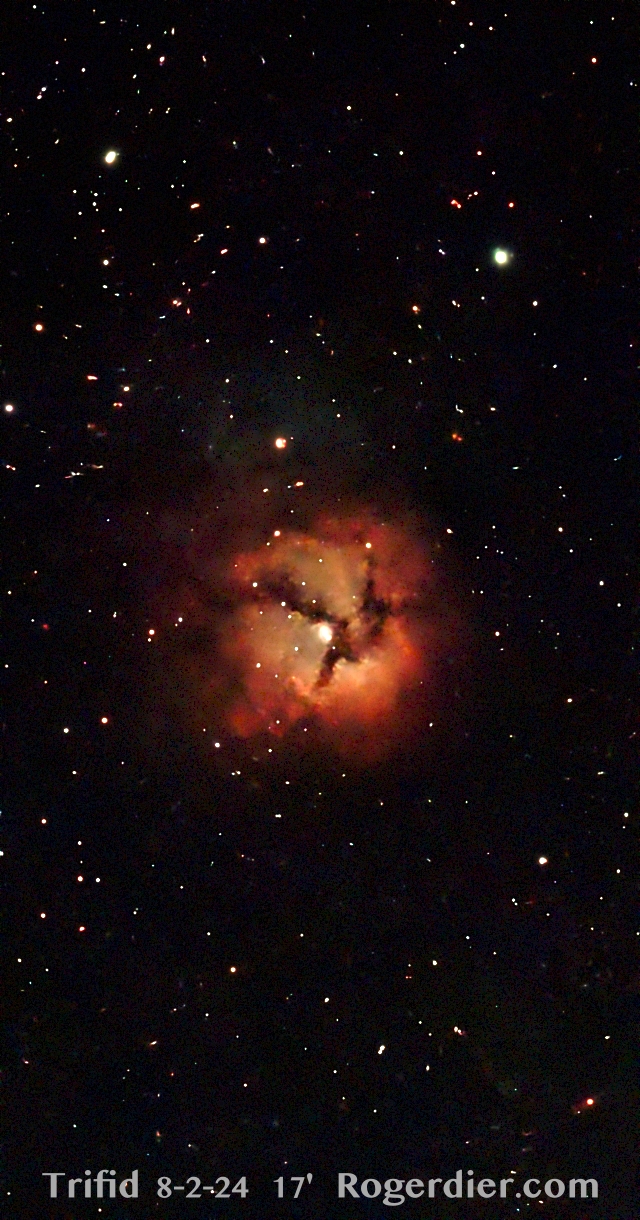
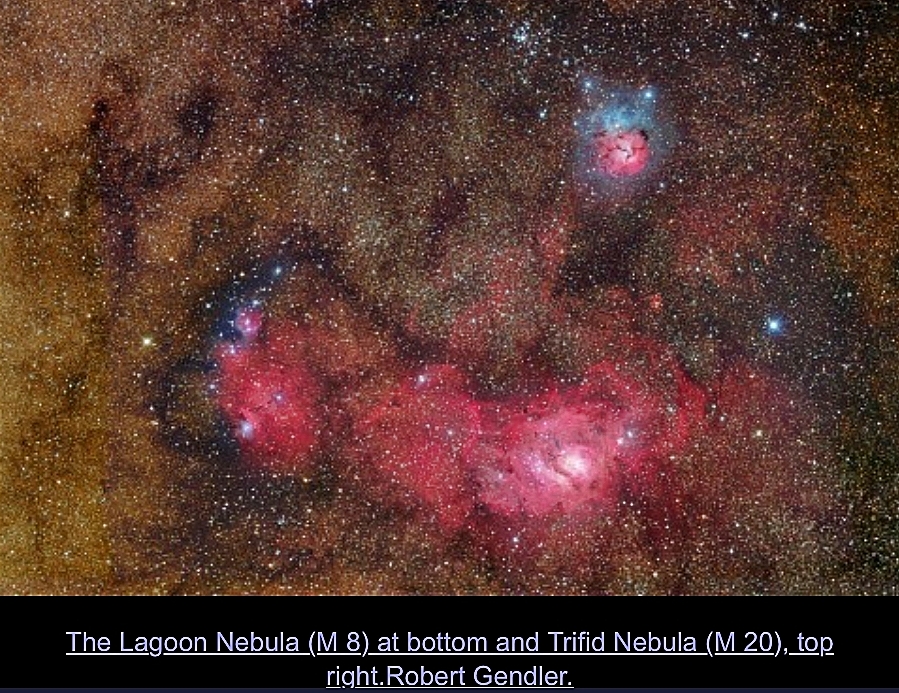
Messier was in the constellation Sagittarius when he discovered this fantastic stellar nursery on June 5, 1764. Trifid means three lobes, and we can see them all. Truncated dark nebula divides the entire arrangement: Emission nebula appears reddish and the reflection nebula on top appears like faint steam coming off a hot cup of coffee.
The Trifid is a nursery that is birthing new suns. It took the invention and orbit of the Spitzer Space Telescope to reveal 30 embryonic stars (tadpoles in a stellar pond) and 120 fully developed new stars. This marvelous creation is only 300,000 years old, 5,000 light years away and glows at magnitude 6.1; a few sharp-eyed people have seen it in the night without optical aid. Whether viewed through an eyepiece or in a photograph or in inky Bortle 1 skies, it is a privilege to see it.
THE LAGOON
The third summer cloud in our tour of the summer sky’s big three star factories is the Lagoon Nebula. We need a sky with a Bortle 1 or 2 designation to glimpse this 5.8 to 6.0 magnitude object without optical aid. Along with M42 in Orion, the Lagoon Nebula is one of two star-forming regions those of us in mid-northern latitudes are able to see without optics. The Lagoon Nebula is a short bus ride south of the Trifid Nebula—both reside in Sagittarius—but the Lagoon Nebula is plumper, spreading across almost two-degrees of sky.
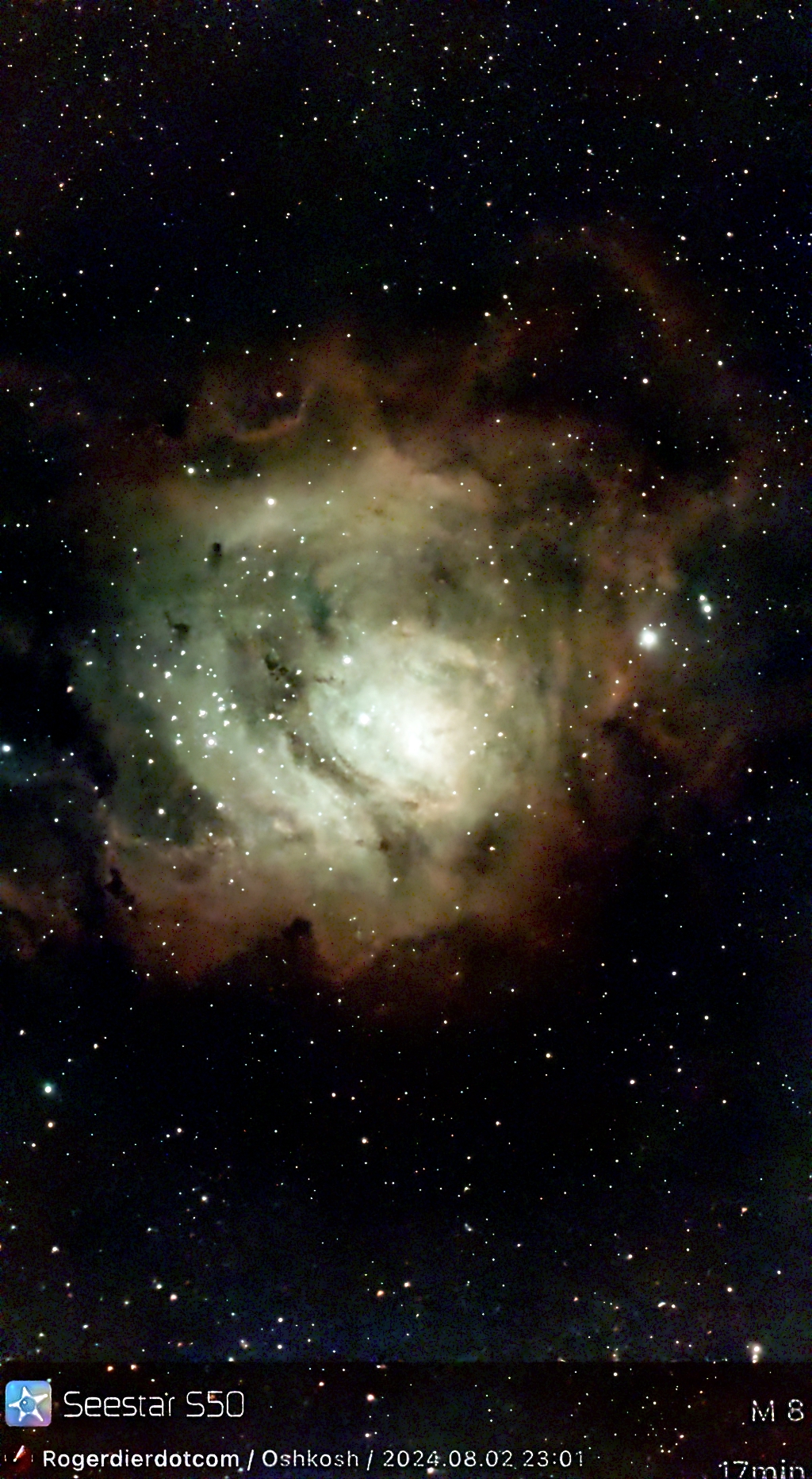
Giovanni Battista Hodierna discovered the lagoon in 1654, early in the telescope age, and he described it as “nebulosa.” Twenty-six years later, English astronomer (and the first Astronomer Royal) John Flamsteed noted it. Messier added it to his catalog in his busy summer of 1764, noting the nebula and the cluster within it.
Within the nebula of my accompany photo you can see dark globules of collapsing clouds of protostellar material, the process described in the beginning paragraphs of this essay. Frankly, this photo was shot weeks ago on a windy night on Ames Point, which jets out from the eastern shore of Lake Winnebago. I’m surprised it turned out as well as it did.
Self-congratulations finished, thank you for reading.
If you would subscribe for free at the bottom of this page, you’ll get these Cosmic postings when they first appear. These musings are free, and always will be, so nothing will ever show up as a deduction in your e-commerce. That’s a promise.
Sources Used: Burham’s Celestial Handbook, SkySafari Plus, Wikipedia, astrophotographer Robert Gendler.
 Cosmic