I have always suspected that I was not from this galaxy.
On August 6, I wrote a little ditty about globular clusters (Gobs of Globs). What I know about globular clusters is basic astronomy gospel: Globular clusters are lovely in the eyepiece field—some are even glamorous—and they are compact and generally circular in shape. Though they appear tightly wound, the stars within are, on average, about a light year and a half apart. Globular cluster stars are made of different elements, and the difference of those elements is a crude predictor of each globular star’s life and death. Most curious to me is that globulars are universally found hovering around the center hub of galaxies, like bees drawn to a thick patch of nectar-filled flowers. Within this Aug. 6 story about five globulars is a chart detailing the Messier number of the globulars, visual magnitude, distance in light years, angular size and constellation where each globular resides.
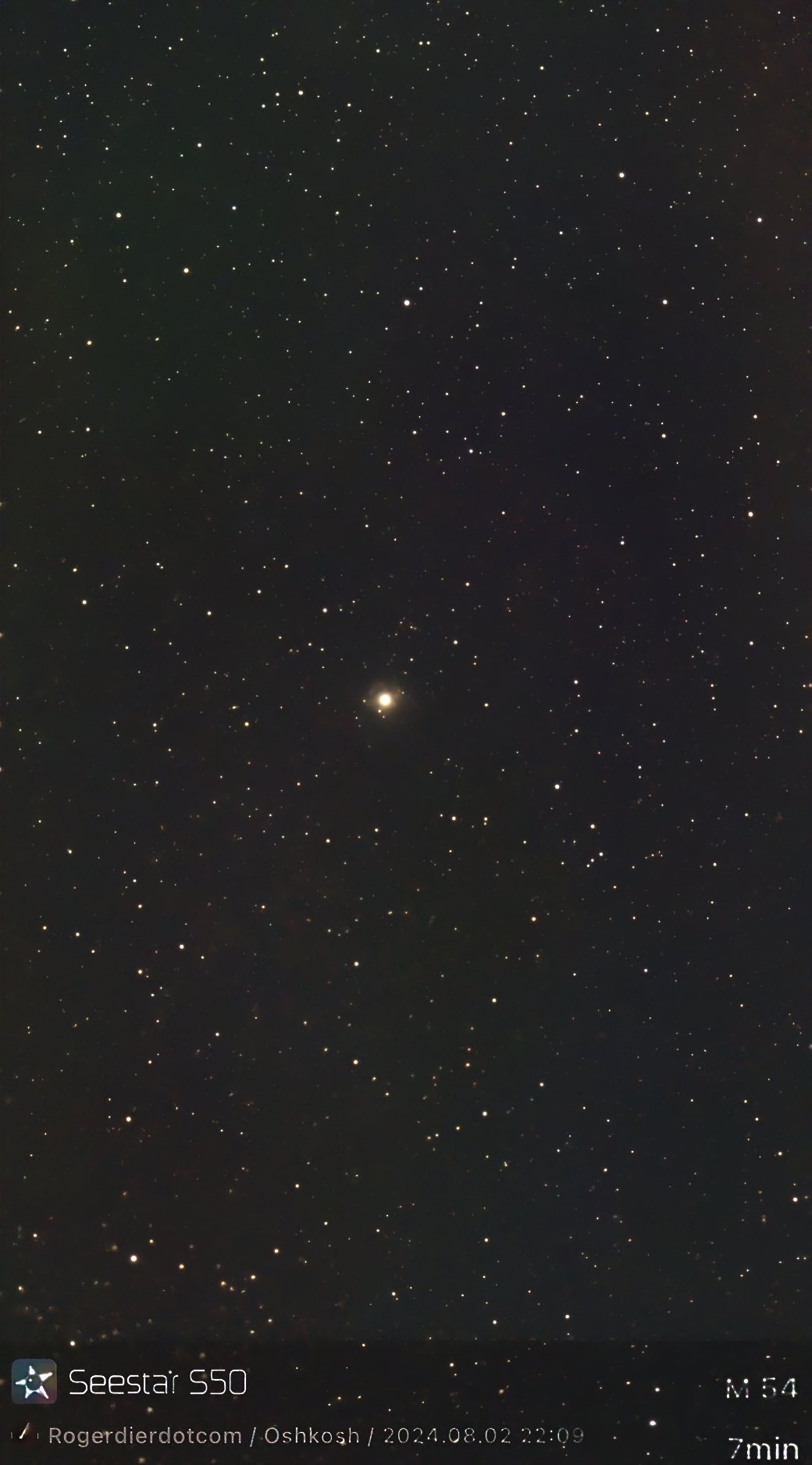
One remote globular, M54, was really far out, almost 83,000 light years from Earth. I remember thinking, That’s a little odd compared to most Messier globulars. I didn’t follow my curiosity. But one of our readers, an Australian who observes, photographs and writes with pleasing precision, reminded me of how much I don’t know.
Ggreybeard wrote: “M54 is an intriguing glob, not being directly associated with the Milky Way but with Sagdeg, a nearby dwarf galaxy.”
Up until then, I had never heard of Sagdeg. Before 1994, neither had anyone else.
SAGITTARIUS DWARF ELLIPTICAL GALAXY
Sagdeg is short for Sagittarius Dwarf Elliptical Galaxy. The discoverers of Sagdeg—Rodrigo Ibata, Mike Irwin and Gerry Gilmore—thought Sagdeg to be the nearest known neighbor to the Milky Way. There’s differences in opinion about that. What is not disputed is Sagdeg’s current position above and on the opposite side of the Milky Way from Earth.
That’s where M54 lies, 82,800 light years from earth, somewhere within the center of the Sagdeg galaxy. While Sagdeg contains a smattering of new young stars, most of its stars and clusters are metal poor and as a consequence, elders of the night sky. What your intrepid astronomer finds most remarkable is that Sagdeg is in a polar orbit around our galaxy, and is headed for another plunge through the Milky Way’s galactic disk, which might already be occurring. Sagdeg is stretched out, in the throes of breaking apart. There’s no consensus on how many times Sagdeg has collided with the Milky Way—I’ve read between three and a dozen times—but it’s generally agreed that the Milky Way is eating Sagdeg. What once belonged to Sagdeg now resides within the kingdom of the Milky Way.
CUE THE SUN!

Finished nearly drowning the escaping Truman (Jim Carrey), the God-like Christof (Ed Harris) issues a thundering command to his production assistants in the movie The Truman Show: “Cue the sun!”
Let’s cue our sun, and explore its origins. What do we think we know? Our sun is not original. What burns bright in our sky has burned bright in other stars long before our sun was conceived.
How did that happen?
King Gravity has Sagdeg in the shredder. Sagdeg undoubtedly has caused gravitational waves during its plunges into the Milky Way, and vice versa. Those waves created new stars and killed existing ones. Many multi-generational stars have chemical compositions similar to our sun. Those elements are not typically found in first- or second-generation stars.
Given the presence and density of substances within the sun, astrophysicists believe that our sun is at least a third-generation star, just like us. All that we are—eyes, fingernails, skin, heart, tears, lungs, bones and brains—are chemical compounds left over from long dead stars. “We are,” Carl Sagan said, “made of star stuff.”
The lingering mystery to me, however, is what creates the human life force, and all life forces on our oasis of a planet? What gives the cold, uncaring cosmos the power to comprehend itself via our human minds? And why has that happened?
MY FELLOW SAGDEGIANS?
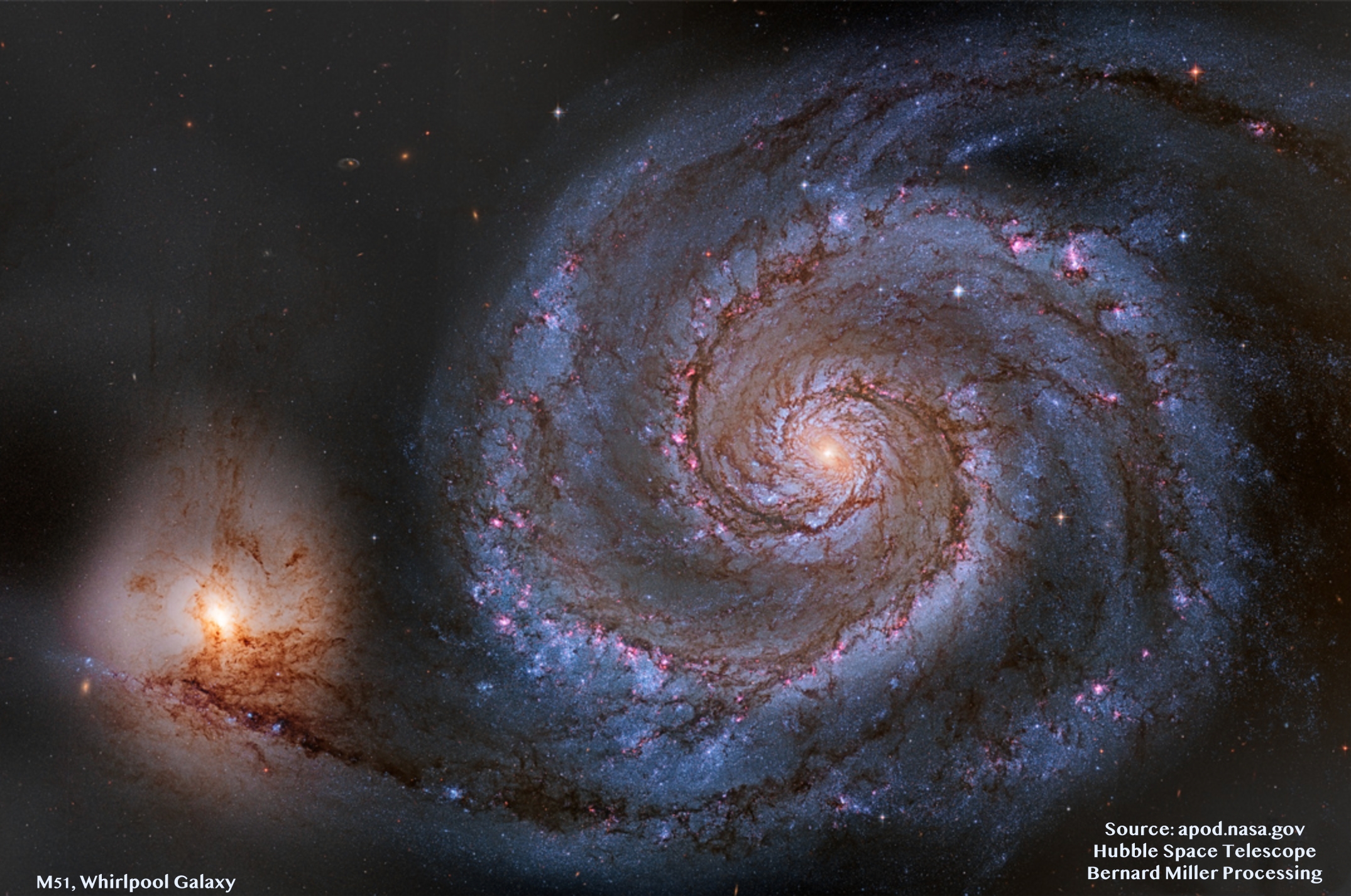
The galactic architecture of Sagdeg extends thousands of light years behind the galaxy’s core. Sagdeg is breaking up but not as fast as it should; astronomers believe Sagdeg is superglued by dark matter, which helps to hold the smaller galaxy—1/10th the size of the Milky Way—together. But there’s mass being exchanged, the same way NGC 5195’s gravity extends an arm of M51, even though NGC 5195 is light years behind it. As Sagdeg passes through our galaxy, stars, gas and dust is leaving Sagdeg in chunks. Over time, even the dark matter within Sagdeg will lose the war. Gravity is not the strongest force in the cosmos, but it’s the most persistent.
Long story short: We all may be orphans from another galaxy.
At the end of this post is a Youtube video that graphically explains what has and will continue to happen to Sagdeg until it is completely absorbed by the Milky Way.
SPEAKING OF SAGITTARIUS
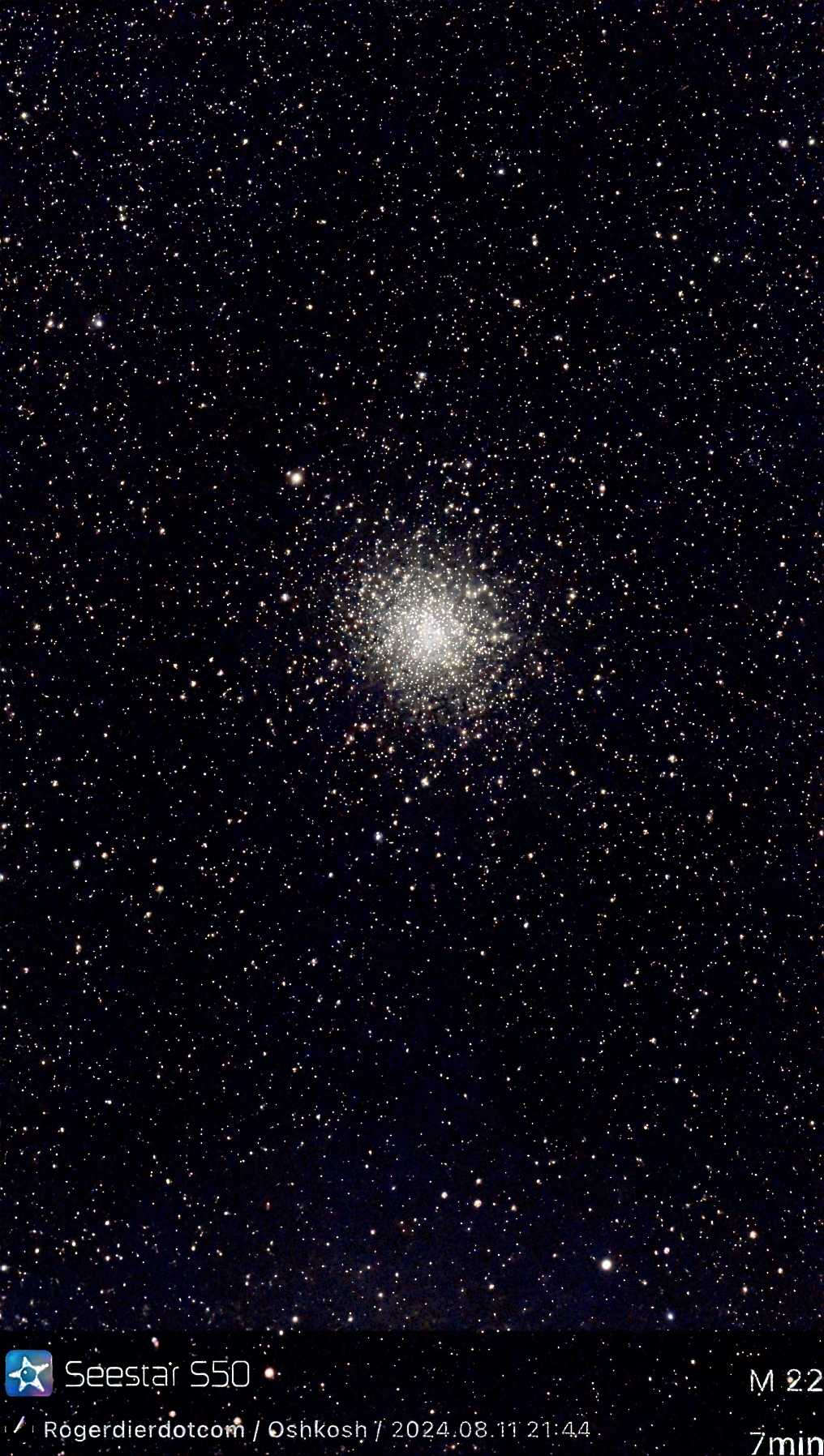
Discovered in the constellation Sagittarius in 1665 by German astronomer Abraham Ihle, the spectacular globular cluster M22 was likely seen by the ancients under dry desert skies. Messier added the cluster to his catalog in June 1764. At visual magnitude 5.1, M22 is the third brightest globular we can see without optical aid; it’s the brightest in the northern latitudes. Also rightly named the Great Sagittarius Cluster, it is an interesting collection of older, metal-poor stars. M22 contains 32 variable stars, at least five and maybe up to 100 black holes and a bunch of large, serious planets, some of which are so massive that they bend the Earth-bound light of stars behind them. From Earth, M22’s angular spread is 24 arc minutes.
This photo was taken when M22 was 21.56 degrees above the southern horizon. When it transits the meridian, M22 only gets as high as 22.09 degrees above the southern horizon from 43.96 degrees north latitude. This is the best photo of a globular cluster I’ve ever taken.
M72
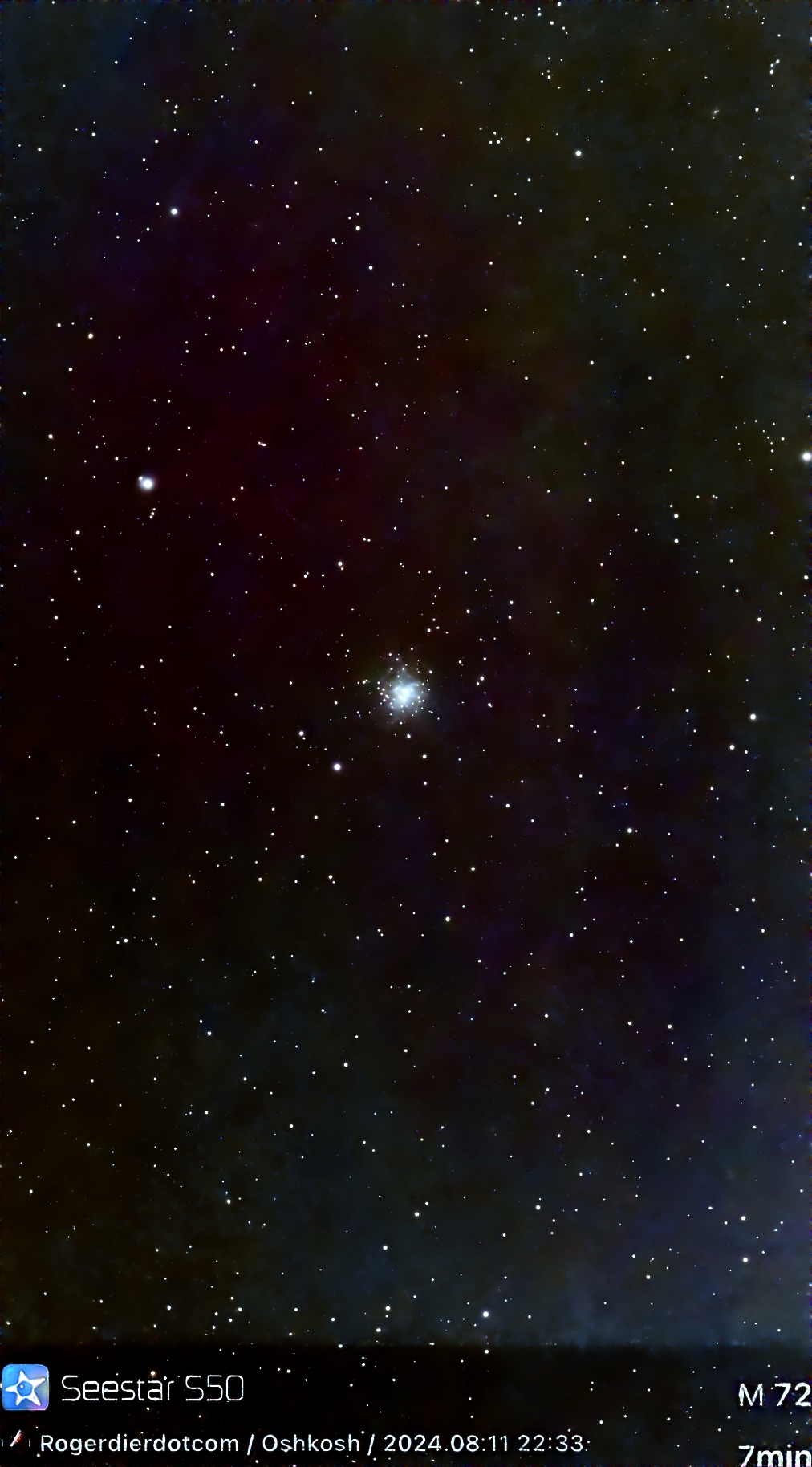
Like M22, fellow globular M72 is a seven-minute exposure taken with a SeeStar S50. It is an ancient globular, even by globular standards, having been around for 9.5 billion years. The old star hub is 54,570 light years from us, located in the constellation Aquarius, and it contains 43 known variable stars. Size-wise from Earth, its 6.6 arc-minute diameter is about 25% of M22’s impressive angular girth. Discovered by Messier colleague Pierre Méchain on the evening of Aug. 29-30, 1780, Messier gave his colleague credit for discovery when he later added it to his famous catalog.
Thank you for reading. The staff at rogerdier.com wishes good health to you and those you care about, and for clear skies when you want them.
You can see and read Ggreybeard’s stuff at: https://cosmicfocus.wordpress.com
AND BELOW, click on the Sagdeg post from the program, “Secrets of the Universe.”
 Cosmic
One response to “Are We Aliens From Another Galaxy?”
Interesting post, especially in regard to Sagdeg – and thanks for the promo.
LikeLike