In a SeeStar S50 chat room on cloudynights.com this week, one playful wag, recalling a childhood tongue twister celebrating large marmots who like to dig holes, asked: How many stars could a SeeStar see if a SeeStar could see stars?
The answer is everything from star birth to star death, dusty carcasses of exploded dead stars to babies right out of the molecular womb.
Last month, curious about the relative thickness of Earth’s atmosphere at the horizon compared with straight overhead, your intrepid star gazer gazed at research: When viewing an astronomical object at the horizon, astronomers are looking at air mass than is 38 times thicker than when peering through air mass at the zenith, directly overhead. Thick soup for sure.
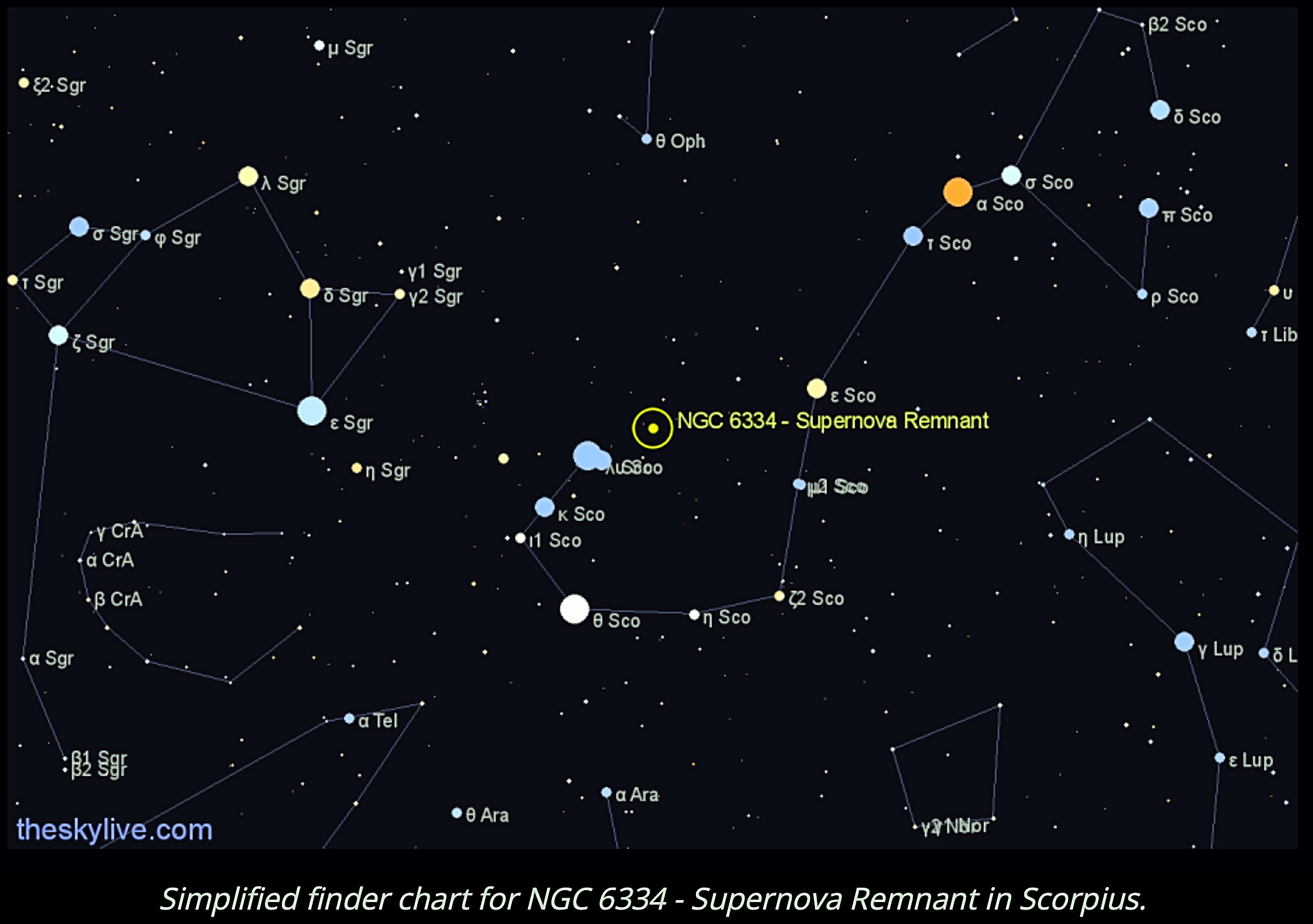
Why does that matter? Outside our home Wednesday evening when the moon was two days past full, I shot two summer star clusters that were quickly sinking in the southwest sky. Those tasks completed, I noticed on SkySafari Plus an object that was new to me with an intriguing nickname. Check that, nicknames: The Cat’s Paw or the Bear Claw. Better known as NGC 6334, the clouds of emission nebula only climb 9.9 degrees above my southern horizon; the quick trip across my meridian lasts a whopping 14 minutes. It was shortly past 9 p.m. local time. If I hurried, SeeStar might be able to peer through the Cat’s Paw window.
HERE KITTY KITTY KITTY
The feline nickname yielded nothing in SeeStar’s search function. I fumbled around with my iPhone. Tick. Tick. Tick. Tick. I could visualize the nebula peeking at me above the distant trees and then quickly dipping behind them in its quick zip to the horizon. I tried the nebula’s NGC number. Bingo. It’s still above the horizon. Along with its NGC number, the SeeStar knows the nebular grouping as the Bear’s Claw. By any name, I was pessimistic that SeeStar would find it. First, there’s a neighbor’s roof to shoot over, and above Dennis’ roof, the leafy trees of Oshkosh’s Doty Street, and above that, sky glow from Fond Du Lac, Wisconsin, a dozen miles south, permanently hugging the southern shore of Lake Winnebago. And last, the light-snuffing equivalent of 35 or 36 Earth atmospheres.
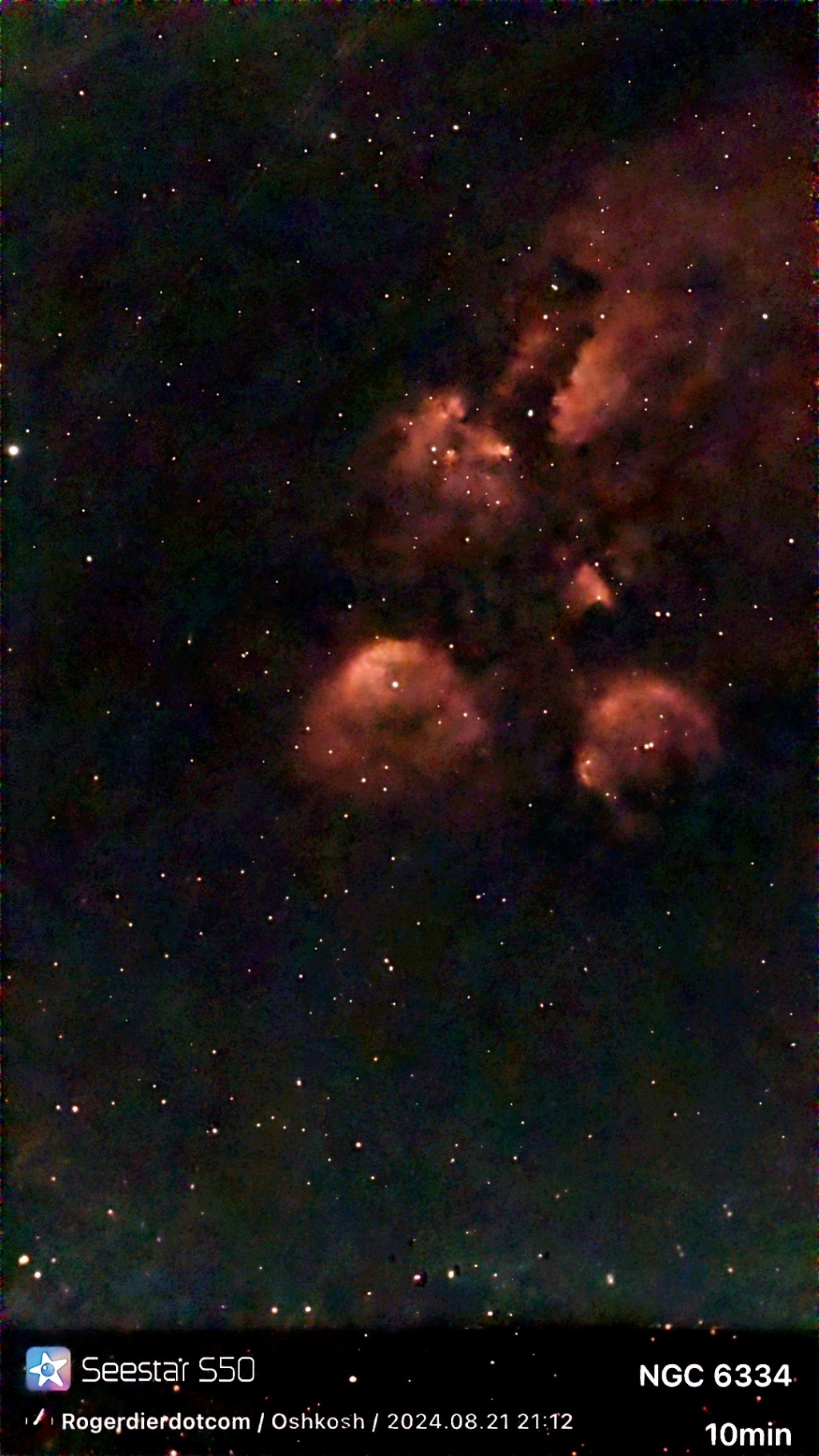
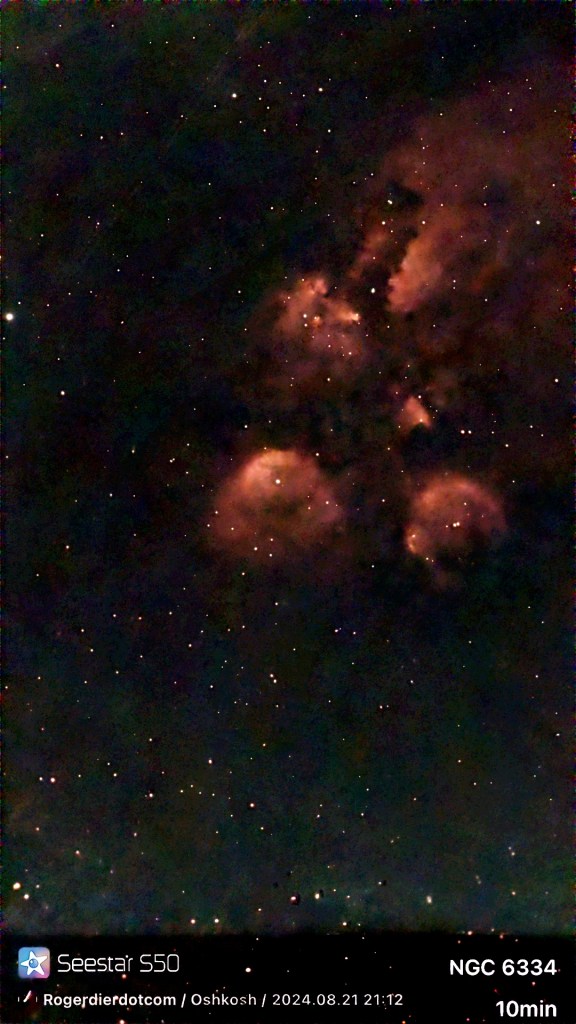
Miracle of miracles, the SeeStar S50 indicated though I couldn’t see the Cat’s Paw, it could, 5,500 light-years distant, right off the tip of Scorpio’s curled up tail. I pushed the magic button and it began shooting and stacking 10-second long images. Sixty subs later (10 minutes worth of exposures) there was something to work with.
SPEAKING OF ZWO’s SEESTAR

Electronic Assisted Astronomy (EAA) is optical cannabis in the minds of night-sky watchers who have been stuck under light domes without the wherewithal to escape. SeeStar does all the work of finding the target in the sky. SeeStar does all the photography. SeeStar does all the stacking. There’s no need to plug in the SeeStar to my home computer to download images. What SeeStar photographs outside goes directly to my photo App on my iPhone, iPad and iMac. Liberating convenience.
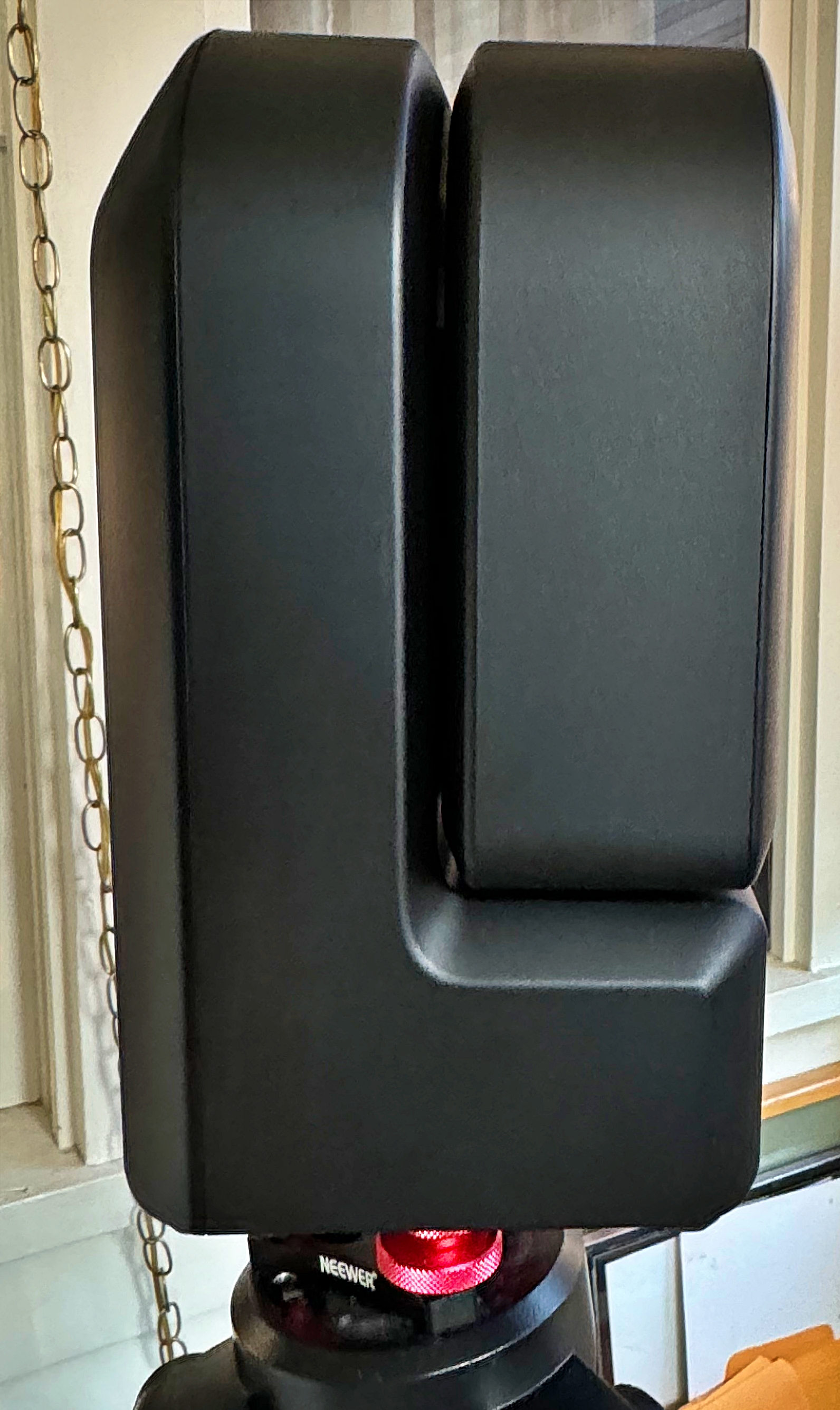
In fact, the SeeStar S50 is to current EAA competitors what the first iPhone was when compared to “smartphones” of 2007: The iPhone’s competitors were pimpled with permanent clunky keyboards that ate into precious screen size. Sleek and compact as an Olympic sprinter—The SeeStar S50 has two halves, intelligence and optics—mind and body. It features a two-inch, triplet lens, it is lightweight, portable and an absolute slayer of bright skies over cities, towns and suburban neighborhoods. When the decision-makers at ZWO rolled out the SeeStar S50 in 2023, they might have mimicked Jobs and announced the SeeStar S50 was an integrated telescope with a tripod, a camera, a computer, a Wifi with Bluetooth, a star stacker with light pollution filters, etc. You can do a lot of great things with this SeeStar’s little football-shaped wonder.
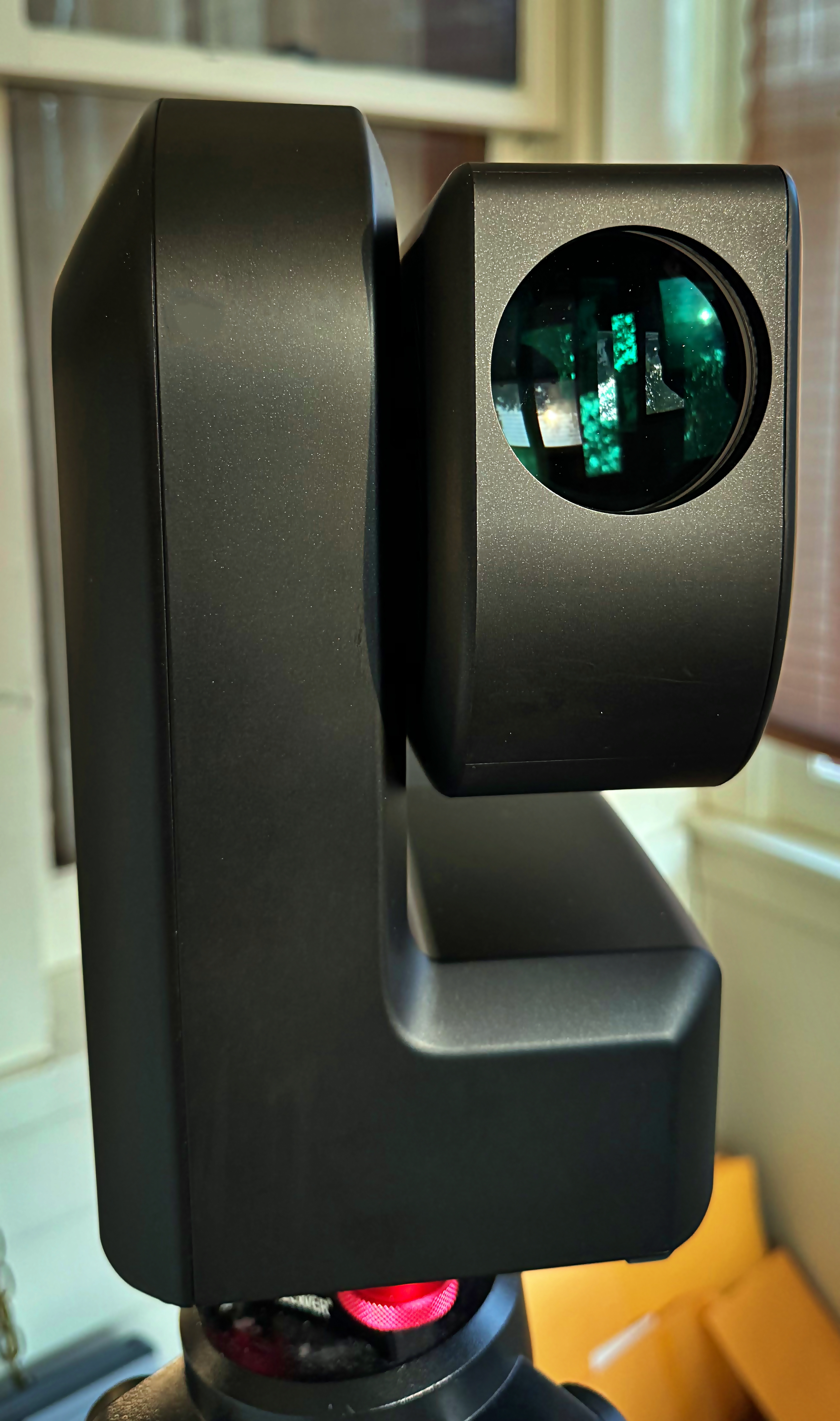
The real beauty is that it is wonderfully affordable. Since it hit the market, the SeeStar S50 has retailed between $399 and $499. Currently, the S50 sells for around $450. Would you rather spend that, or buy a larger conventional telescope, which only fits on a burdensome weighty tripod, outfitted with a heavy mounting plate and counterweights, that requires expensive filters to reduce light pollution, and expensive drives to track the sky, and expensive cameras to photograph what you’re seeing? Some may say the SeeStar is cheap. I say it’s inexpensive, and well-made; That’s shorthand for value. The market will decide.
HISTORY
In some astronomical communities disagreement and outright bickering are badges of honor. It holds true when speaking of the Cat’s Paw Nebula. Does NGC 6334 exist because of a past supernova? Or is all this dust and gas there because one or more collisions with a galaxy like Sagdeg? The origin matters to some. To others, not so much. What is known is that gas, dust and pressure created about 2,000 large, hot and very blue-white stars deep within NGC 6334’s oven. Kevin Morefield of astrobin.com speculates there may be tens of thousands of new stars we can’t see, buried in the cocoons of molecular gas and dust that are visible.
To be precise, NGC 6334 is the cloud at the lower left, the one that’s 80 light-years wide. The whole smash is so beautiful to see emerging on your iPhone or iPad as the SeeStar images stack up. The Cat’s Paw nebula is a visual magnitude of 10. In the American Midwest, trying to see this grouping visually in an eyepiece pointed almost parallel to the horizon, looking through the equivalent of three dozen Earth air masses … Well, good luck. To see it magically appear on a phone screen is a sweet buzz.
Red is the dominant color of the Cat’s Paw emission nebula because the blue and green wavelengths are scattered. The whole of the Cat’s Paw Nebula is ionized by the electromagnetic energy blasting out of those badass blue giants emerging from the nursery. Lot’s of hydrogen in that froth.
PRAISE FOR PIXINSIGHT

Also pictured is the Cat’s Paw without the stars—I have some software that makes that kind of star-eliminating magic—it’s a great add on to the PixInsight suite. A few months ago when your intrepid astronomer first shopped for imaging software, I read countless dire warnings about how difficult and complicated (and expensive) PixInsight was.
Yet, those who dove into PixInsight and learned how to use it one application at a time all swore it created the best images ever made by Earthbound optics. So I took advantage of PixInsight’s trial period and tried it for free. I became addicted to the learning. It felt like scholarship. The cottage industry of YouTubers who introduce prospective PixInsight users to the basics of the software are like Shepards to the stars.
When in doubt, read the reviews and trust the actual users who learned how to make PixInsight work its magic. Of all the functions PixInsight has and all that it can do, I have learned to use perhaps one percent of PixInsight’s imaging intelligence, if that. But it’s really a door opener for beginning astrophotographers, or in the Cat’s Paw Nebula’s case, a window-opener.
The staff of Rogerdier.com does not condone or encourage the use of cannabis, alcohol or any mind-altering substances. The founder of this site has 40-plus years of sobriety and he’s discovered his life is so much better without chemically polluting his tiny brain.
Thank you for reading. Here’s to your health and the health of the people you care about. Let’s all hope for clear skies when we want them, day or night.
 Cosmic
2 responses to “How Many Stars Could a SeeStar See?”
Nice image, Roger. Proof that the Seestar is a budget save which delivers.
LikeLike
Thank you. You may have shot this at some point, since it is much higher in the sky from Australia.
LikeLike