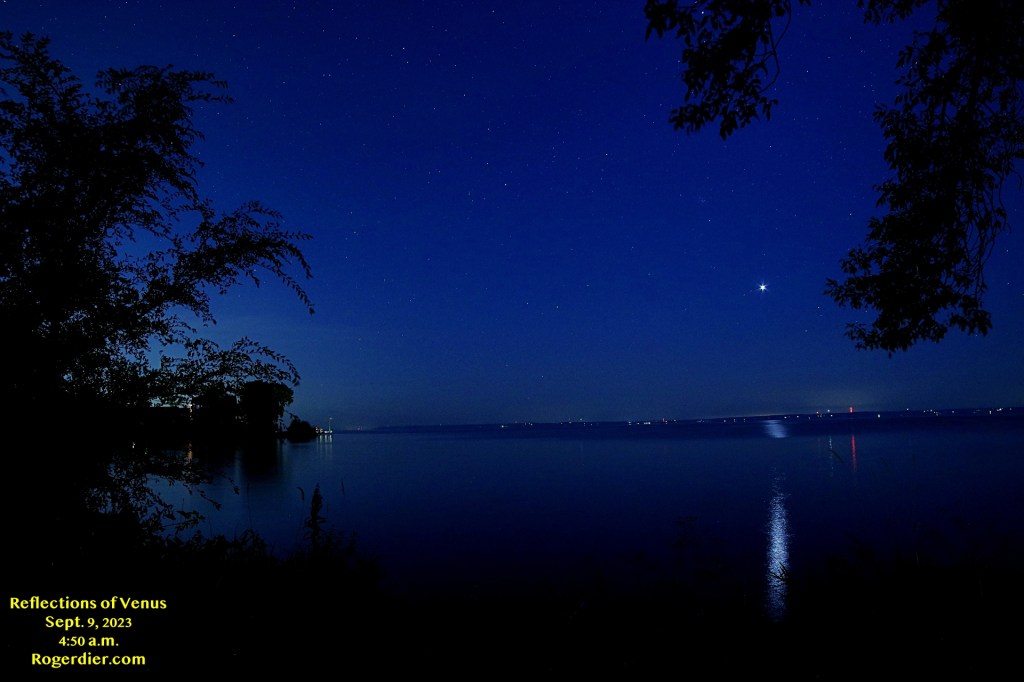
Traipsing along the shores of Lake Winnebago a year ago, I planted my tripod and captured a moment of cosmic quiet with my Pentax K-70 camera. We have this image, but that is only part of this picture, or any picture. No one can present the sweetly pleasant odors the moment the photo was taken before that promising new day, nor can any photographer recreate the waking sounds of that end-of-night moment, gazing across the lake, amazed that the beam of Venus Light makes the water appear frozen.
And moments like these are unique to the photographer, a mixture of joy and astonishment, like first seeing Saturn and her rings in a telescope, or the summer Milky Way shimmering across the night from a place on Earth completely divorced from artificial light. Or when your little boy sees the Pleiades for the first time glimmering above the trees, and exclaims, “It looks just like a Little Dipper!” Those moments change us. Ours is the most aesthetic and spiritually fulfilling hobby on the planet.
From time to time, I go through my burgeoning collection of digital photos and toss bad shots into the digital garbage can. I’m glad I kept Venus on the water.
The Hidden Galaxy
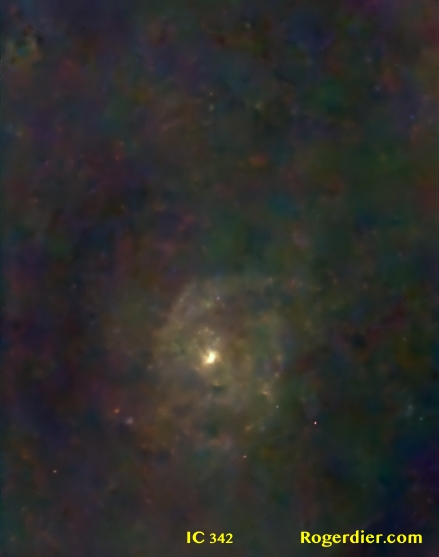
One of the more challenging objects I struggled to capture during the past ten nights is the barred-spiral galaxy IC 342, the so-called Hidden Galaxy in Camelopardalis. It’s not that it is overly faint at magnitude 9.1, it’s the fact that it lies only 10 degrees below the galactic equator. That means there’s a lot of interstellar goop to shoot through. The dust and debris between us and IC 342 is estimated to reduce its brightness by 2.4 magnitudes. It’s not close to us, either, with distance estimates between six and ten million light years.
All of these conditions kept it hidden from us until 1895 when it was discovered by W.F. Denning (1848-1931), a British amateur astronomer. As an amateur, Denning was just like us: Here for the love of it.
The image here is made with a SeeStar S50, then I processed the heck out of it with PixInsight, eventually taking all of the stars out of the image to accentuate the spiral nature. My tricks processing this 20-minute exposure failed to reveal the barred nature of its spiral arms. Oh well, next time.
NGC 891
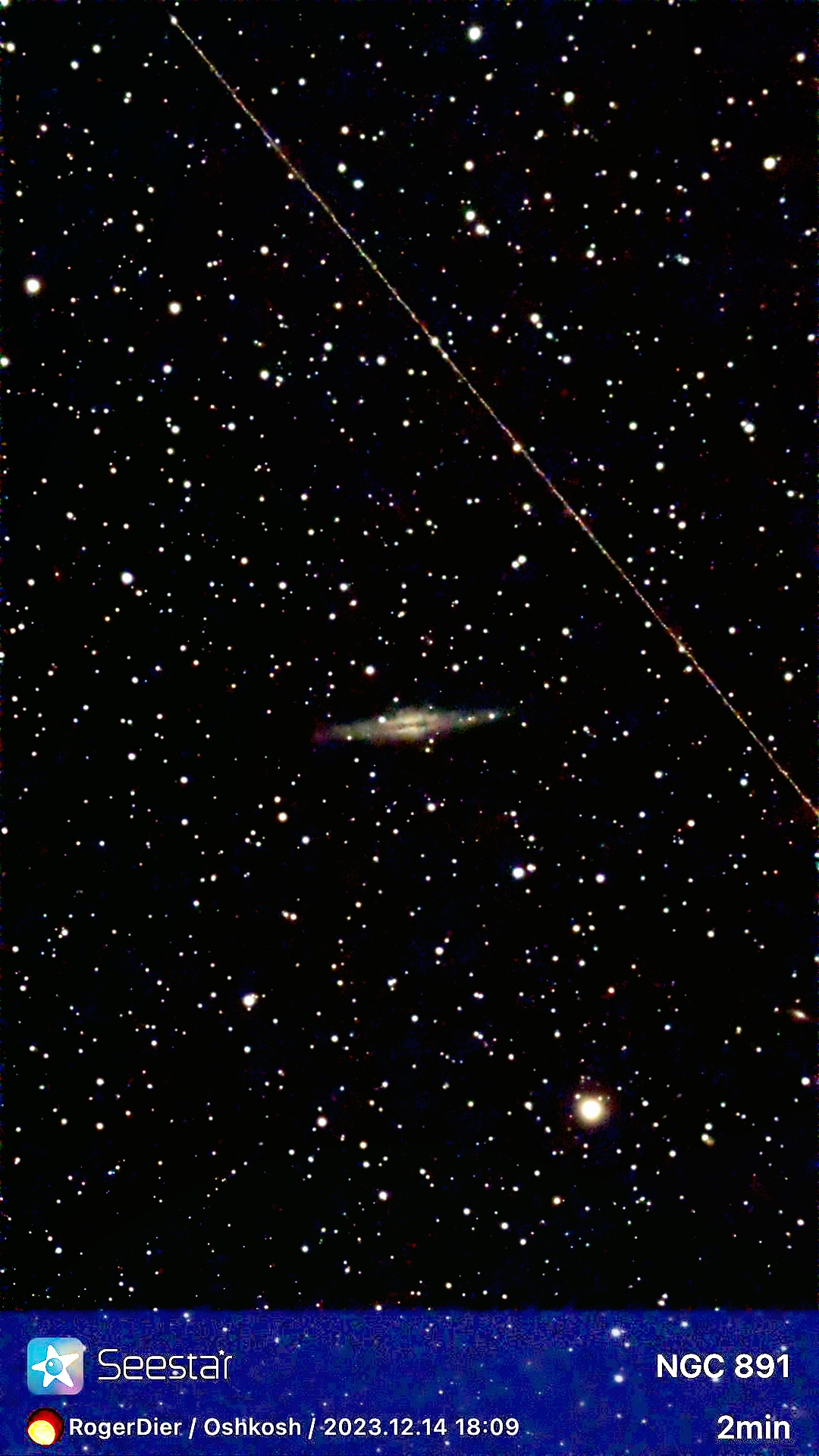
Another 2023 photo I recovered was taken in mid-December. The SeeStar was still new to me, and after first glancing at this photo, I thought, “Not bad for a beginner.” I didn’t have PixInsight back then (I had never heard of it), but I know it now. I processed 891 a few days ago. It’s like giving an old car hot wax. There’s a new sheen. The satellite slicing through the field during the two-minute exposure even looks like it knows where it’s going.
LDN 1272
Before this week, I also had never heard of the Lynd Catalog of Dark Nebula. Though LDN 1272 could easily be confused with a new pharmaceutical to treat a chronic ailment, it’s really a place in the cosmos. LDN 1272 was in a favorable position to show itself off (or not) so I ordered the SeeStar S50 to find it and hold the point. When shooting dark nebula, one hopes there is light somewhere that illuminates the darkness.
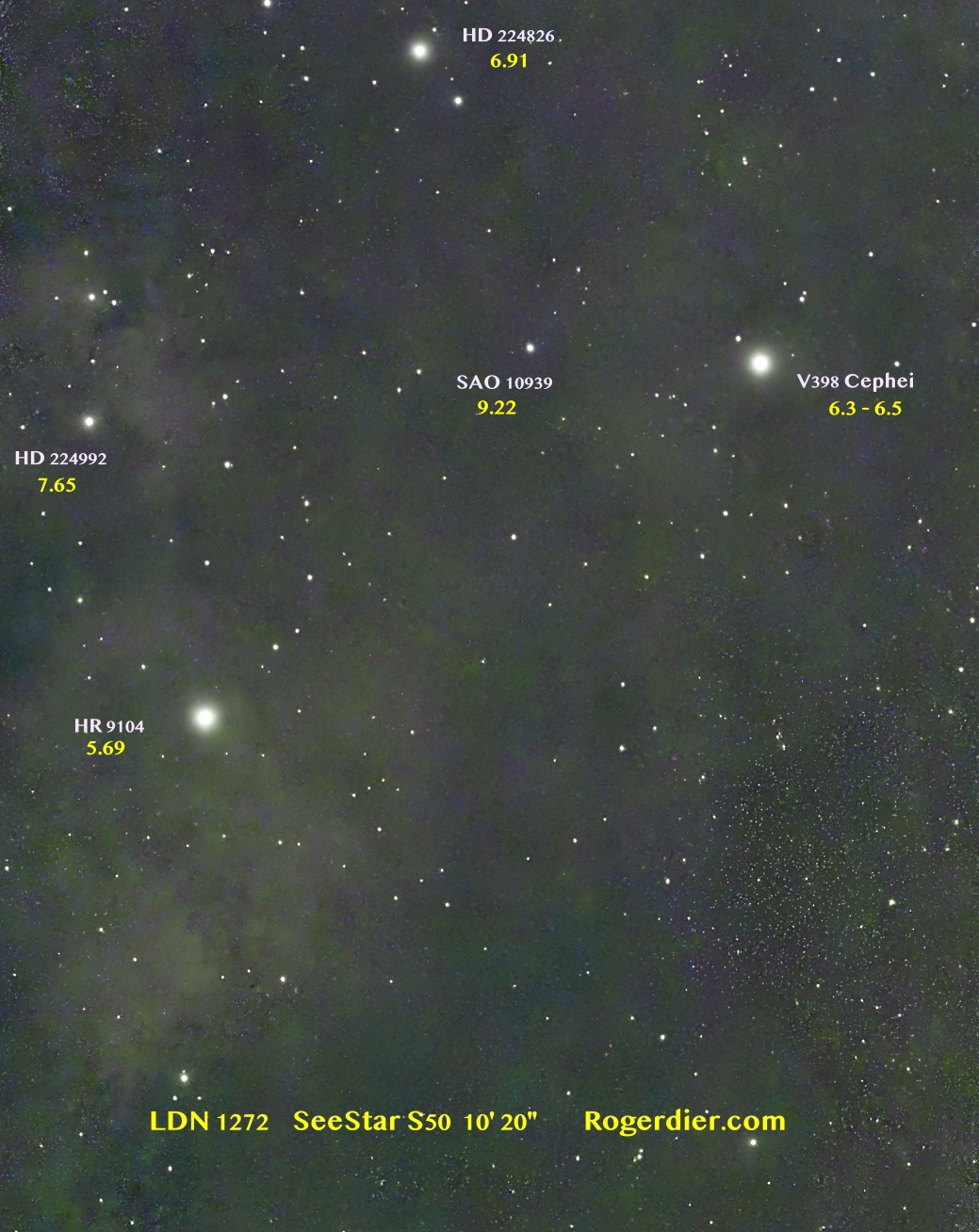
Located in Cepheus, LDN 1272 occupies 8.6 square degrees of sky, so you are not getting all of it here. Young stars deep within the molecular womb backlight the very substances that created them. Also known by a few as the Shark Nebula, it is one of the more challenging objects to photograph because it’s both dark and distant, about 3,000 light years away.
All the charming stars in the photo that I’ve identified by name and magnitude do not belong to the LDN 1272 nebula itself. They are all in the foreground. Still, it wouldn’t be as pretty a picture had they decided to live elsewhere.
Thank you for reading this post on Rogerdier.com. We appreciate all the new subscribers who subscribed (for free) at the bottom of this post. Here’s to clear skies and your good health and the health of those you care about.
 Cosmic
One response to “Reflections of Venus”
I like your reflections of Venus image. An innovative shot.
LikeLiked by 1 person