There’s a new comet speedily tumbling through the inner solar system, drawn by the pull of our 865,000 mile-wide solar furnace that is the sun. C/2023 A3, also known as Tsuchinshan–ATLAS, has traveled tens of thousands of years to get this far, falling out of the Oort Cloud, a mystical cobweb of leftover rock, ice, grains of matter and gas and who knows what else that exists 2,000 to 200,000 AUs from the sun. An AU is an acronym for Astronomical Unit, the mean distance from the center of the sun to the center of the Earth.

Every time your intrepid astronomer hears that a comet is coming, I get weak in the knees and head for a place where I think it will be visible. Comets have the same power over all of us who see, scan, observe and shoot photos of the sky. Comets are Sirens of the Solar System. In Greek mythology, Sirens were beautiful but dangerous bird-woman creatures who seduced sailors with their beguiling, mostly naked forms and seductive calls. Unable to resist the Sirens, sailors met their deaths when they steered their wooden ships over ship-splintering shoals, focused only on the Sirens’ lust-inducing forms and serenades.
That’s what brought me to the eastern-facing shore of Lake Winnebago before sunrise on Wednesday, Sept. 25. I lust over the chance to see a comet. With many calling C/2023 A3 the Comet of the Century, I must see this new Siren. Few things are overhyped in astronomy more than comets. By now, I should know better. The artist’s rendering is always overdone, with thick, sweeping tails, bright as full moon comas silhouetted by glass-clear, blue-black twilight skies. Renditions of comets are never as they really are. Still, it could be spectacular.
ORION RETURNS
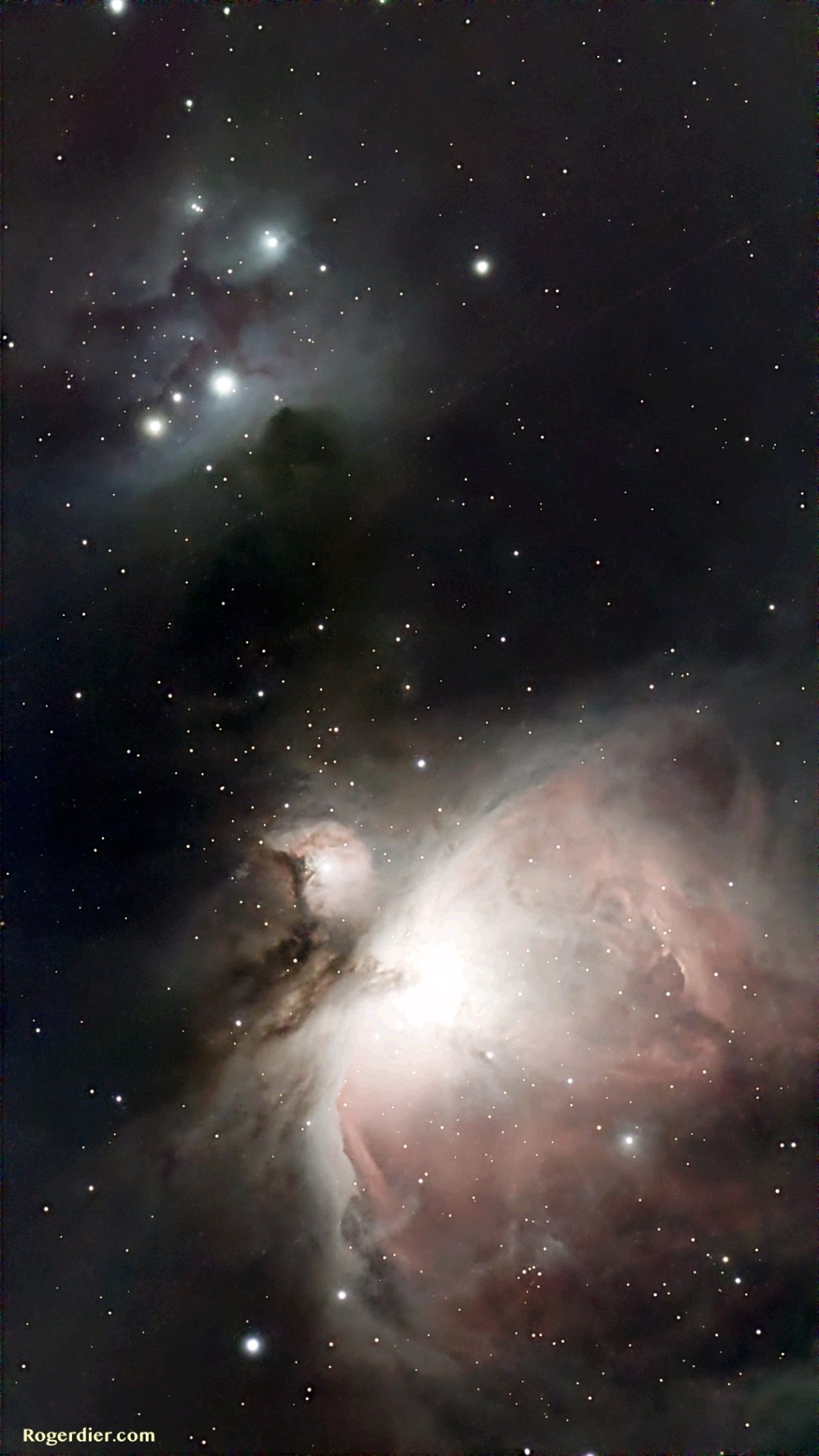
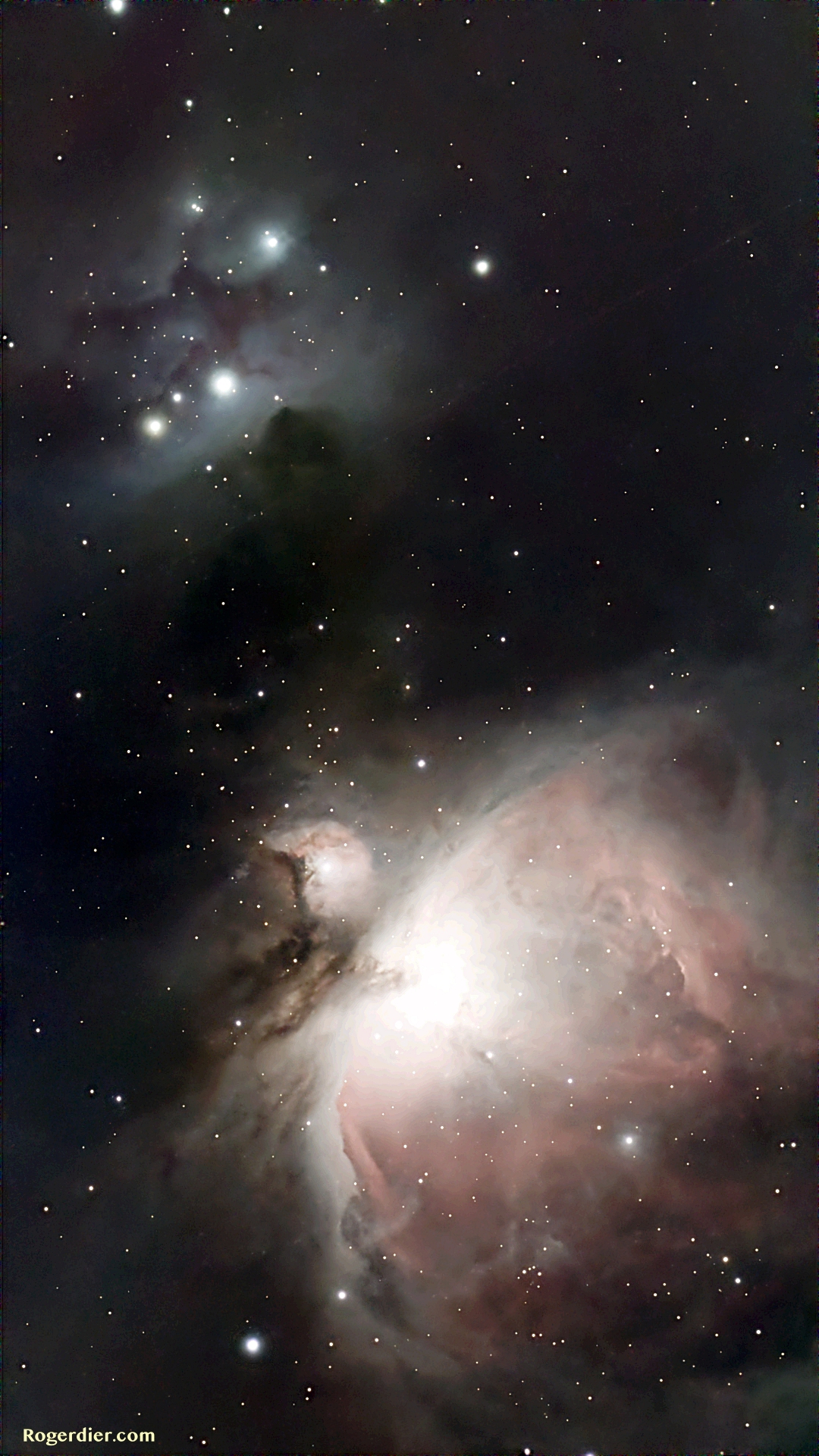
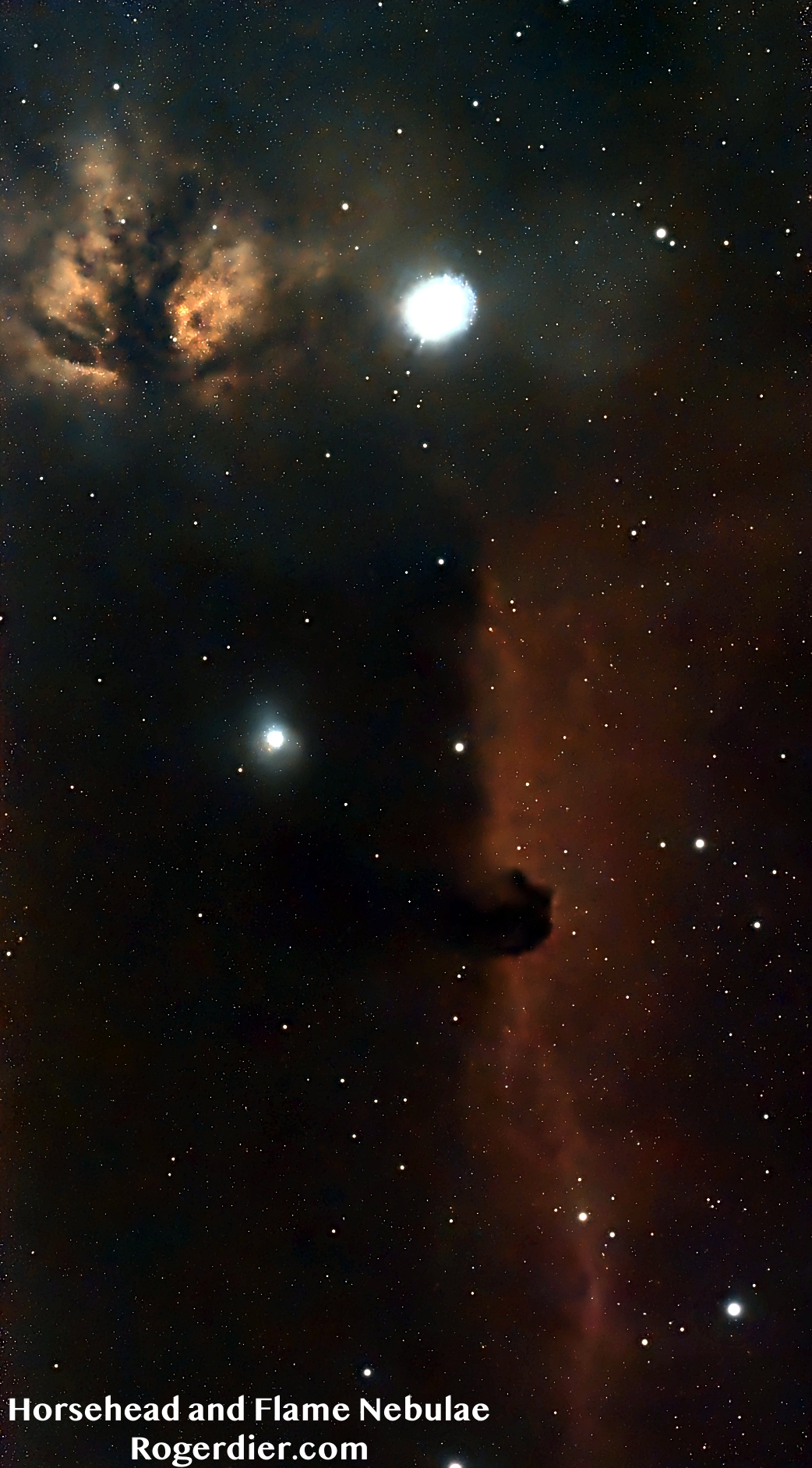
While waiting for the comet of the century to appear, I shot two, seven-minute exposures of the Great Orion Nebula, M42 and its sister nebula, M43. And as long as it was clear and we were moments away from the beginning of astronomical twilight, I sent the SeeStar S50 to the Horsehead Nebula, discovered by Williamina Fleming in 1888. I wrote about Williamina’s life and her remarkable discovery and contributions earlier this year: https://rogerdier.com/2024/02/08/williaminas-horsehead/
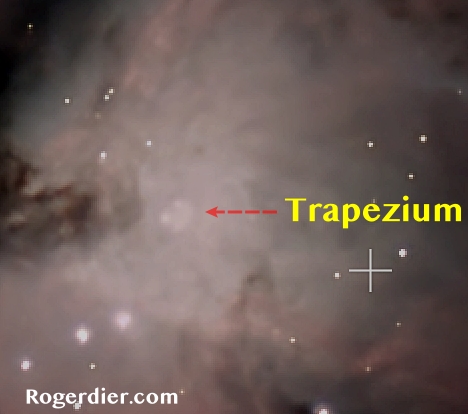
A little trickery in the post-processing of the photo enables us to view Theta Orionis, also known as the Trapezium. Galileo discovered it, though he could only make out three stars. The tiny cluster contains at least six stars, they are powerful newborns, throwing energy on most of what we can see in the Orion Nebula. The stars of the Trapezium are 15 to 30 times the size of the sun, and are within 1.5 light years of one another and shine with a collective magnitude of 4.3.
Orion the Hunter. What a piece of sky! Everything is gorgeous about Orion, even without optical aid. I once met a kid whose parents named him Orion. I’m still jealous. Orion commands the winter nights above North America. Orion looks like a hunter: Big shoulders. Muscular legs. A bright, bold warrior-hunter. Under dark skies, you can see him holding up his shield, or a pelt (take your pick). His two curs—Canis Major and Canis Minor—are near, waiting for his next command. In ordinary light pollution, we can still see the three stars that form Orion’s belt, and from there, his dangling sword where these two pictured goodies reside.
WAITING FOR THE COMET NEAR ARDY & ED’S

It was mostly peaceful on the small dike that protects the boat landing across the road from the famous Ardy & Ed’s Drive-In. Ardy & Ed’s sits on Main Street along the lake in southern Oshkosh. There’s two benches on the cement next to where I parked my telescope; you can see them in the distance at lake’s edge. I was well into a shoot of the Horsehead Nebula when an older fellow on crutches came by wearing a headlamp. I rose off the bench and asked him to dim his light because I was taking a time-lapse of something in Orion. He turned it completely off. I thanked him and showed him on the developing shot on my iPhone. He said it was really neat. I told him there’s supposed to be a comet coming over the horizon in the next couple of weeks. He said he heard that, and he was looking forward to seeing it. He wondered away along his route. About a half-hour later, a pair of shoes grinding gravel announced another approaching human. We exchanged greetings, but that was it. It’s a beautiful spot to view the eastern horizon, but it’s not private.
The last quarter moon sailed along in Gemini, joined there by Mars with nearby Jupiter in Taurus. The three were flying in celestial formation. The lake was calm. The SeeStar found where the comet of the century should be above the horizon. I put the SeeStar’s field in grid mode. The comet slowly moved from two to three to four degrees above the horizon. Allegedly. I did not see the thousands of miles of tail streaming brightly away from the sun, or the comet of the century’s shimmering nucleus. We may still see that, but on Sept. 25, 2024 between 5:15 a.m. and 6:20 a.m. on the shore of Lake Winnebago, what I wished to see hid behind the equivalent of 38 thick layers of Earth atmosphere.

CAROLINE’S ROSE
At the end of Wednesday, I parked myself in a lawn chair outside one of the doors of our home. I sent the happy SeeStar into Cassiopeia, the queen of open clusters. There the SeeStar settled on NGC 7789, also known as Caroline’s Rose, named after Caroline Herschel, the sister of Sir John Herschel. Little sister Caroline caught typhus at age 10, and that may have stunted her growth. Fully grown, Caroline stood 4-feet, 3-inches.

Caroline, the eighth of ten children, moved from her native Germany to Bath, England, and then to Dachet, Berkshire and eventually to Slough where brother and sister created and used the famous 40-foot telescope. Caroline discovered eight comets during her life, and was the first woman paid for her scientific work, making 50 pounds a year by 1796—courtesy King George III—and in her 88th year, she was the first woman to be awarded the Gold Medal of the UK’s Royal Astronomical Society. Caroline’s salary was generous; the equivalent in 2024 dollars is about $6,500 per-year. She could buy a lot of bangers and beans with that. Caroline lived nearly a century, dying at age 97 in 1848, thrilled with the whole of her remarkable life, but maybe not the typhus part.
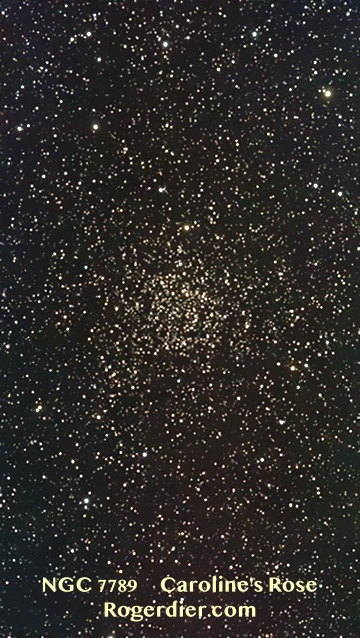
Caroline’s Rose is one of the oldest open clusters known, estimated to be around 1.6 billion years old. In this 15-minute exposure, we can see the main body of components, which shine with a collective brightness of magnitude 6.7. It’s head-scratching why Charles Messier chose not to include it in his catalogue of faux comets; maybe he didn’t see it. But Caroline Herschel did, and she did it first, and all glory goes to her. NGC 7789 is a fatty, about 20 arc minutes wide. Through binoculars, one can easily see 40 to 50 stars of Caroline’s Rose.
Ardy & Ed’s Drive-In opened in 1948, 100 years after Caroline Herschel’s death. It all fits together, friends.
Assuming the comet of the century actually shows up, we’ll be back with stunning (or disappointing) pictures of it. Until then, thank you for reading. We toast your continued good health and the health of the people you care about.
—Roger Dier
 Cosmic
5 responses to “The Siren Call of a New Comet”
“Hello, Wisconsin!!!” Thanks for your far-ranging and fun story, Roger. Sadly, I think this comet is much easier seen in the southern half of our planet. Best Wishes, Bob in Oregon
PS: I had no idea Caroline was such a snappy dresser!
LikeLike
Hi Roger, it seems the new smart-scopes have found a way to automate and uncomplicate the various time-consuming processes that those of us with conventional telescopes have to deal with at the beginning of a session. Balancing, levelling, polar aligning, celestial alignment, navigation, plate solving, darks, flats. It all seems so simple!
What is the maximum number of exposures that you can take?
LikeLike
Hi Rog, So good to hear from you again. Told myself I’m not going to publish anything until I can snag a picture of the comet. Per the 10 tenets of astronomy, now that the comet is in the night sky our post-sunset weather for the next few days looks bleak. Your SeeStar question: You can take exposures ranging from 10 seconds to one minute. Most people take 10 second exposures because you get more data. After every fifth exposure, the software applies dithering to the previous five exposures, so that takes 10 to 15 seconds before stacking resumes. I’ve never started with my battery at 100 percent and photographed a single object until it ran dead, but what I’ve read and experienced, the battery will last up to six hours on temperate evenings. If you ask the SeeStar to heat your objective, that will suck more energy. All this said, if five, 10-second exposures can be accumulated in one minute, one hour of shooting will net 300 exposures and six hours of shooting will give you 1,800 exposures of a single object. I’m told that some SeeStar users also use auxiliary batteries, so the six-hour limit can be extended, evidently. Sometimes, the SeeStar rejects subs and will continue to reject them until the operator resets the process—I have learned a few tricks—or the astronomer adjusts the leveling slightly to help the tracking. It tracks remarkably well. To do that, you stop the photography process, goto leveling, give it a quick tweak to get it close to 0.0 level, and return to your image. SeeStar asks if you want to start over or continue with what it was working on. Continuing is seamless in the stacking. It’s an amazing little instrument. Best thing about it, the image goes directly to my photographs in my phone or iPad. My wife and I did some prime focus lunar photography tonight using a DSLR. Afterward, I had to run a cord from my camera to the back of my iMac to get the pics out of the camera. I used to think that was really slick. Ha Ha. Hope I’ve answered your question. Let me know if I have not. The best to you and your family my friend.
LikeLike
So is there a limit to the number of 10 second images you can tell it to take and stack in a session? 99? 999? 9999?
LikeLike
There is no limit. The only limitation is battery life and length of night and position of the object you’re shooting in the night sky. Also, SeeStar struggles with objects more than 75 degrees above the horizon. It can shoot them, but there are a lot of rejected subs, it seems.
LikeLiked by 1 person