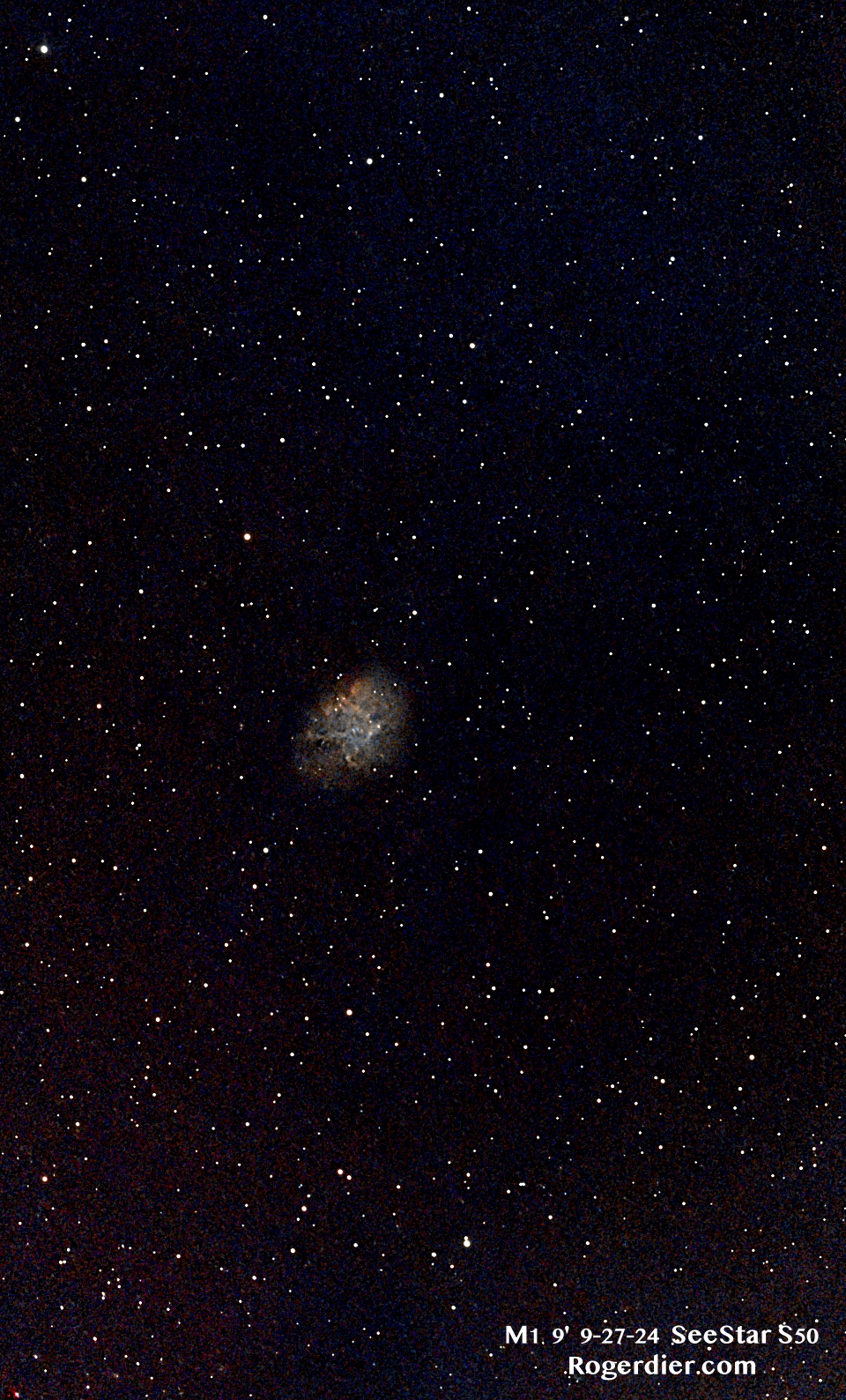
Last week, while waiting to see the comet of the century, which, rogerdier.com has learned, really does exist, I took a picture of M1, the famous Crab Nebula.
M1 is famous for a number of reasons. We’re pretty sure the explosion that gave Charles Messier the first item in his catalog of objects that resemble comets occurred in 1054. Sky watchers in Asia and the Middle East recorded its first appearance on July 4th. The supernova was a big and bright deal, reaching magnitude -6. The new star remained visible in the daytime sky for 23 days. It took almost two years for the mysterious star to disappear from the night sky as viewed by telescope-less humans. As nebula go, it’s still bright at magnitude 8.39.
FROM ZERO TO TEN LIGHT YEARS
The snapshots we take of the aftermath of supernova explosion reveal hydrogen gas plowing through the interstellar medium at 600 miles-per-second. It’s breathtaking speed. Extrapolated, the hydrogen leading the M1 explosion moves 36,000 miles per minute, 2.160 million miles per hour and 51.840 million miles in an Earth day. In the 970 years since that star blew up, M1’s gas entrails have stretched across 10 light years.
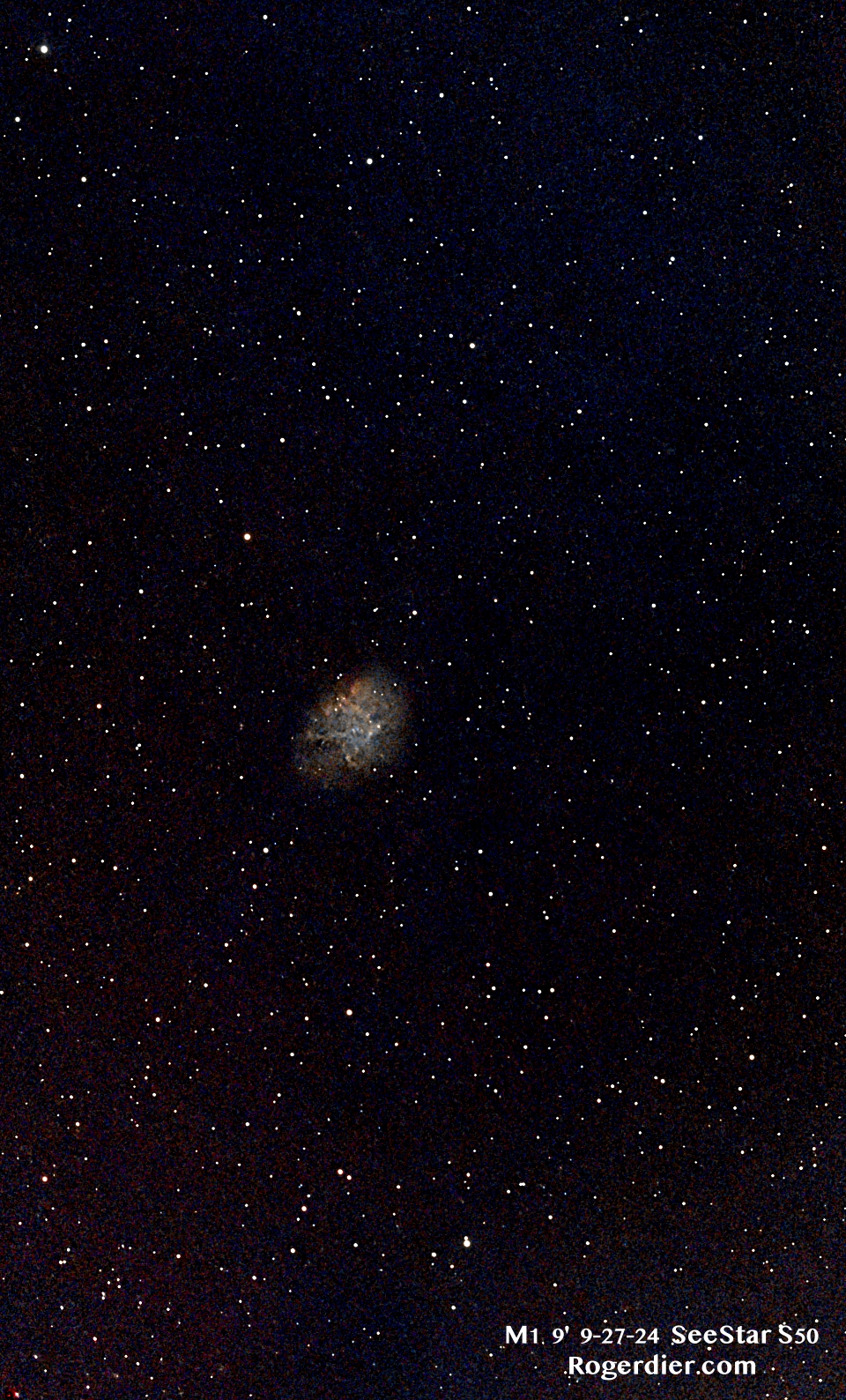
The supernova that created the Crab Nebula is one of the first recognized Pulsars, electromagnetic beasts—this one spins on its axis 30.2 times per second—and spews great gobs of toxic radiation and electromagnetic energy, enough, some astrophysicists believe, to wipe out all life on Earth had our planet been within 50 light years of that supernova. Happily, Earth escaped the pulsar’s radiation cook. There is an ocean of space 6,500 light years wide between us and the crabby one.
William Parsons, the 3rd Earl of Rosse, is credited for giving the Crab Nebula its forever nickname, but that credit is misplaced. Rosse first thought M1 was a cluster, but once he built a larger speculum-mirrored telescope, he changed his mind. Two fellows who observed with Rosse on occasion get credit for naming the Crab Nebula. John Pringle Nichol of Scotland, who had observed with the 3rd Earl at Birr Castle, was the first to put the nickname on paper. Another Earl visitor at Birr Castle, Thomas Romney Robinson, also wrote that the nebula had “streams running out like claws in every direction.” A few years after his colleagues dubbed it the Crab Nebula, Rosse began referring to the supernova remnant the same way, so his Lordship gave a kind of royal endorsement to the name. Yep, it’s good to be an Earl in the Monarchy.
PIXINSIGHT POWER
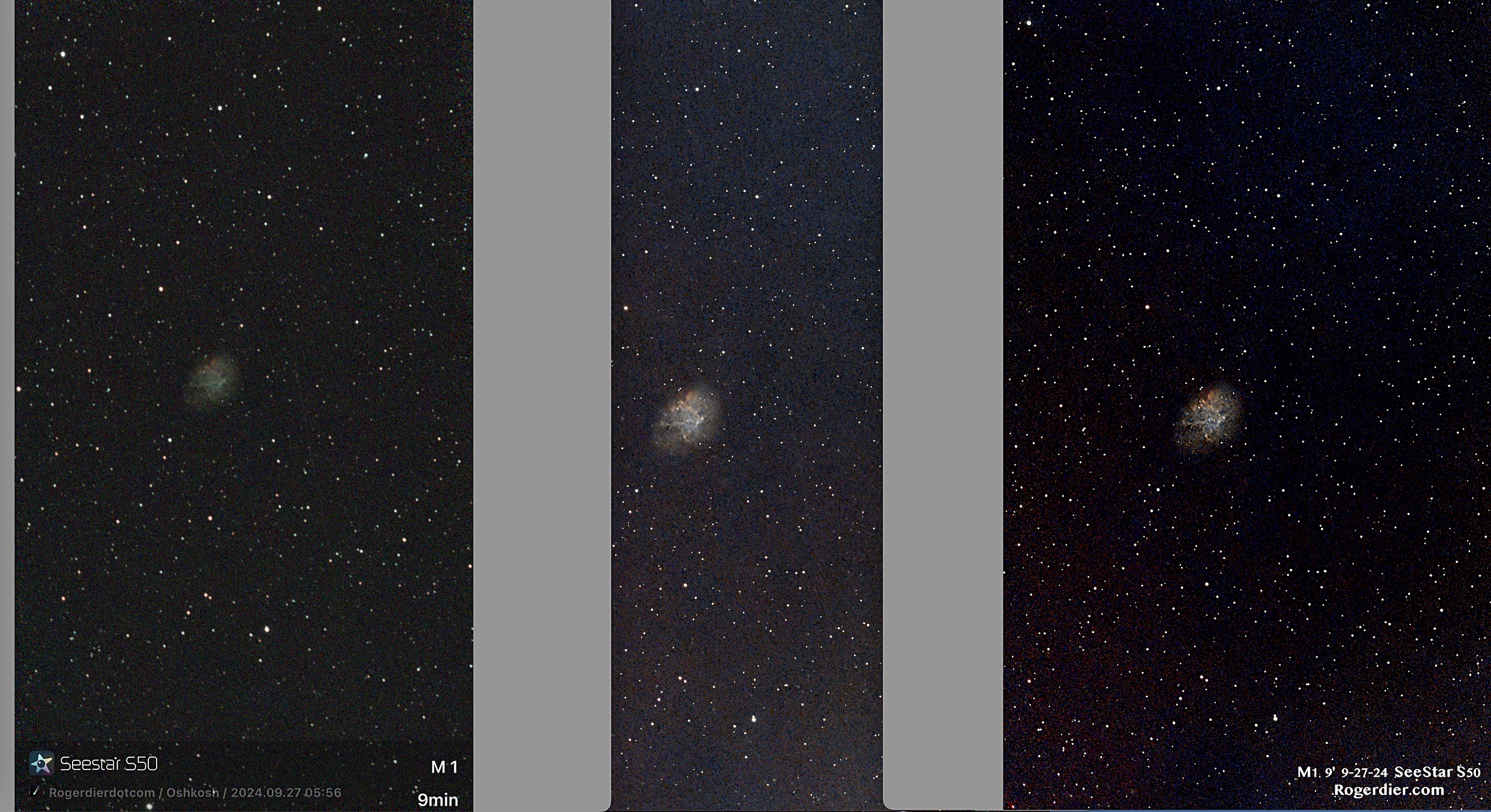
In previous posts, I mentioned how well PixInsight works at dressing up SeeStar S50 images. The three M1 images shown are made from the same SeeStar’s 9-minute, 54-frame shoot. The one on the left is the raw SeeStar stack, the one in the middle has rudimentary touch up, and the one on the right is PixInsight’s Full Monty.
The combination of PixInsight with the closed-loop optics of SeeStar saved this astronomical soul. Once upon a time, living in a Bortle 6 zone was depressing. Though data shows that more light invites more crime, communities with high Bortle numbers spread lumens of light skyward to make themselves feel safe on Earth. If undaunted astronomers wish to actually observe in those environments, prepare to punch in credit card info: High-end light pollution filters, telescopes, eyepieces and star-tracking mounts to darken the sky for observational or photographic astronomy are not cheap. If they want to flee the light for a darker night, there is the time, distance and driving risk to get there and return safely.
MOTHERS GOT MADD
The driving risk is real. Back in my Minnesota days when Mothers Against Drunk Driving pushed for stronger enforcement, the state made mandatory traffic stops along highways and county roads to assess whether drivers were impaired. The program survived about six weeks before the courts shut it down. But the data collected during the stop-and-test program revealed that at any moment over the course of an average day, six percent of drivers exceeded the state’s .08 blood-alcohol limit. Six percent were drunk. Rounding down, it means one in 20 cars on our roads has a drunk driver at the wheel. It’s a sobering number that tends to stick in the mind.
THE HIDDEN GALAXY
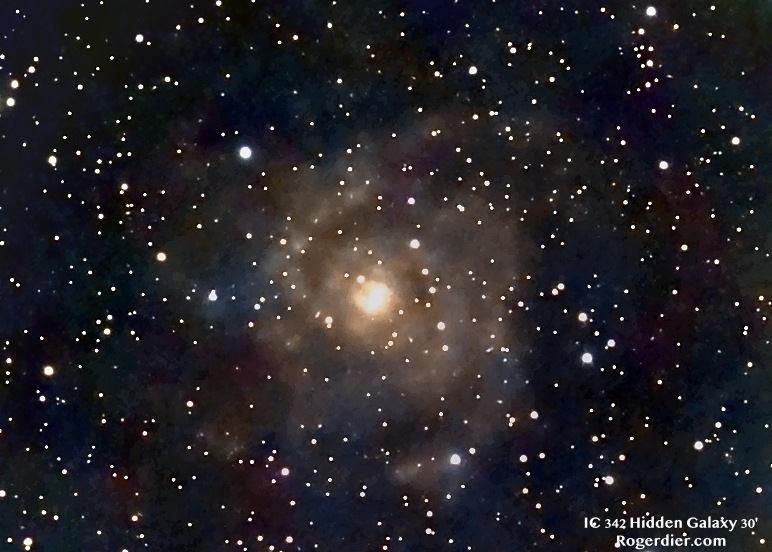
One night last week, I ran the gauntlet of knowing that some of the drivers coming in the opposite direction were drunk and drove west of Oshkosh to get a better picture of IC 342, better known as the Hidden Galaxy. IC 342 is 10 million light years distant and because it is close to the plane of our galaxy, there’s a lot of goop between us and it. The Hidden Galaxy hides in Camelopardalis. Getting out from under the Oshkosh light dome helped the SeeStar’s image quality. The distinct semi-barred arms show up; they were not as pronounced when the SeeStar shot it from our Oshkosh neighborhood a month ago. This 30-minute exposure shows why the Hidden Galaxy is a tweener: barred and not barred. According to astrophotographer Gábor Tóth, “The Hidden Galaxy’s morphological classification is SAB (rs)cd. The code means it is an intermediate spiral galaxy being between non-barred and barred states (SAB), the next part (rs) refers to a galaxy in transition between not-having and having ring-like structures.”
THE DOUBLE CLUSTER
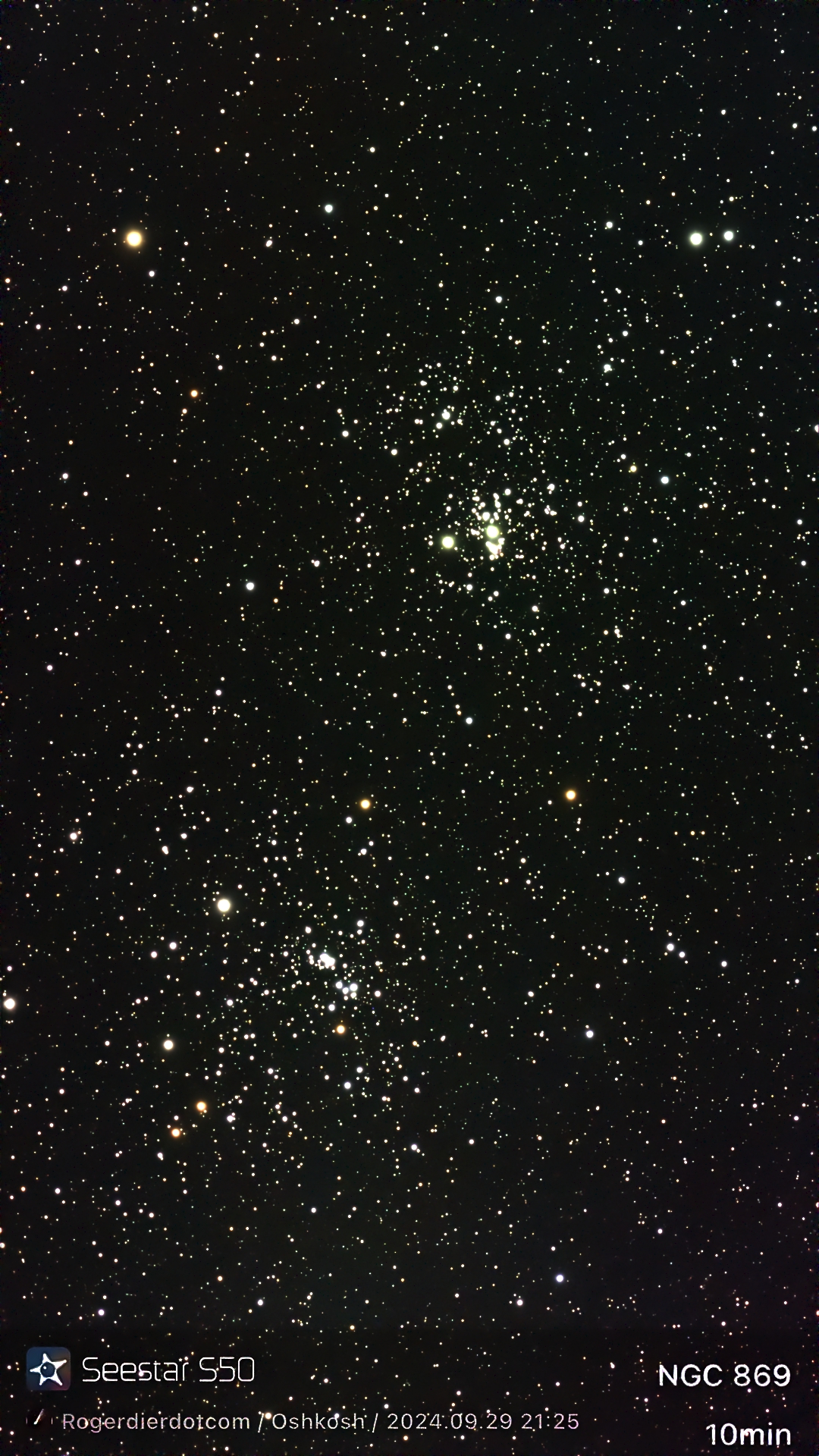
The California Nebula aside, Perseus is known primarily for its meteor shower, which peaks between Aug. 10-12, and the Double Cluster, whose main components are NGCs 869 and 884. Also known as Caldwell 14, the Double Cluster is young—12.8 million years old—about one-tenth the age of the Pleiades, which is estimated to be between 75 million to 150 million years old. I shot this photo from our yard a few nights ago during an evening of above-average transparency. Cluster 869 is the more populated group, with 4,700 stars, about 1,000 more stars than its sister cluster 844. There are some big blue-white boppers in each gathering, on their way out of the clusters to claim their territories like bright young lions brimming with dominance.
This cluster was visible to the ancients, though not as identifiable as a cluster. The Greek Hipparchus noted it as a cloudy spot in 130 BC. Undoubtedly Arabs, First Nation tribes of North and South America and Asians who paid attention to the night sky also found the Double Cluster area to be different from all the rest of that section of the Milky Way. It was William Herschel who first identified Hipparchus’ cloud as separate clusters.
There is symmetry in the double cluster and the famous meteor shower which annually streams from Perseus. The double cluster is really close to the radiant of that Perseid Meteor Shower, so the double cluster is really a Three-fer: Two clusters and one radiant.
NGC 957
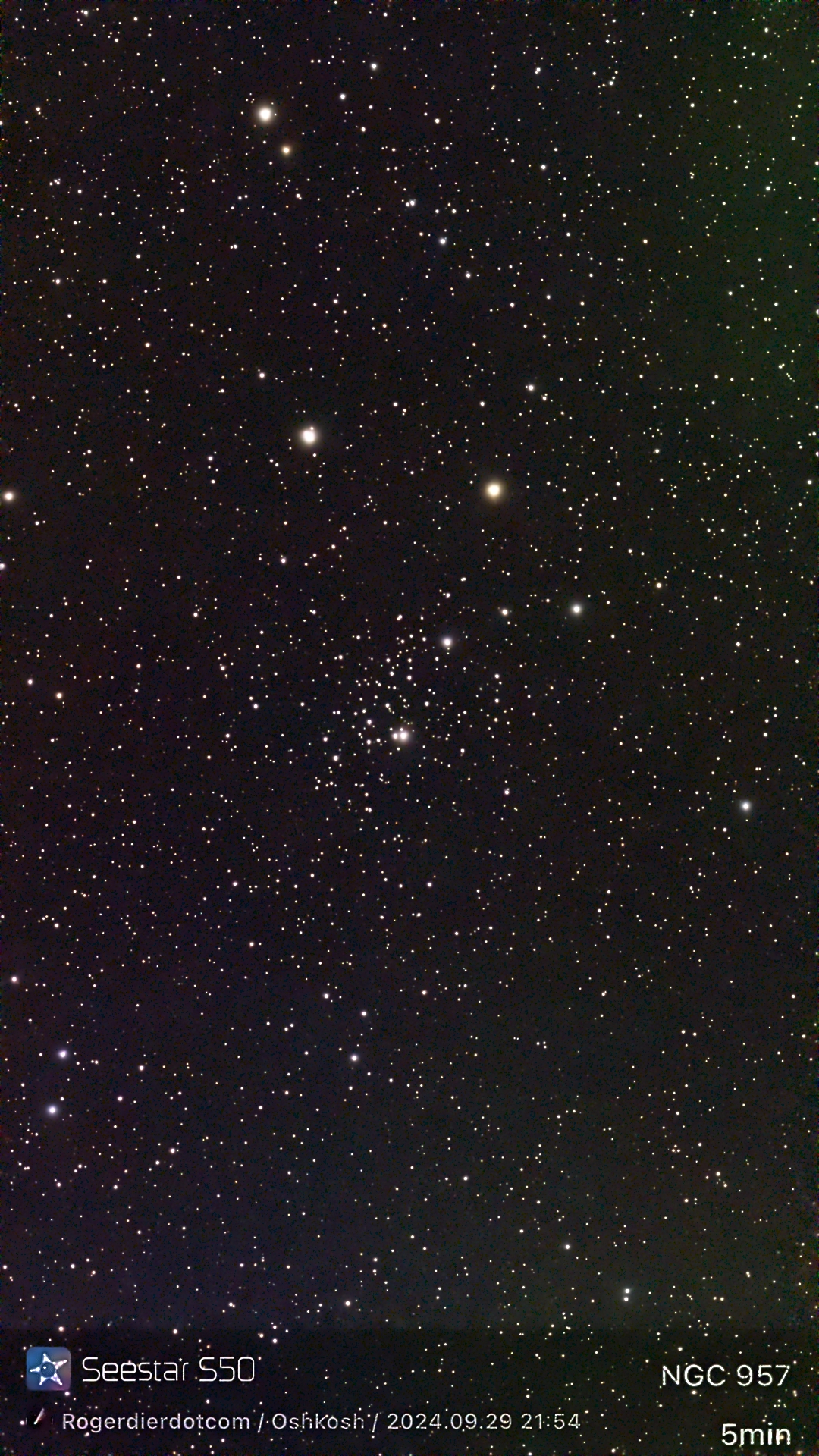
One evening last week, I planted a chair next to our home and stumbled upon this small neighbor of the Double Cluster. It’s a sparsely populated outpost on the Perseus open cluster highway, kind of like a small town along a Wisconsin road: A filling station with one rusty pump, a few tired homes, and two taverns—one called the Gabe’s Tap and the other Lucky’s. A young cluster whose estimated age is between four and 11 million years old, NGC 957 is 5,920 light years from Earth, roughly 1,500 light years closer than the big double cluster to its south. The brighter stars in the photo’s field are not actually members of the roughly 100 stars that are physical members.
Below is research linked to the supernova of 1054. Thank you for reading and a special thank you for the readers who subscribed (for free) this week. It’s easy to do, just head for the bottom of the page on your iPad or Desktop. Here’s to your health and the good health of the people you care about.
–Roger Dier
It was thought that First Nation tribes in the southwest of North America memorialized that event with drawings on the walls of caves. Now, we’re not so sure that they did. J.C. Brandt (NASA) and R.A. Williamson (St. John’s College) published a richly detailed abstract at Harvard about these drawings. 1979JHAS___10____1B.pdf
On Jan. 16, 2014, Clara Moskowitz, writing on Scientific American’s blog site, wrote that what was depicted on two of those cave sites were not what we thought they were. https://www.scientificamerican.com/blog/observations/e28098supernovae28099-cave-art-myth-debunked/
The App SkySafariPlus claims that First Nation tribes of the North American Southwest depicted the 1054 supernova on cave wall drawings, but that has been debunked. I’m surprised the SkySafari writers haven’t corrected that.
In the narrative about the origins of the Crab Nebula name, I leaned on information found at this site: http://www.ianridpath.com/startales/rosse-crab.html.
For more information and photographs by Gabor Toth, visit https://astro.i-net.hu/content/hidden-galaxy-ic-342
 Cosmic
3 responses to “Who Really Named the Crab Nebula?”
A nice collection of images, Roger. I like your colourful rendition of M1. I reckon Charles Messier would be gobsmacked by it.
LikeLiked by 1 person
Thank you, Roger. Are you able to view the goodies of Perseus from your location in the southern hemisphere? I read this circumpolar constellation in the northern latitudes is a nonstarter for observers in the Down Under neighborhood.
LikeLike
Hi Roger
About 90% of Perseus rises above my theoretical Northern horizon. The California Nebula reaches an altitude of about 18º, so viewing from my location, through the Sydney light dome, is possible but not very rewarding.
🙃
LikeLike