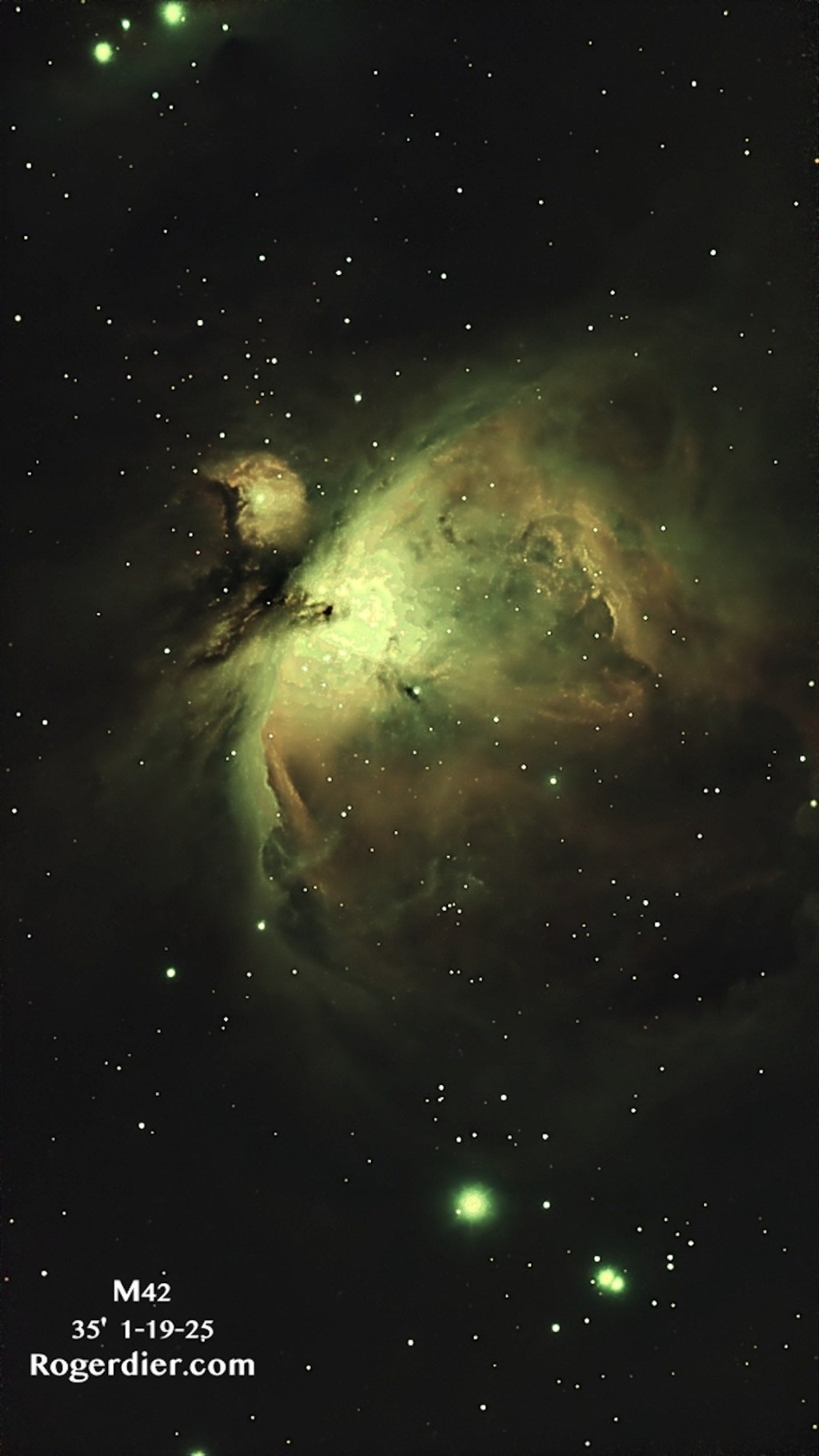
Your intrepid astronomer visits more than a few astronomy sites during his infrequent online trekking. This time of year, nearly everyone who photographs the night sky has proof that they have visited popular winter sky tourists stops. Many of the modern amateur portraits are stunning. Equivalent to the American Grand Canyon, Yellowstone National Park or a Disney Theme park (pick one) is the great Orion Nebula M42. The smudge is visible to the naked eye even in moderately bright skies. Point a SeeStar at the stellar nursery like M42, pile up 10-second long exposures (the featured portrait has 35-minutes worth of stacked images), add a little Pixinsight processing, RC-Astro XTerminator software, which wipes out atmospheric noise and reduces star size, and garnish with a SetiAstro function to reduce star halos and behold: A miracle 1,350 light years away appears.
Mosaic Mode
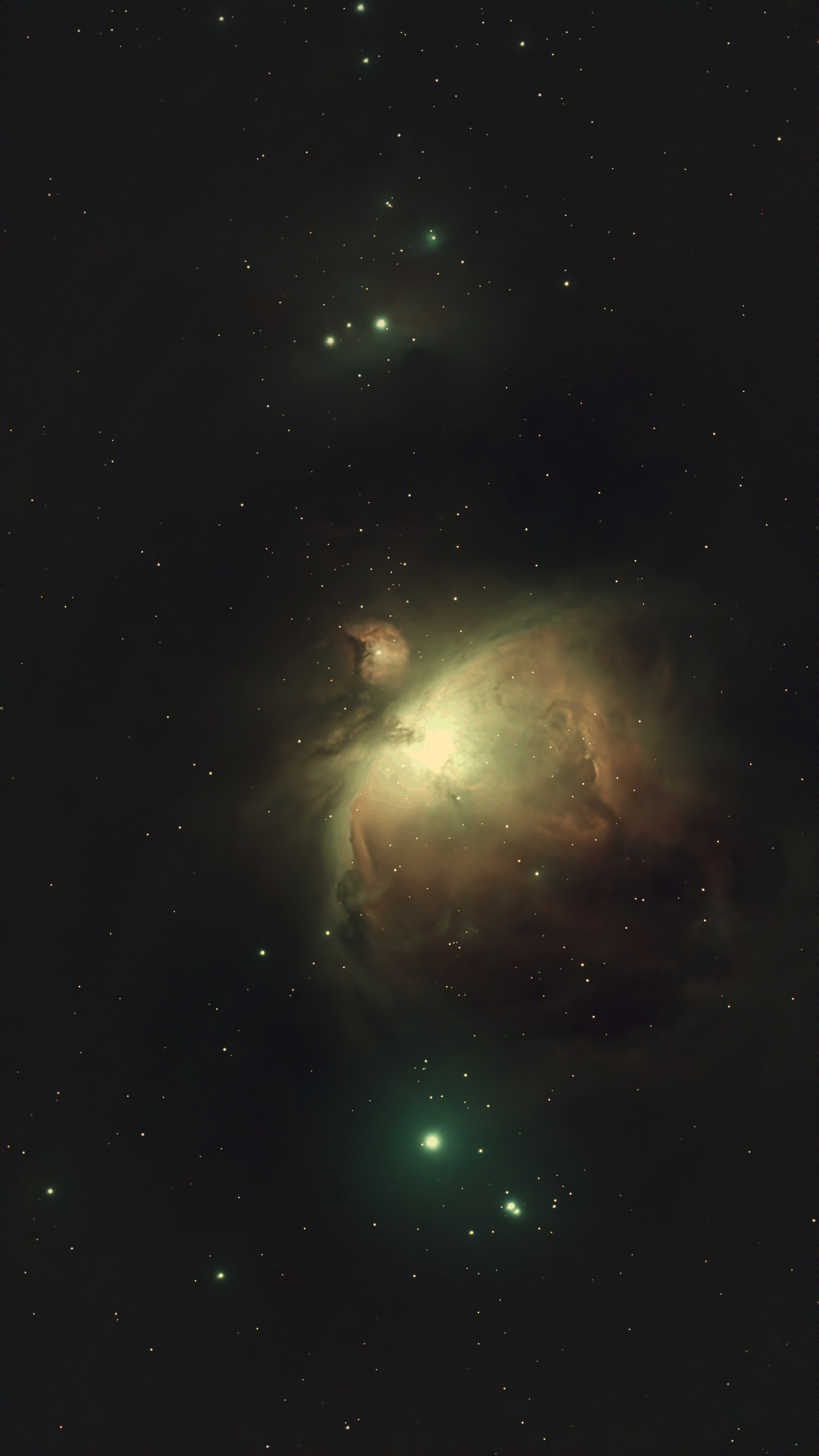
A few months ago, ZWO, which makes the SeeStar S50 and a number of excellent astronomy products, uploaded new software to S50 customers which allows enthusiasts to take pictures of bigger pieces of the night sky. In early January, I took a wide-angle picture of M42 and compared with the field of view in standard S50 shots (about 1.25 degrees high and ,75 degrees wide), the field of view widens but the detail is a little lacking.
I’ve seen some Mosaic mode shots that are just stunning, and the Mosaic Mode photo here was affected on the night of Jan. 3, 2025 by turbulence and moisture. Plus the exposure is not as long. When in Mosaic Mode, the camera is shooting a larger area of the sky, and it must account for the moving dome overhead as the stars rotate around the northern axis of earth in a general east to west direction. So the S50 is doing a lot more work and it takes more time to align 10-second exposures. Many of those exposures are discarded by the software because, like a lot of things in human life, they don’t align correctly.
How Far is Far?
The other day, flipping through YouTube posts, I came across a short ditty posted by a fellow named RichardB1983. To demonstrate how far away the nearest star is from our lovely little sun, RichardB1983 went on a lengthy boat and car ride, starting presumably in the United Kingdom and ending up in Spain. The nearest star to Earth is Proxima Centauri, a red dwarf with the mass of about 12.5% that of the sun and 14% of the sun’s diameter. At 4.25 light years away, it’s as next door as next door gets in our part of the cosmos. At the end of this post, RichardB1983’s demo is worth five minutes of your time. When we toss around light year distances like they were recreational discs, it’s easy to forget some of the things astronomers are seeing and photographing are beyond far.
Eridanus the River
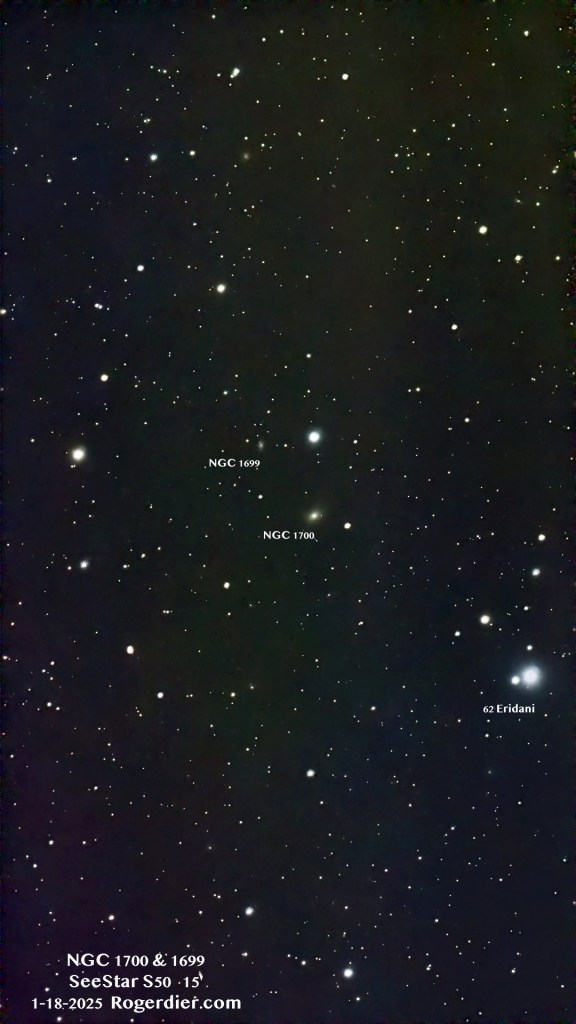
Off the beaten trail of the tourist site M42 is the constellation of Eridanus the River. The galaxy NGC 1700 piqued my curiosity on the windy night of Jan. 18, 2025. It’s way out there,180 million light years from our own galaxy. I took a 15-minute exposure with my little SeeStar S50, and NGC 1700 comes off as a boxy diffused smudge. The current thinking is that three billion years ago, NGC 1700 was actually two galaxies that merged, and the merger is ongoing. Classified as elliptical, the Chandra instrument in 2002 took an X-ray of the area and discovered NGC 1700 sits at the center of a rotating caldron of hot gas. At magnitude 11.2, you’d need a six-inch glass to find it visually. That and a dark sky.
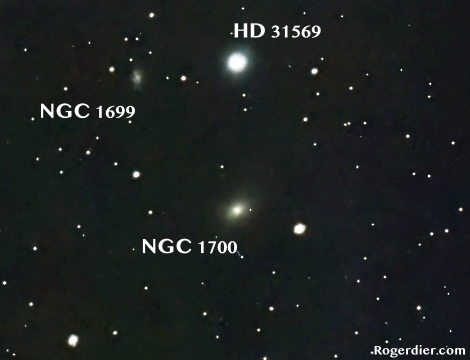
Nearby is NGC 1699, a spiral galaxy that is much fainter at magnitude 13.9. In the cropped version, the spiral shape is apparent. William Parsons first cataloged NGC 1699 on the evening of Feb. 13, 1860. Like NGC 1700, it’s about 180 million light years distant.
This section of Eridanus is not far from the brilliant Orion beacon that is Rigel. I’d guess within five degrees, maybe less. In the wide-field shot, the brightest star in the large portrait is 62 Erandani, shining at magnitude 5.5, 62 Erandi is visible without optics in a lightless location. Binoculars are needed to see the double in the blue star system, which shines at magnitude 9.11. It’s a hot pair. If our sun has a luminosity of 1.0, 62 Erandani is significantly hotter, cooking at 574.89. Unlike the two aforementioned galaxies, 62 Erandani is much closer to Earth—a mere 741 light years away.
I See, You See IC 434
The Flame and Horsehead nebulae are must-see tourist stops in Orion. The familiar Horsehead silhouette is often seen in elementary school books on astronomy. The image pictured here is one of my longer SeeStar exposures; there are 3,300 seconds of photos piled up. Do the math and it comes to 55 minutes of light falling on the SeeStar S50’s Sony sensors.
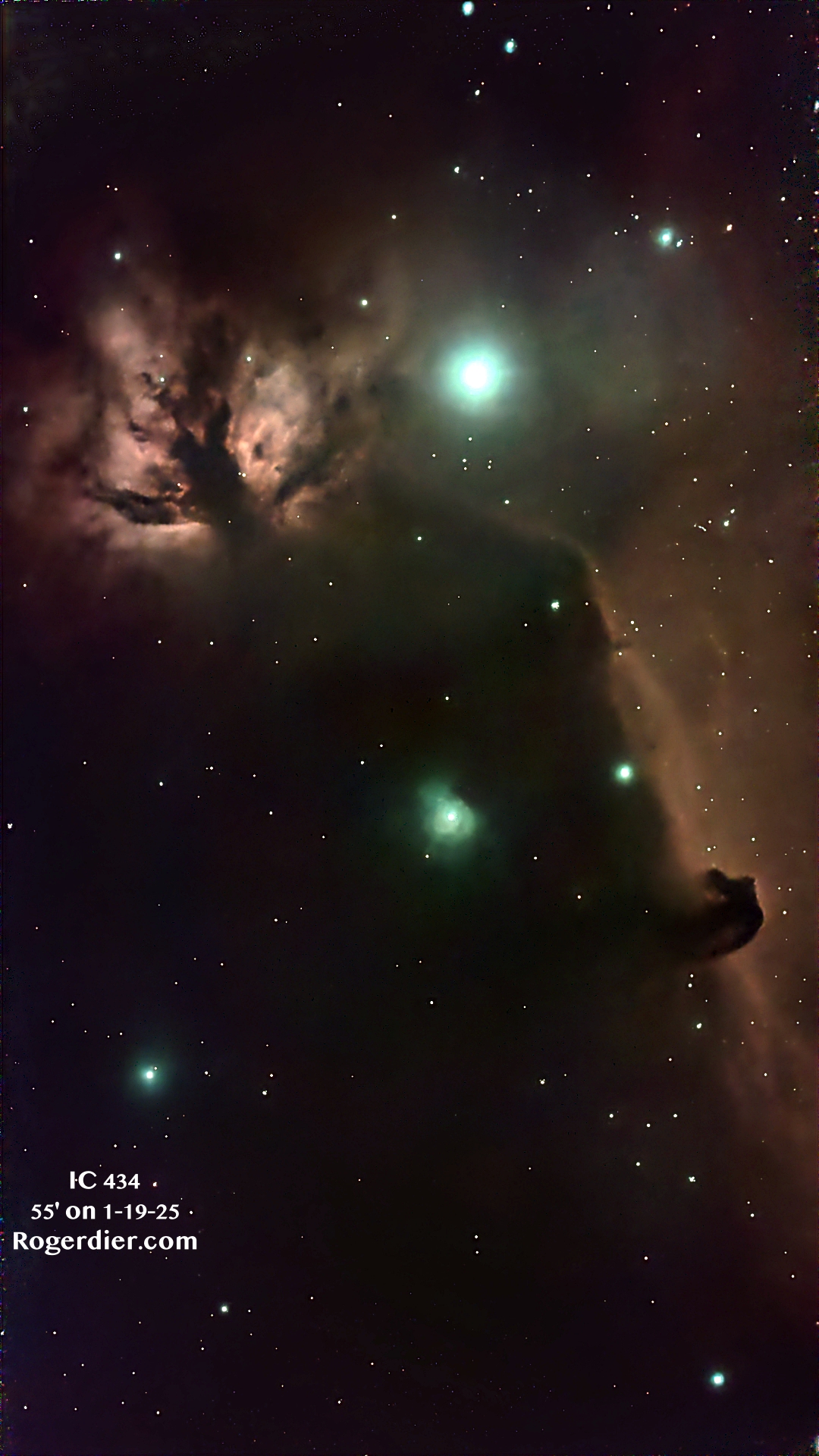
The image arrived on a night that was colder than a well digger’s lunch. Bitter stuff, minus 6 with gusts up to 15 mph. I took it while laying on our couch watching a Buffalo Bills vs Baltimore Ravens playoff game on Sunday evening. How is that possible? I braved the elements to set up and calibrate the SeeStar, asked it to lock in on the Horsehead Nebula, manually adjusted the frame to include the Flame Nebula in the field, then scurried back into my house, quickly shed my winter gear, climbed on the couch and placed my iPhone 15 on the edge of the window, where it easily picked up the SeeStar’s Wifi signal. Every so often I’d check the screen of the iPhone to see how the shot was progressing. Easy peasy.
During the Horsehead shot, Michelina asked me if I was worried that someone would steal the telescope, which was heroically shooting pictures outside of the window in icy air. I said it was possible, but on hard winter nights like that night, there’s not a lot of riffraff walking around searching for trouble.
Thank you for reading this edition of Cosmic. If you are reading on a pad or desktop, scroll down and subscribe for free.
Here’s RichardB1983’s short Youtube video: https://youtu.be/vcJHHU9upyE?si=v04n6Rdo4KECPwvt
 Cosmic
6 responses to “Tourist Stops in the Winter Night Sky”
No matter how much star gazing I’ve done, I always come back to Orion. The entire region in around it is just mind blowing. Thanks.
LikeLike
Hello Williameabian,
Isn’t Orion impressive, both with the unaided eye and via optics? There’s so much inside the Big Guy. i never tire of spending time admiring all that constellation has to offer. Along with Scorpio, Gemini and maybe Cygnus, Orion actually looks like the character the ancients thought it to be. Thank you for reading and sharing your thoughts.
LikeLike
Hi Roger, great to see another of your posts. Your descriptions are helping me to understand how the Seestar functions. I now know that it discards sub-standard sub-frames, which is similar to the SharpCap software which I use. I could tell it to keep them but there is no point in doing so if it has interference from satellites, aircraft, clouds etc.
The automated mosaic function of the Seestar is interesting. I’ve only dabbled with mosaics of the Small Magellanic Cloud and need to give it another go.
As for taking images while inside the house, if I owned one I would set it up out the back where it is more secure and set it to run until the target dropped too low. I’d then go to bed and fall asleep watching the image forming. (Then I’d probably wake up in the morning and find some bird has crapped all over the lens).
With my more cumbersome telescope, I have it mounted on wheels and can only roll it out onto the front driveway. I am always wary that someone might interfere with it but I rope off the access and never spend more than a few minutes indoors. However, like you I see no unwelcome visitors in the street during the evening, other than some neighbours coming and going. Everyone’s probably indoors watching their movies at that time.
LikeLike
Hi Rog,
Nice to hear from you. When I think back to all those known and unknown astronomers had to endure to look at the night sky telescopically, sometimes in freezing conditions, and some of the crude rigs they sometimes had to invent to snap a crummy picture of what they were seeing, I feel a little guilty sometimes at how liberating the SeeStar is, and how easy it is to operate. But being taking pictures inside a warm house when it’s -5 or -10 below Fahrenheit is a quick decision. The sky dictates when we can play under it, does it not? We have to go snag the stars when the moon isn’t around the area we’re photographing, and most importantly, when the sky is clear and those rivers of air in our atmosphere are quiet.
We live in a corner lot in a nice neighborhood. I have just started leaving the camera running outdoors while I’m indoors. But I have security cams covering all sides of the house so if anyone grabs it they won’t be anonymous for long. Really great to hear from you, Roger. I’ll look at your pages tomorrow. It’s almost Midnight here.
LikeLiked by 1 person
Hi again Roger,
How easy is it to get your Star Adventurer tracking mount to align with the south polar axis? I saw your set up in your driveway in the shot featuring Venus above the horizon. The challenge I have here, and you may have there, is that trees and our home block huge chunks of the sky. I set up to the south of our house; I have a fairly good view of 2/3 of the southern horizon. It’s the only area I can shoot. If an unimpeded view of the sky dome is 100 percent, I probably have access to 25% of it. We work with what we have, right?
LikeLike
At home I lose some regions of the sky but what I do lose becomes visible at another date or time, so one way or another I get a good view (through the murk). My view of the SCP is unobstructed.
I bought the Star Adventurer ten years ago and struggled with polar aligning it. Our “pole star” is not close enough to the SCP and is only a dim magnitude +5.5. So I put the SA on pause and concentrated on my telescope activities for a few years.
By the time I went back to the SA last year, I had developed very accurate polar alignment on my telescope, first using PoleMaster, then moving on to SharpCap. So I decided to include SharpCap in my Star Adventurer setup, using my otherwise redundant PoleMaster camera and I am getting decent alignment with this method.
My main use for the SA is to take to observing nights with the Society. I don’t want to dismantle my telescope, so taking the SA to a dark sky site is a good option for me – and the sky is unobstructed. However, our observing sessions are usually cancelled due to poor conditions, as happened this weekend, so I’m not using the SA very much!
LikeLike