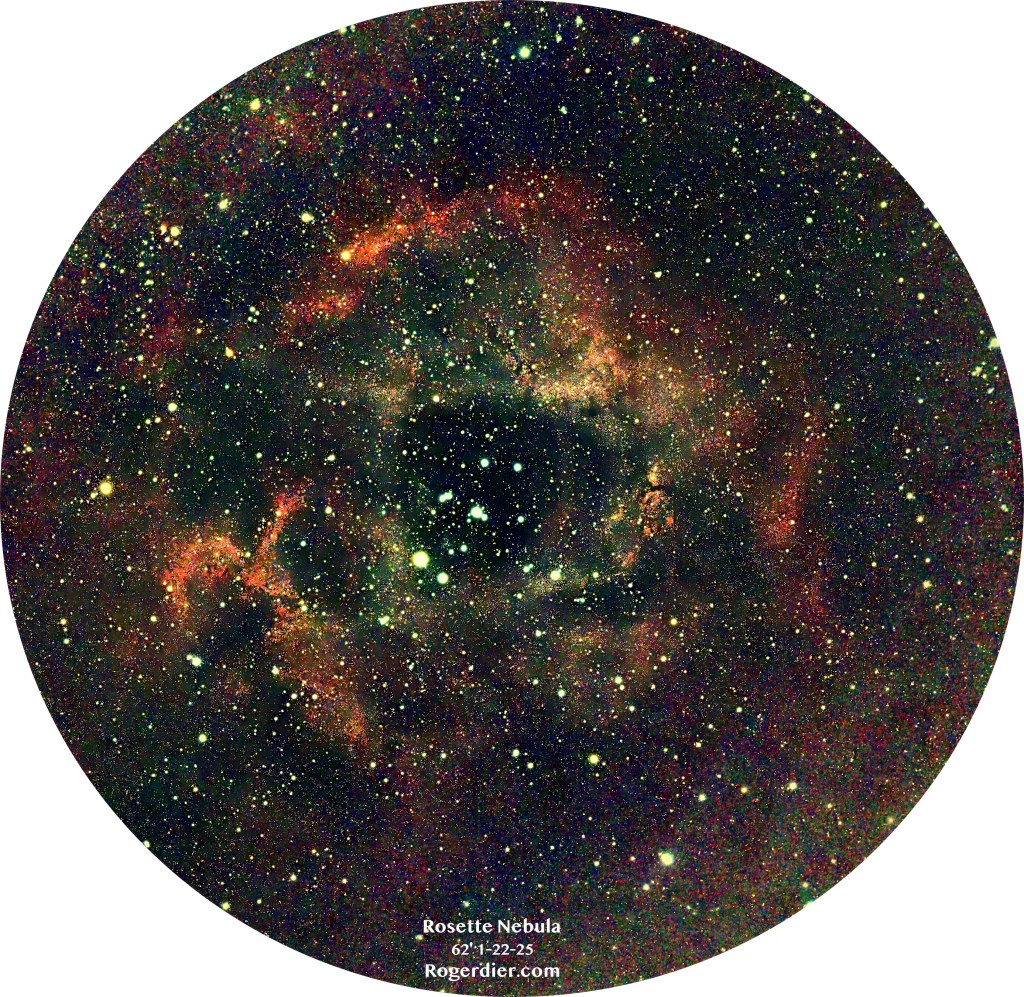
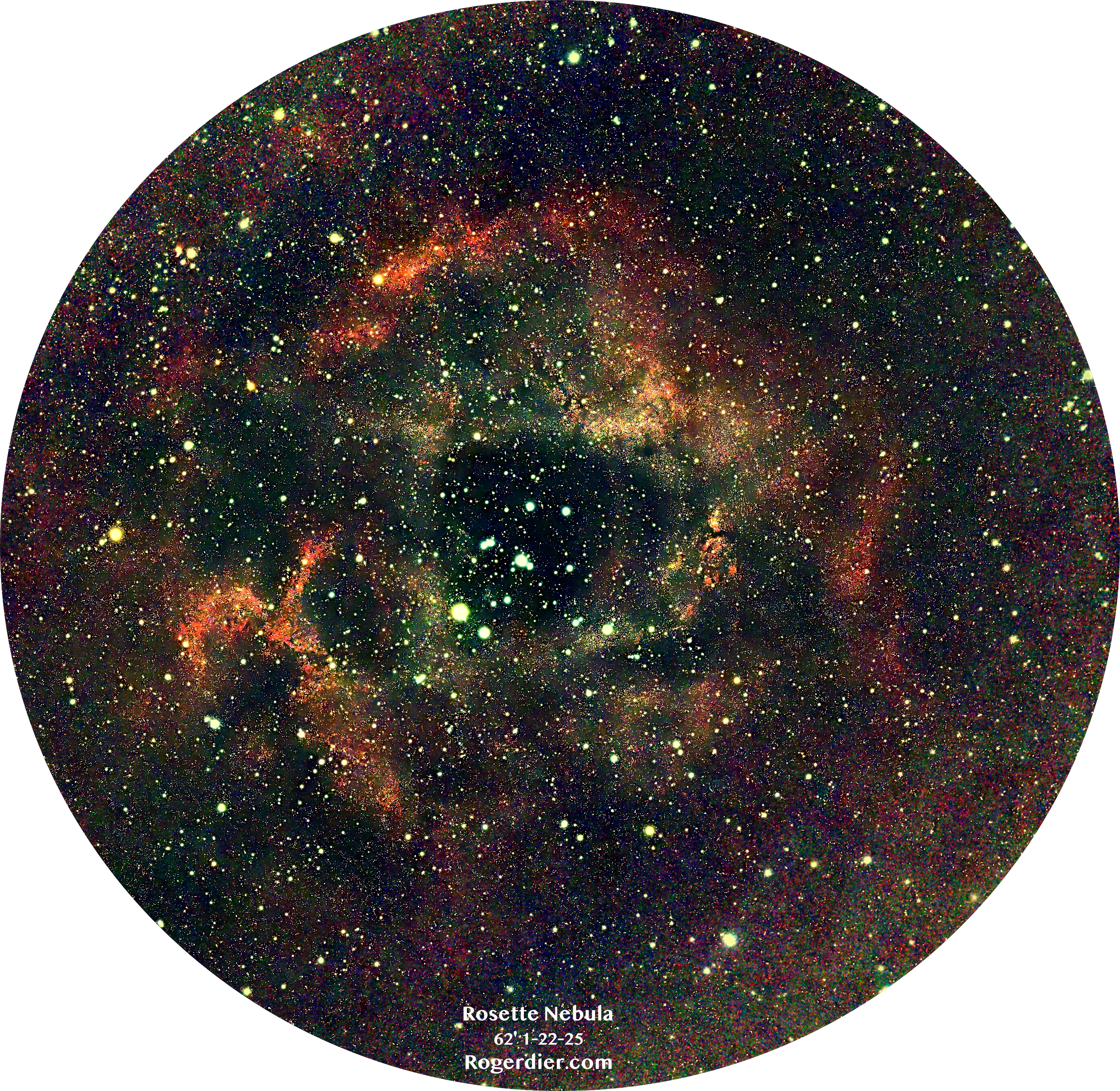
On a recent night that would chill emperor penguins of the Antarctic, the little wonder-scope that is the SeeStar S50 stood outside our frosty family room window and went to work. Grinding away in minus 8 Fahrenheit temperatures, the S50 with its modest two-inch triple lens spent about two hours photographing the sky in a wider-than-normal circular pattern. The object of its sensors? The Rosette nebula in the dim, forgettable rest stop of a constellation called Monoceros.
The ancients didn’t recognize Monceros as a constellation. The 17th century cartographer Petrus Plancius first slapped it on a sky chart around the time Galileo was sending shock waves around the world with news of what he was seeing through his two-inch spyglass. Monoceros is Greek. It means unicorn. On we go.
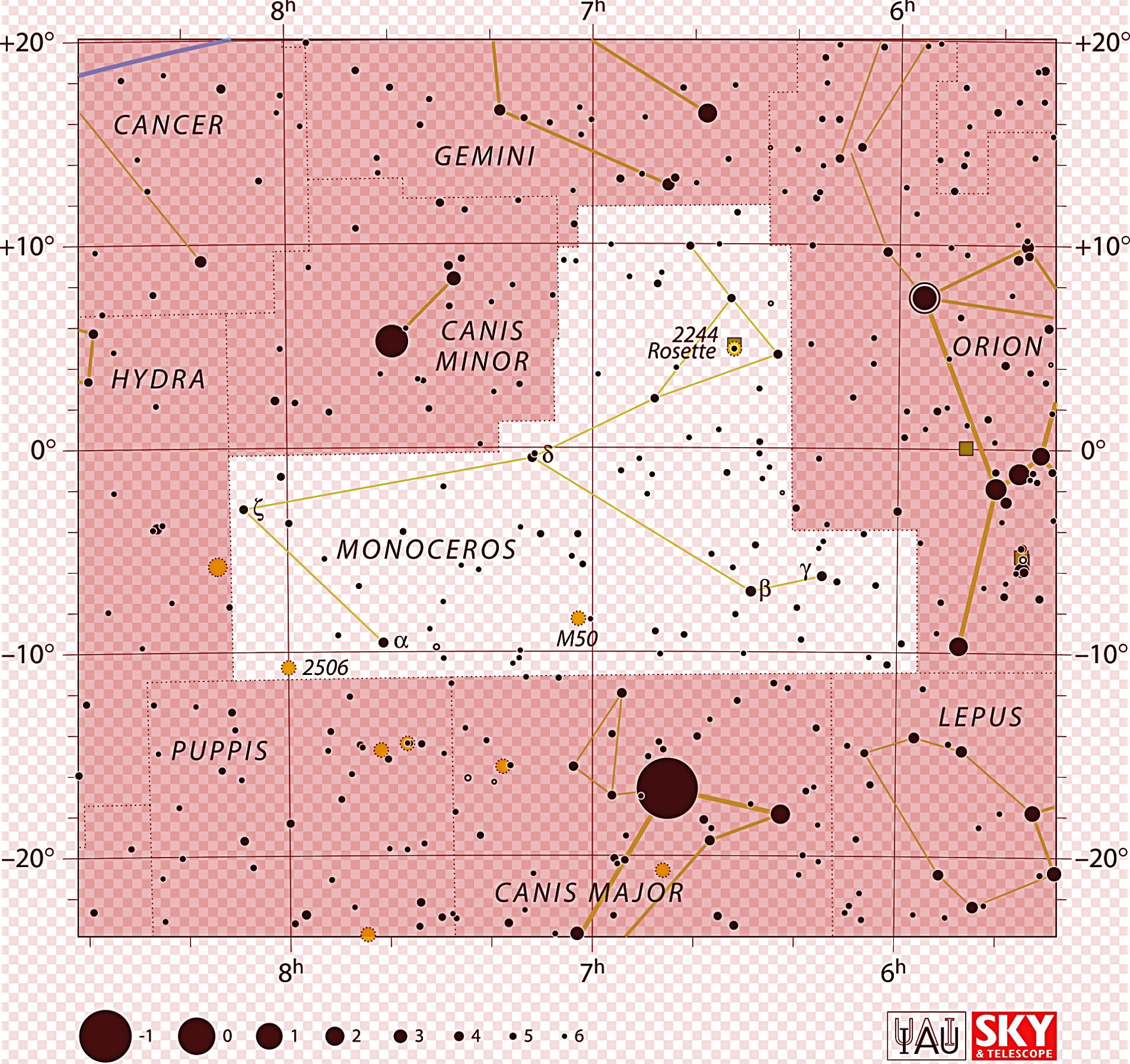
How visually nondescript is the group of suns? There are no stars in Monoceros brighter than 4th magnitude. Ok, technically, Alpha (magnitude 3.93), Gamma (3.98) and the multiple star system Beta (3.76) are brighter than the 4th magnitude, but they have not wrapped themselves in stellar glory. I live under a Bortle 6 light dome. From my yard with these eyes, there’s nothing where Monoceros is supposed to be. It’s a blank area of the east of Orion, south of Gemini, north of Canis Major and west of equally dim Hydra.
BORING BUT INTERESTING
Being in the middle of the celestial equator, however, Monoceros has the goodies. It’s home to numerous open clusters, a black hole, about a dozen exo-planets, variable stars, a pair of weak meteor showers, a recent supernova, multiple stars and the famous Rosette Nebula, a dim 7th to 8th magnitude halo of gas and dust that is 100 light years wide. Telescopes had been around for more than 250 years before the Rosette was first noticed, sort of simultaneously by Lewis Swift and Edward Emerson Barnard in the early 1880s.
The Rosette is a favorite “get” of amateurs, so on the night of the 19th, a bitterly cold beast, I placed the S50 outside a window in the family room, did all the aligning and leveling, ordered the telescope to find NGC 2244, an open cluster at the heart of the Rose. Once there, I switched to mosaic mode, plotting the field of view with my index finger, hoping it was large enough to grab all of the Rosette. I watched the first images stack on my iPhone. Convinced the SeeStar was honed in, I sprinted around the house and back into our family room, hoping not to break the Wifi connection between SeeStar and iPhone.
180 MINUTES LATER
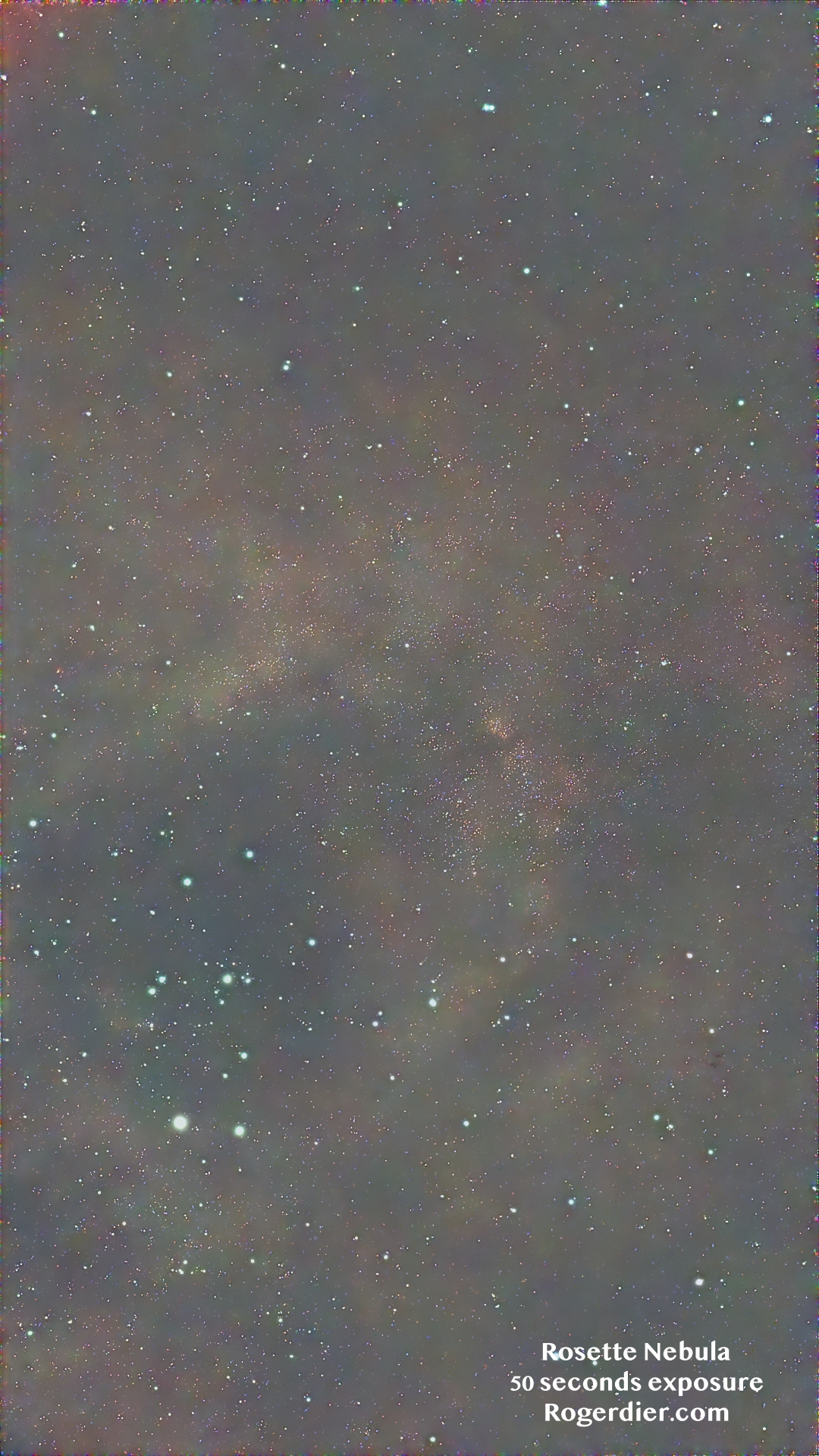
Watching an NFL game and periodically checking the deepening Rosette image on my iPhone was easy astronomy. My SeeStar battery held up fairly well in the cold, draining from 85% down to around 30% when I went outside to shut it down. Cradling my now sleeping frozen SeeStar baby back into the house, I went into my iPhone photos hoping to see the 63 minutes worth of aligned photos the SeeStar I had seen accumulate. All I had was a lame exposure of 50 seconds worth of a part of the Rosette nebula. It was barely perceptible. WTF?
The next day, a Monday, I transferred all of the subs of the Rosette from the previous night from the SeeStar to my photo app on my desktop. That tedium finished, I transferred the subs to a finicky old App called Starry Sky Stacker. It accepted 42 out of 300 plus subs and then froze. After three forced shutdowns of the App and nothing useable stacked, I retreated to my bed where I buried my face into a pillow and sobbed.
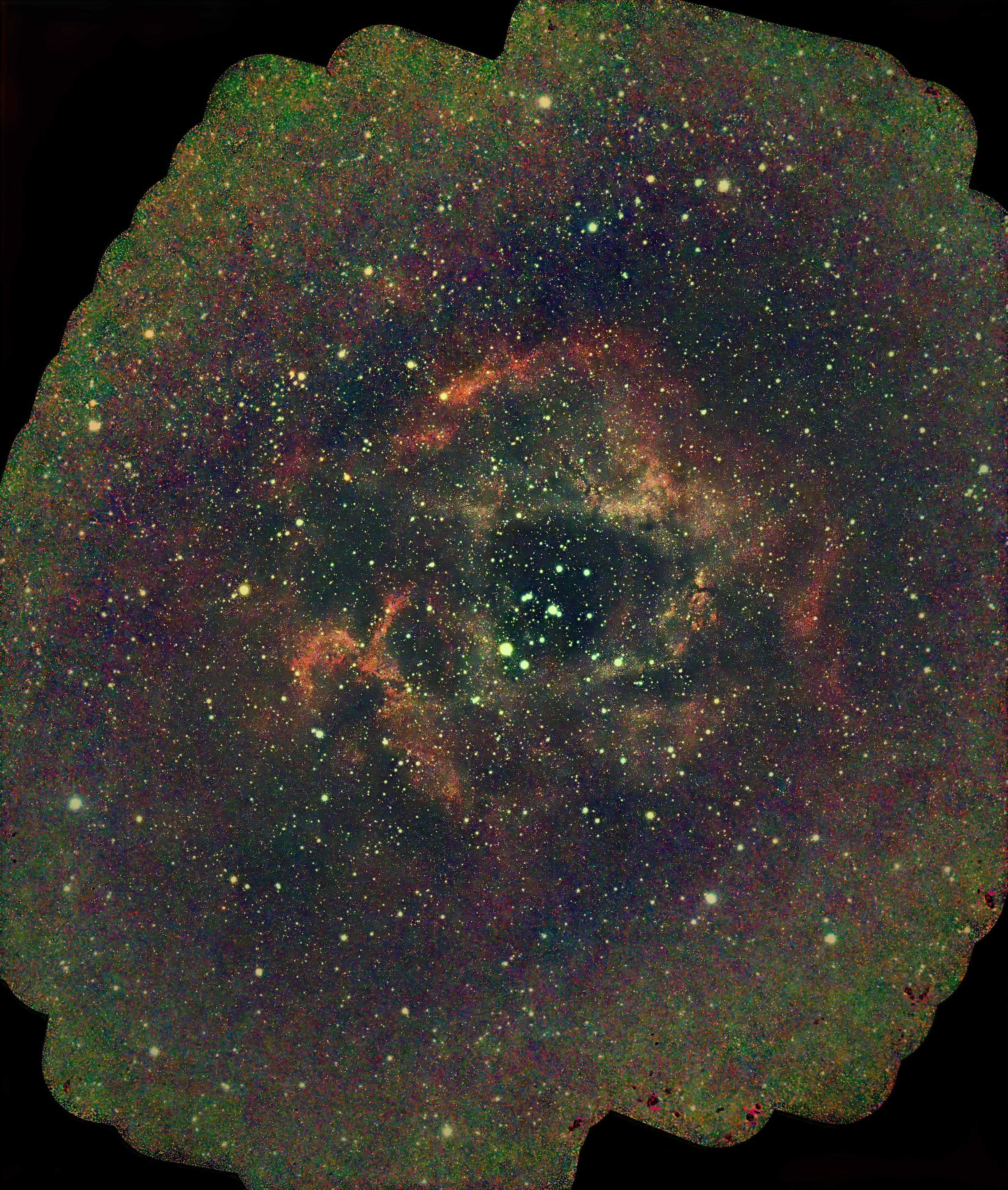
Not really. There’s a useful website thats populated by amateurs called Cloudynights.com. It’s been around for almost as long as there’s been an Internet. A SeeStar S50 forum flourishes on that site. There amateurs help amateurs understand what the S50 can do. During the week, my idling mind vaguely recalled past posts where one or more S50 users discussed how to get the SeeStar to stack subs (single frames of 10-second exposures). I didn’t know the A-B-Cs of how to make that happen, but I turned on the SeeStar and got into its memory where it stores all the subs. Long story short, once I found the cache of images from Sunday night, I was able to figure out how to delete the subs that looked icky and employ the good frames in a SeeStar-assembled image. It took about 20 minutes for the SeeStar App to arrange about 325 subs into the image that I lost a few nights before. Below is the recovered image right out of the SeeStar App and freshly washed in PixInsight.
SUPER HOT STELLAR NURSERY
NGC 2244 is at the center the nebula, and these hot young O-type stars, estimated to be only 4 million years old, have so much energy that they are creating a donut hole at the center of this massive cloud of gas and dust. One of these young stars is estimated to be 400,000 times brighter than our sun. What? Serious, ass-kicking energy. There is so much radiation and stellar wind from this cluster that hydrogen atoms are being stripped off and cooked red. The muscular stellar wind and radiation blowing off these energetic juvenile delinquents slams surrounding gas and dust together to create more new stars.
That’s the story behind this picture. Every astronomical picture we see from Earth or taken from a robot in space is an achievement of high human intelligence. The bodies we occupy, the air we breathe, the hearts that beat, our wondrous brains and the most mysterious parts of ourselves—our souls—originated in and from the cosmos. Whether we came to be by design or chaos, for us to understand on a primitive level the universe around us—as living beings made of starstuff—is a miracle. The cosmos created us to take selfies of itself.
Photo credit to Sky & Telescope for its map of Monoceros.
Until next time, thank you for reading.
 Cosmic
3 responses to “The Rosette Returns”
Hi Roger,
Some more questions about the Seestar:
It took 325 subs in total but how many subs were taken by the Seestar in each segment of the mosaic, before it moved to the next segment?
To what extent do the segments overlap?
To what extent are each of the above parameters programmable?
Finally, you mentioned that the Seestar battery dropped to 30% of capacity. The low capacity may have contributed to the loss of subs. Does Seestar have a power input option for either 12v DC or USB 5v DC?
LikeLike
Hi Roger,
How this works is that you arrive at a Night sky target. If you tell SeeStar you want to shoot NGC 2244, it will take you there. It may start shooting once it IDs the target, but you can interrupt the shot and expand the field of view by using a couple of finger tools on the screen of your phone or pad.
As the subs are taken and accepted, the large field the user has created is filled in with exposed images. Sometimes the subs are not accepted, and if a few 10 second exposures are not accepted, SeeStar informs you that they are misaligned. It often self-corrects the alignment and stacks the images every 12 to 15 seconds. There’s a couple of tricks I learned to help it correct if it can’t find its way, but that’s too detailed to go into here.
I’m sure there is overlap of subs on a mosaic field of view—there should be—it’s designed to stack images as it runs. I don’t know how that works precisely, but the longer the exposure on a mosaic portrait, the higher the quality of final image simply because there is more time for subs to accumulate and stack.
It was cold as a witch’s teat that night, and that helped the battery drain faster. On a simple image, some users report getting five hours on a single charge. That I went from about 80 percent to 30 percent in nearly three hours of shooting was better than I expected. ZWO designed the battery to recharge at least 500 times—I may be 1/10th of the way there. It can be run off a different power source, as the plug in connects to a regular outlet.
You the operator can determine what you shoot, the field of view, and how long you want to expose your camera to that object.
As I detailed in my story, a few days after I thought I lost the subs, I found them in a storage area in the scope/camera. I was able to eliminate the subs there were partially obstructed by three branches, etc. After that, once I manually asked it to re-create the image I thought I lost, the SeeStar had in its memory the FOV of the Rosette that I outlined last Sunday night.
I hope this has helped .
LikeLike
Good Monday Morning (where I am) Roger. Here is a link to an “Unofficial Wikipedia SeeStar S50” site that contains a lot of technical information that may be helpful to you. Copy and paste: https://unofficialseestar.wiki/doku.php?id=start&do=index
LikeLike