It’s October 1, 2025, and I have finished my latest book, “John Mayasich—Immigration Roots to Olympic Gold.” It should be available on Amazon.com in a few weeks. It’s a compelling story about a truly remarkable family and their Croatian immigrant parents who raised 11 children in northern Minnesota. One child, John Mayasich, absorbed everything important from his parents and went on to become the finest hockey player of his generation.
But let’s go farther back in time than pre- and post-World War II America.
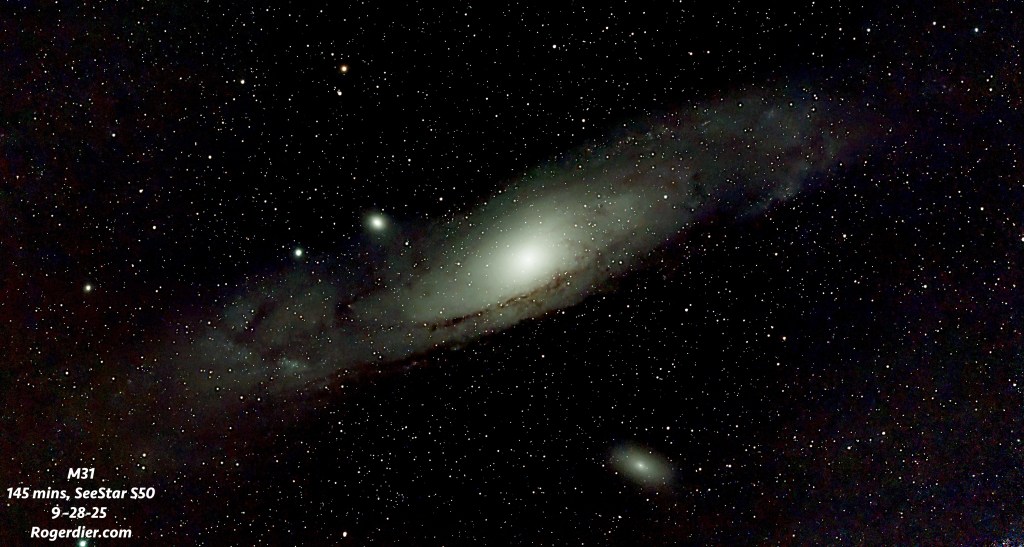
I was happy this past week to take to SeeStar S50 out to our driveway on the north side of the house and shoot the showpiece of the autumn sky, M31, also known by several other names, the most popular is the great Andromeda galaxy. M31 is the brightest of three galaxies within a small field of view, and at 2.5 million light years distant, it’s the farthest object the human eye can see without optical aid. If you live under extraordinarily dark skies, or travel to a black dome void of bright moonlight and artificial light, you can see M31 in the constellation of Andromeda. It shines at 3.4 magnitude. This time of year is when M31 absolutely ripens for observers and astrophotographers. M31 is delicious and it appears in the NE sky at sunset about 35 degrees above the horizon.
In 964 CE, a Persian astronomer, Abd al-Rahman al-Sufi, in his manuscript titled “Book of Fixed Stars,” was the first person to catalog M31. He wrote that it was “nebulous smear” and “a small cloud.” He pretty much nailed it. Charlie Messier came along in 1764 and made it the 31st object in his small catalog of night sky stuff that look like comets but really aren’t.
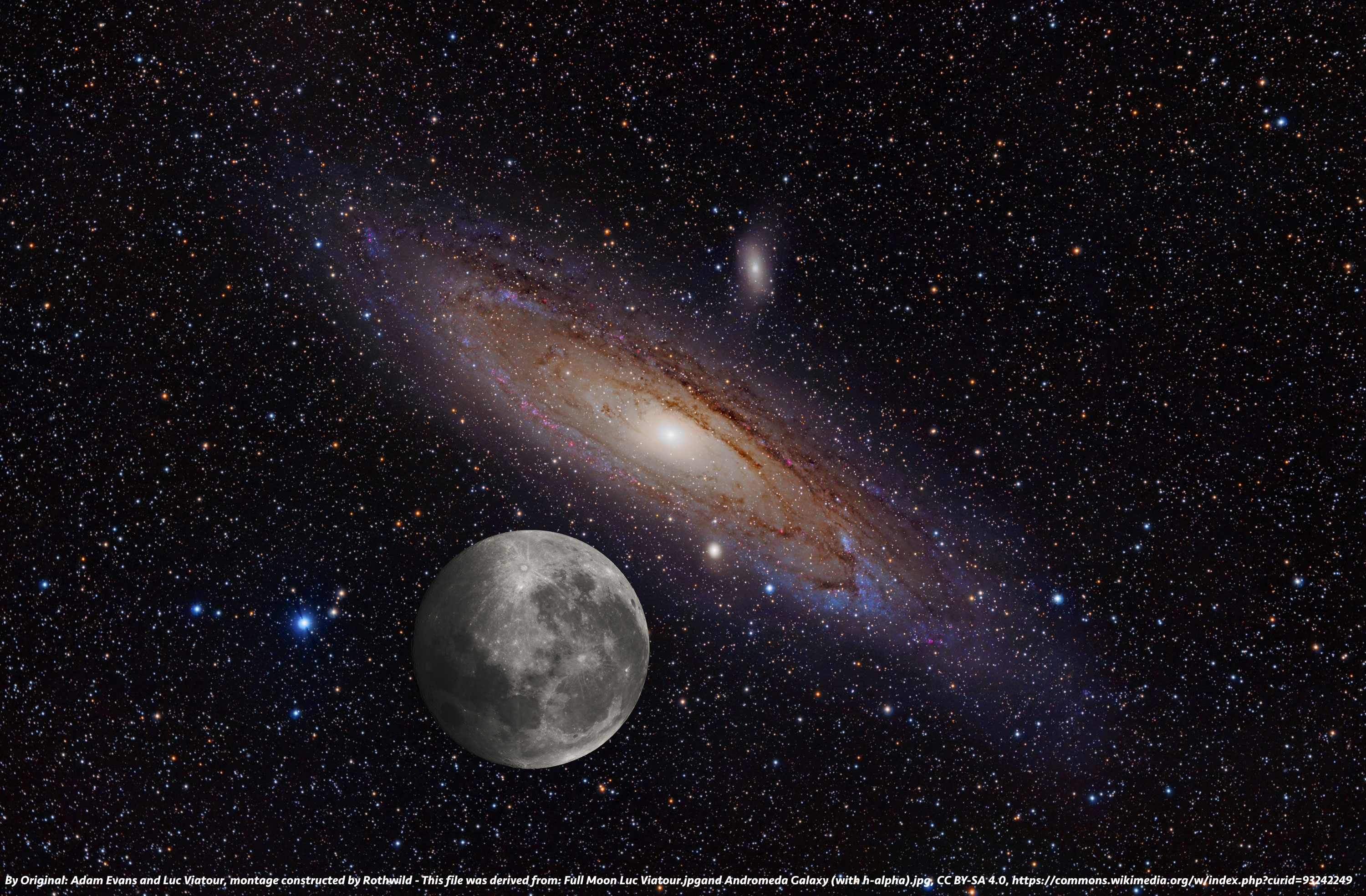
Adam Evans and Luc Viatour teamed up to create an image comparing the visual sizes of the moon with M31.
I shot M31 on a few nights last week. One evening, Sept. 28-29, the seeing and transparency were pretty good. A few years ago, to aid the seeing pleasure offered by my Vixen 8-inch instrument, I purchased an Astromik CLS light pollution filter. About seven or eight months after purchasing the then-tariff-free SeeStar S50, I purchased a light- and dew-pollution limiting tube that fits over the two-inch, triplet of my SeeStar S50. In conventional scopes, non-solar filters are inserted between the primary lens and the eye of the observer. SeeStar users don’t look through an eyepiece, they see the image on their phones or pads or indoor theaters.
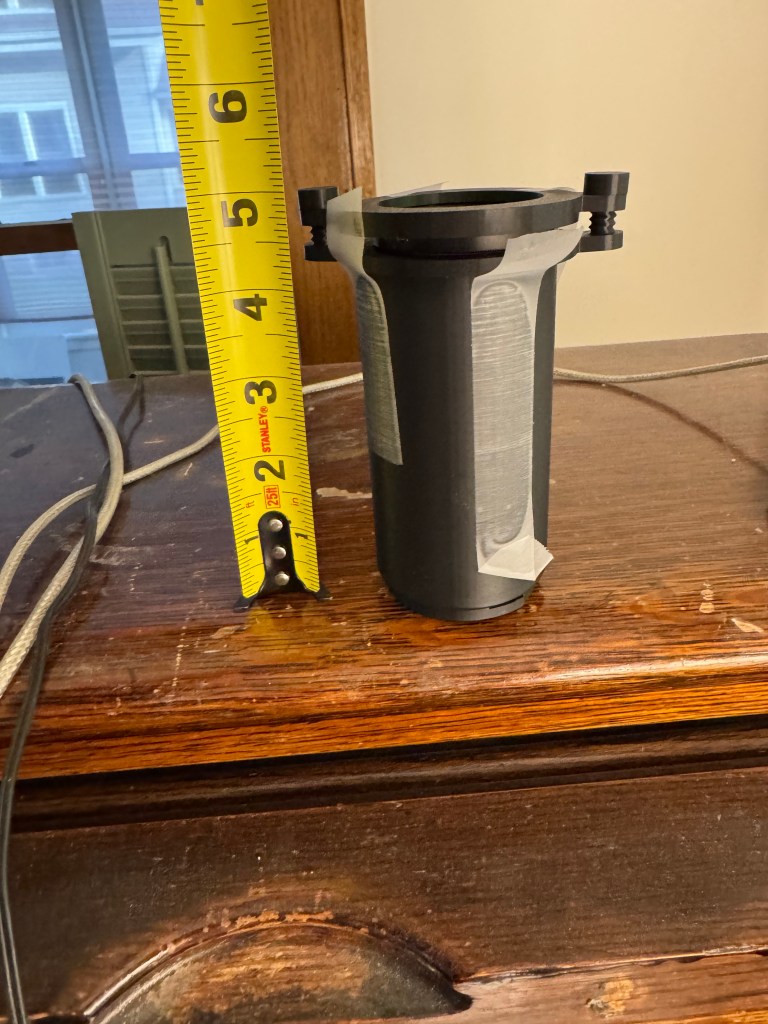
The only place to put the Astromik 2-inch CLS light pollution filter is in front of the primary lens, and this is how it looks. Call me crazy.
After washing the image with PixInsight and Photoscape X, I’m pretty pleased with how many images the SeeStar was able to stack and what the final product reveals. There’s about a trillion stars in M31, and if you hopped in a jet that could fly at 186,000 miles per second, it would only take 152,000 years to fly from one side of M31 to the other side. On hikes like that, treat yourself and fly first class.
M32 (above) M31 and M110, below the primary galaxy, are easy to spot. There may be some stellar transfer of matter (stealing, really) going on; M31 swiping matter from M110. The elliptical dwarf galaxy M110 was independently discovered by Caroline Herschel on August 27, 1783; All three pictured galaxies are in the Local Group of galaxies, of which our Milky Way is a part. A Wikipedia page said there’s a 50-50 chance of M31 colliding with our Milky Way galaxy within 10 billion years. Our sun (and planet) will be long gone in 10 billion years, but if that happens and someone witnesses it, they’re going to have a story to tell.
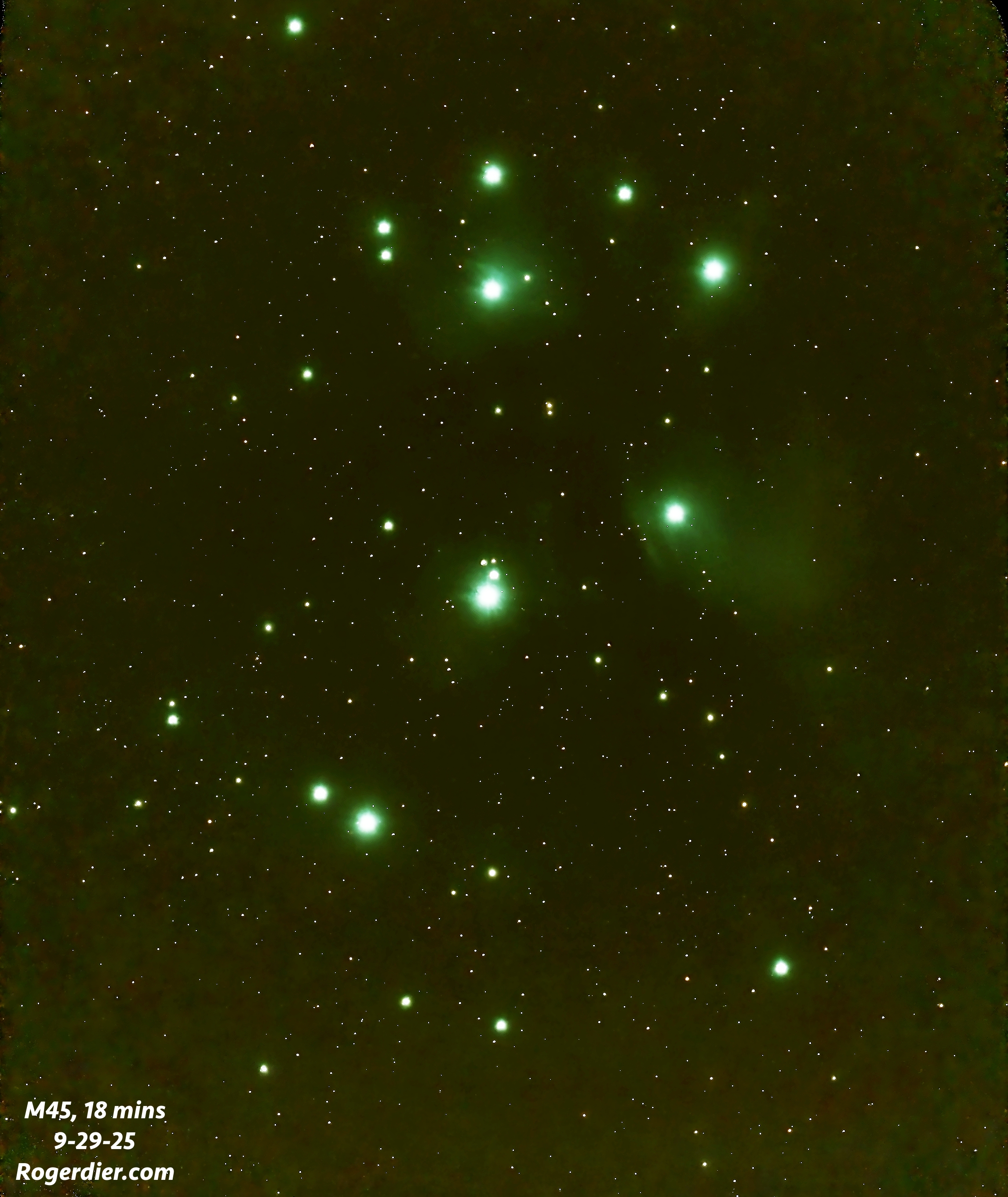
Shortly after midnight, I was preparing to tear down and turn off the SeeStar when I glanced above the trees to the east. There rising above the tree tops was everyone’s favorite autumn asterism.
The SeeStar still had gas in the tank. Why not?
After sending her over to the Pleiades, she went to work for about a half hour and gave me 18 minutes worth of images.
It’s good to climb back into the night sky after a nine-month vacation. Thank you for reading and we’ll see you next time.
 Cosmic