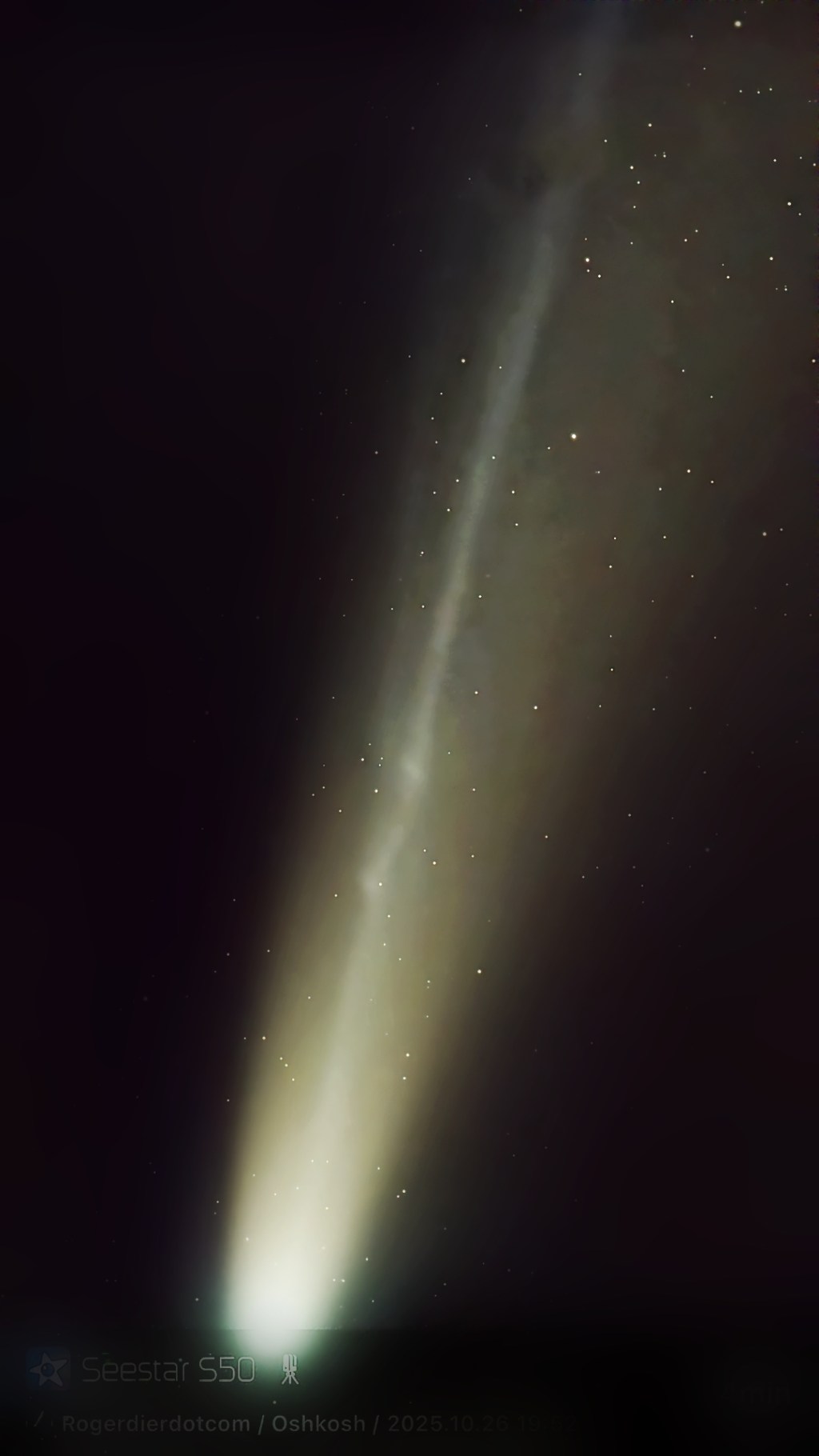
When I was a young lad, devoid of optical instrumentation and a lot of other things cerebral, I thumbed through astronomy books and gazed at magnificent drawings of ancient comets that lit up the night time sky, and could even be seen in daylight! Imagine that! And I did. Of course, photography had advanced by the early part of the 20th century to capture Halley’s Comet during its last journey in 1909-10, and every general astronomy book written for elementary students had a picture of Halley, and the story of how that comet got its name.
Seeing a naked eye comet in 1960s suburban Green Bay Wisconsin skies? Not a chance.
By far, the sweetest cometary sight seen from Earth this year is Comet Lemmon. Currently, in Northern latitudes, Lemmon is visible after sunset for two and one-half hours, give or take.
Discovery
Lemmon was first picked up on Jan. 3, 2025 by a sky survey instrument on Mt. Lemmon, part of the Catalina range north of Tucson, Arizona. It was dimmer than 20th magnitude. When the orbit was determined(1,350 years) it was not expected to be what it has become. Such is the way of comets.
I first shot Lemmon about a month or so when it was in the morning sky. Now that it is zipping across the early evening sky in pursuit of the sun, it’s moving at 37 miles per second. It will reach perihelion in a couple of weeks on Nov. 8.
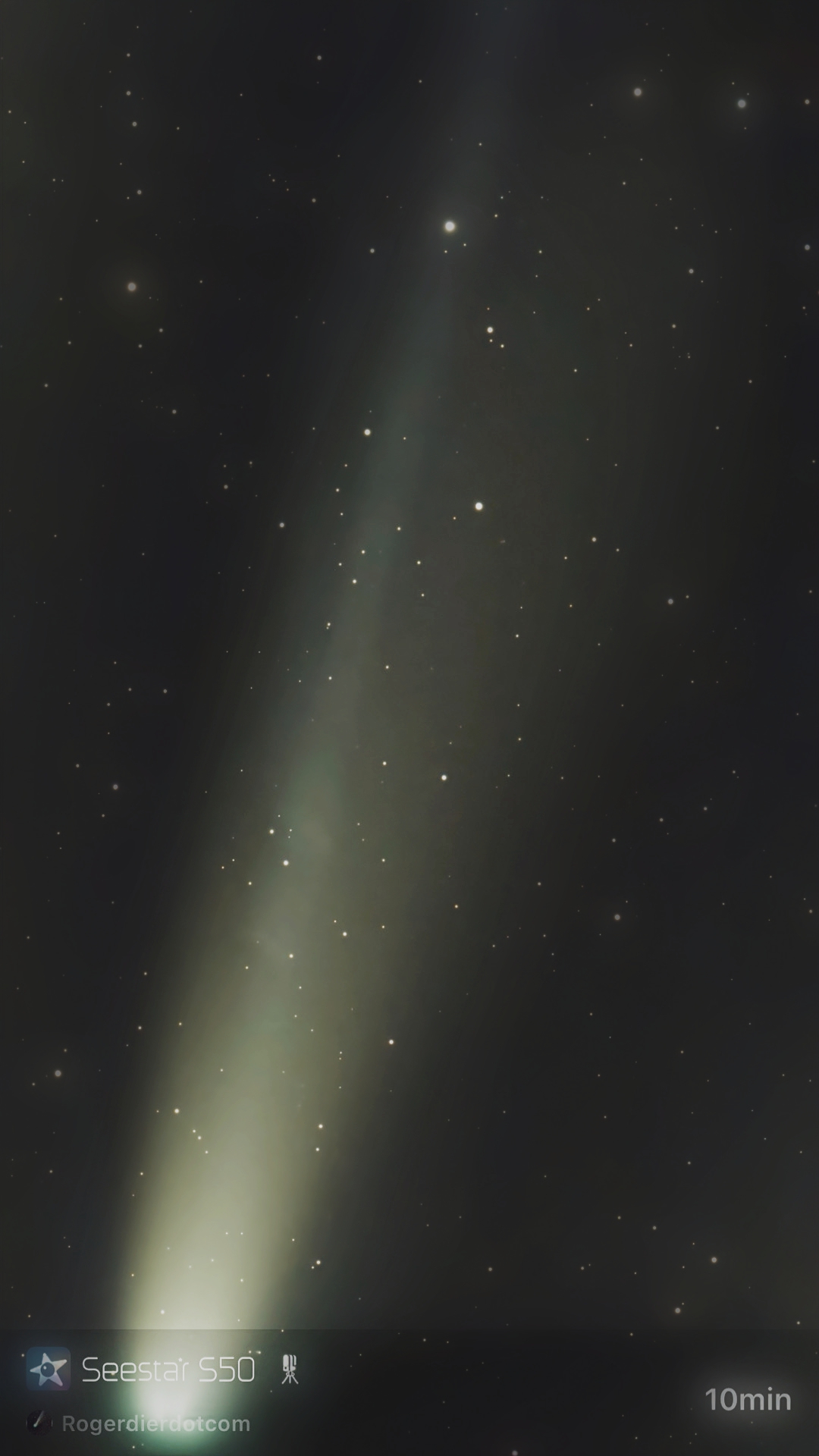
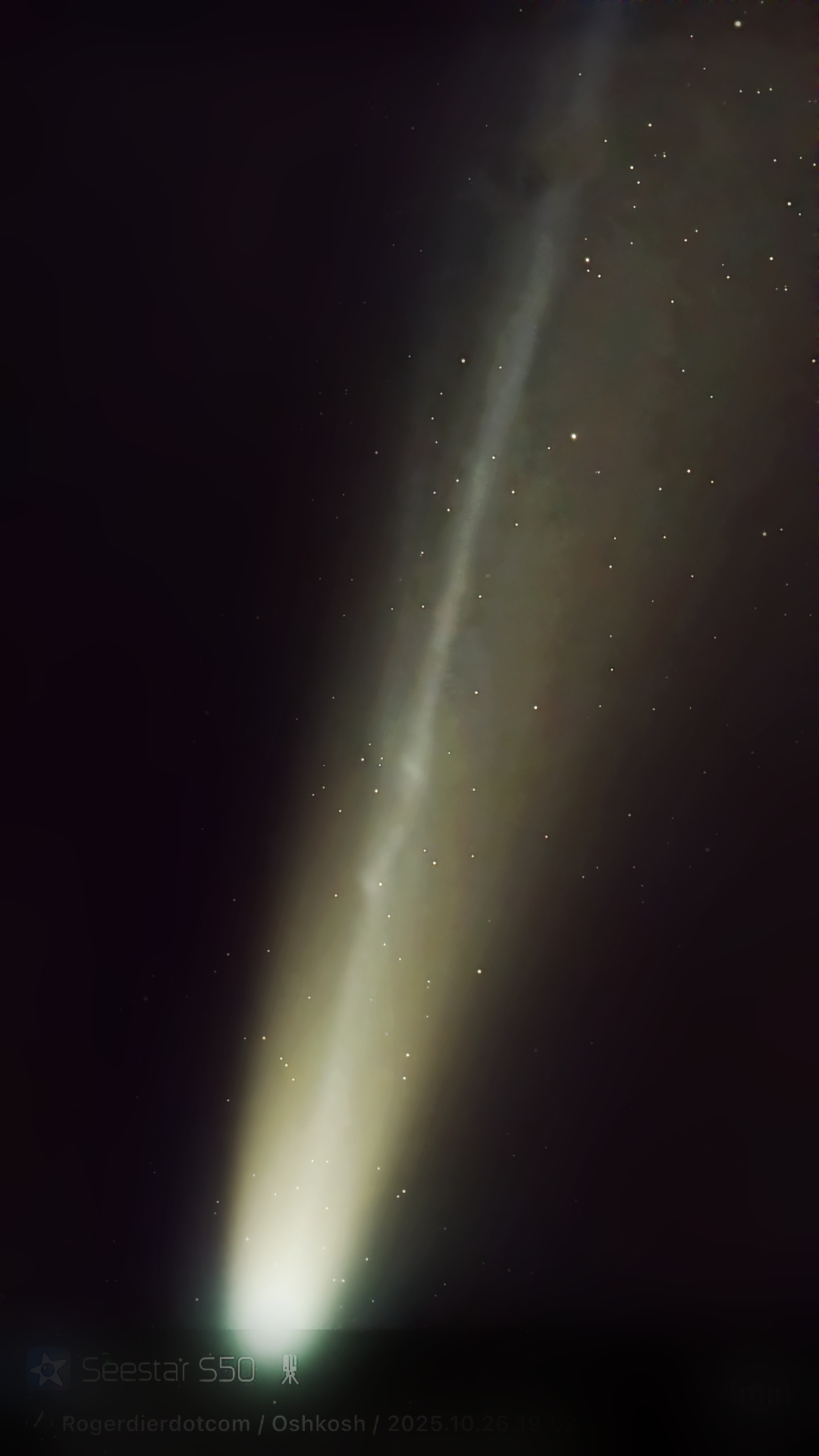
Over the last two or three nights, the sublimation process (solid to gas) off the coma has produced streaks both bold and crooked. Let’s compare two of my photos taken on Oct. 24 and Oct. 26.
On the left is a photo of comet Lemmon taken Oct. 24. The dust cloud and outgassing are almost uniform. The writer regrets not removing the ZWO stamp on either of the photos taken with his SeeStar S50.
The photo on the right shows significant new elements have entered the tail of the comet and the coma of the comet is be buffeted by the increasing solar wind. Who knows what the comet is going to look like as it draws nearer to the sun?
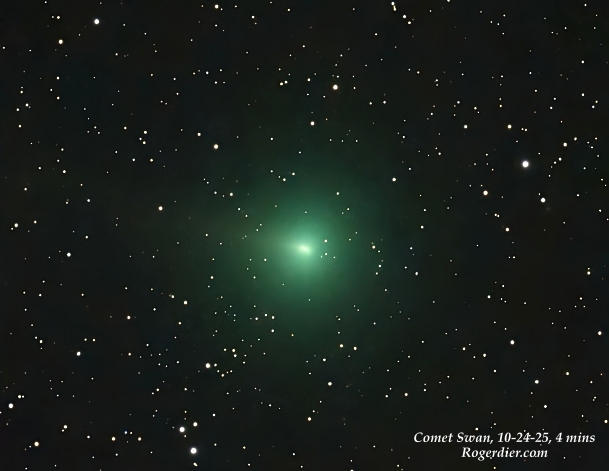
I also photographed Comet Swan a few nights ago. Swan takes a long time to go around the sun: 22,000-plus years from visit-to-visit. Earlier on this trip, it showed a more prominent tail. Now it resembles a fluffy seed head of a dandelion after it has bloomed. There’s a suggestion that a tail extends back behind the coma to the left of the bright, fuzzy coma.
Al Nagler

Reflecter, published by the Astronomical League, announced in its September 2025 issue that that Albert H. Nagler, known in the astronomical community as simply Al, became the recipient of the organization’s highest honor, the Astronomical League Award.
On page 14 of the Astronomical League’s current issue, they give a synopsis of Nagler’s journey in life. It’s fascinating, and I quote the publication directly:
Al, who turns 90 this year, enjoyed strong educational preparation that included the prestigious Bronx School of Science and a subsequent BS in physics. While in high school, he built an 8-inch reflector that earned him a prize, a paid article in Mechanics Illustrated, and a job at Farrand Optical Company where he worked for 16 years. Working under Farrand’s Grumman Aerospace contract with NASA, he designed the optics for an infinity simulator used to train Gemini astronauts. After a stint as chief optical engineer at Keystone Camera Company, for whom he designed a zoom lens for the company’s pocket camera, he founded Tele Vue in 1977.
(Nagler’s) work with Farrand introduced him to 45-lens optical elements that produced 145-degree fields, and he used that experience to develop Tele Vue eyepieces that soon took amateur and professional astronomy by storm. In 1977, he introduced the Tele Vue Nagler eyepieces whose 82-degree apparent fields and edge sharpness stunned observers. His newer eyepieces boast stunning 102-degree fields. He has even added a white phosphor night vision eyepiece that can triple the effective aperture of a telescope. Congratulations to Al for a lifetime of work that has benefitted untold thousands of amateur astronomers worldwide.
I have a few Nagler eyepieces in my arsenal, and though very expensive, the eyepieces created by Al’s company, Tele Vue Optics, are worth every ounce. I often get the looking through the portal of a spaceship feeling when using Nagler eyepieces. I knew there was a wizard behind the precise and flawless design and placement of every element in Tele Vue eyepieces, but I didn’t know much about the career of Nagler. What a journey.
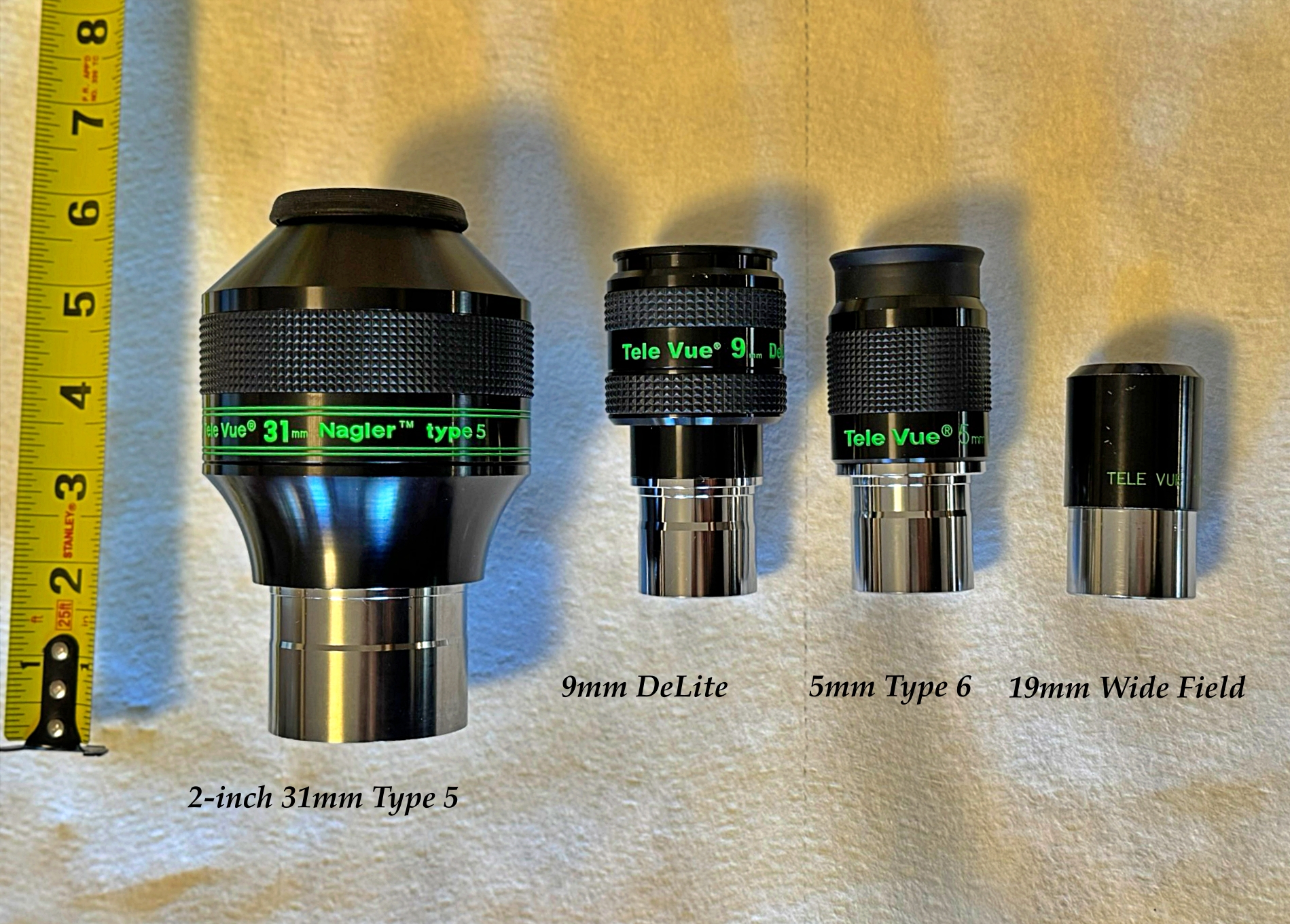
Below are my Nagler’s. The first one I purchased—the Tele Vue 19mm Wide Field—was in the 1980s. It was only Nagler I owned for decades, and it wowed me and my Minnesota astronomy pal, Willy Groebner, for years. It still does. The fat two-inch, 19mm Type 5 was my retirement gift to myself. The views through my Vixen 8-inch are extraordinary. The 9mm and the 5mm I picked up during the 2020’s.
Thank you for reading. The staff at Rogerdier.com wishes you good health and clear skies.
The Photo of Nagler appears on Tele Vue’s website, Company7:
http://www.company7.com/televue/telal.html
I regret to inform you that Al Nagler died on the same day this was posted. Here is his obituary:
Albert Hirsch Nagler Obituary
Albert Hirsch Nagler, 90, of Wanaque, NJ, passed away on October 27, 2025, at his beloved business, Tele Vue Optics, fittingly with a telescope in hand.
Born in the Bronx, NY, on May 22, 1935 to Mildred and Isadore Nagler, Al was a proud graduate of the Bronx High School of Science, where he built his first telescope, a spark that ignited a lifelong passion for designing and building telescopes and associated optics.
Al was a devoted husband to his wife Judi of 64 years; a proud father to David and Sandy Nagler and Meryl and Michael Budnick; a loving grandfather to Allison Nagler-Manuel and Brian Manuel, Marisa Budnick, and Hayley Budnick; and the most adoring great-grandfather to Thea Manuel. He was also affectionately known as “Uncle Al” to countless members of the amateur astronomy community.
His career was as extraordinary as his spirit. From drafting bra underwires to developing complex optical systems used by NASA Apollo astronauts to train for lunar landings, Al’s ingenuity knew no bounds. That same brilliance led to his groundbreaking Nagler eyepiece design, which revolutionized the way amateur astronomers viewed the sky. An entrepreneur at heart, Al also partnered in a second business that helped pioneer electric motor safety brakes.
Beyond his professional achievements, Al’s passions extended to art, music, travel, and, above all, family. Nothing brought him greater joy than gathering loved ones for any occasion, large or small.
Al will be remembered for his boundless optimism, kind spirit, and contagious joy. No matter what challenges arose, he always found the bright side and helped others see it too.
Funeral services will be held at 1:00 p.m. on Wednesday, October 29, at Robert Schoem’s Menorah Chapel, W-150 Route 4, Paramus, NJ. Shiva will be observed on Wednesday, October 29, at the Budnick home in Wayne, NJ, and on Thursday, October 30, at the home of Judi Nagler in Wanaque, NJ (2–4 p.m. and 7–9 p.m.).
 Cosmic