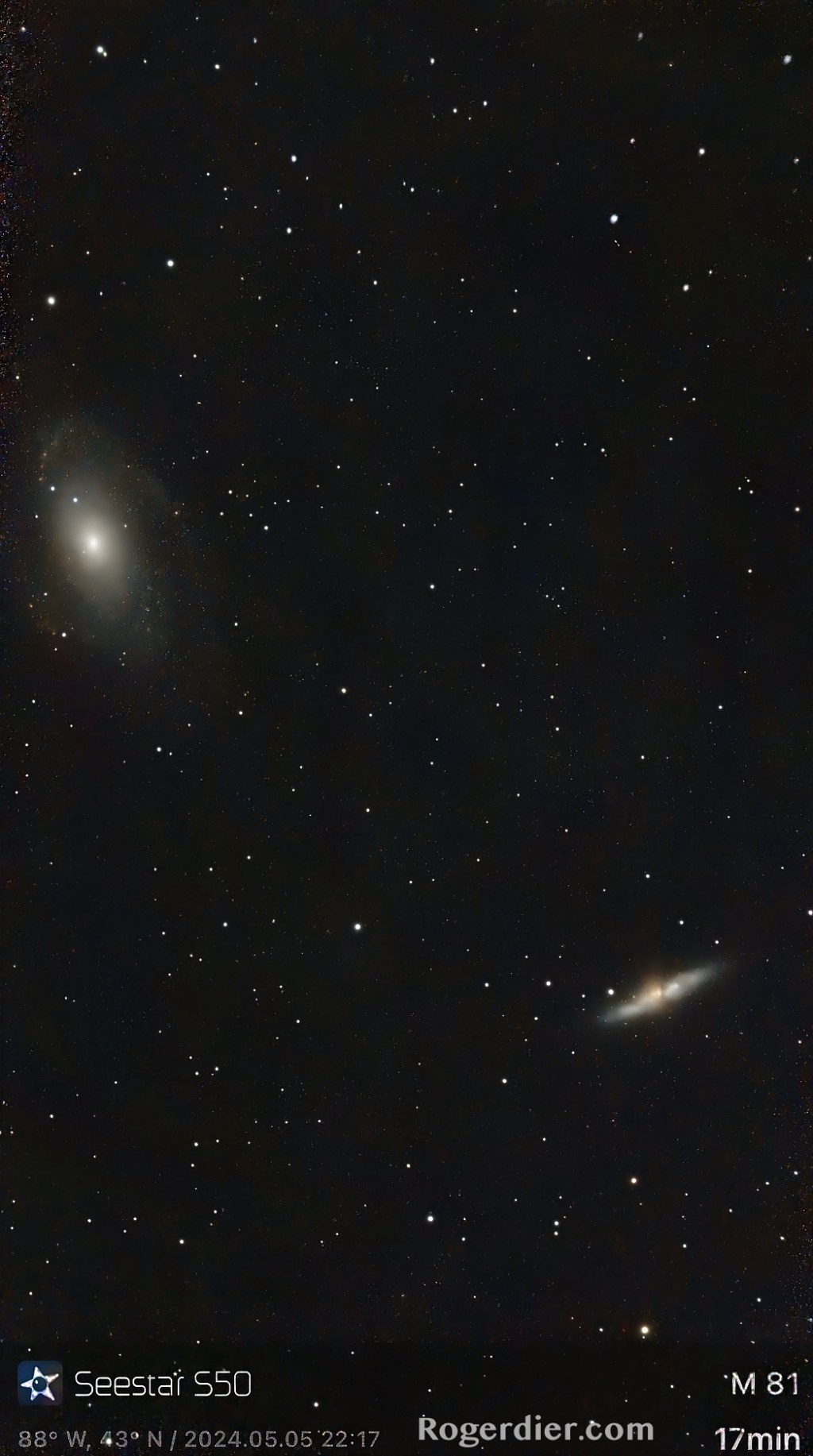
Leo’s Trio
I decided to escape the Oshkosh Light Dome Sunday and drove about five miles west to a country road. Multiple astronomy Apps promised fine conditions but it wasn’t as clear or transparent as forecast. What else is new? It was quiet as dark settled over that country road in Winnebago County; the only sounds heard in the night were yips from a litter of young foxes.
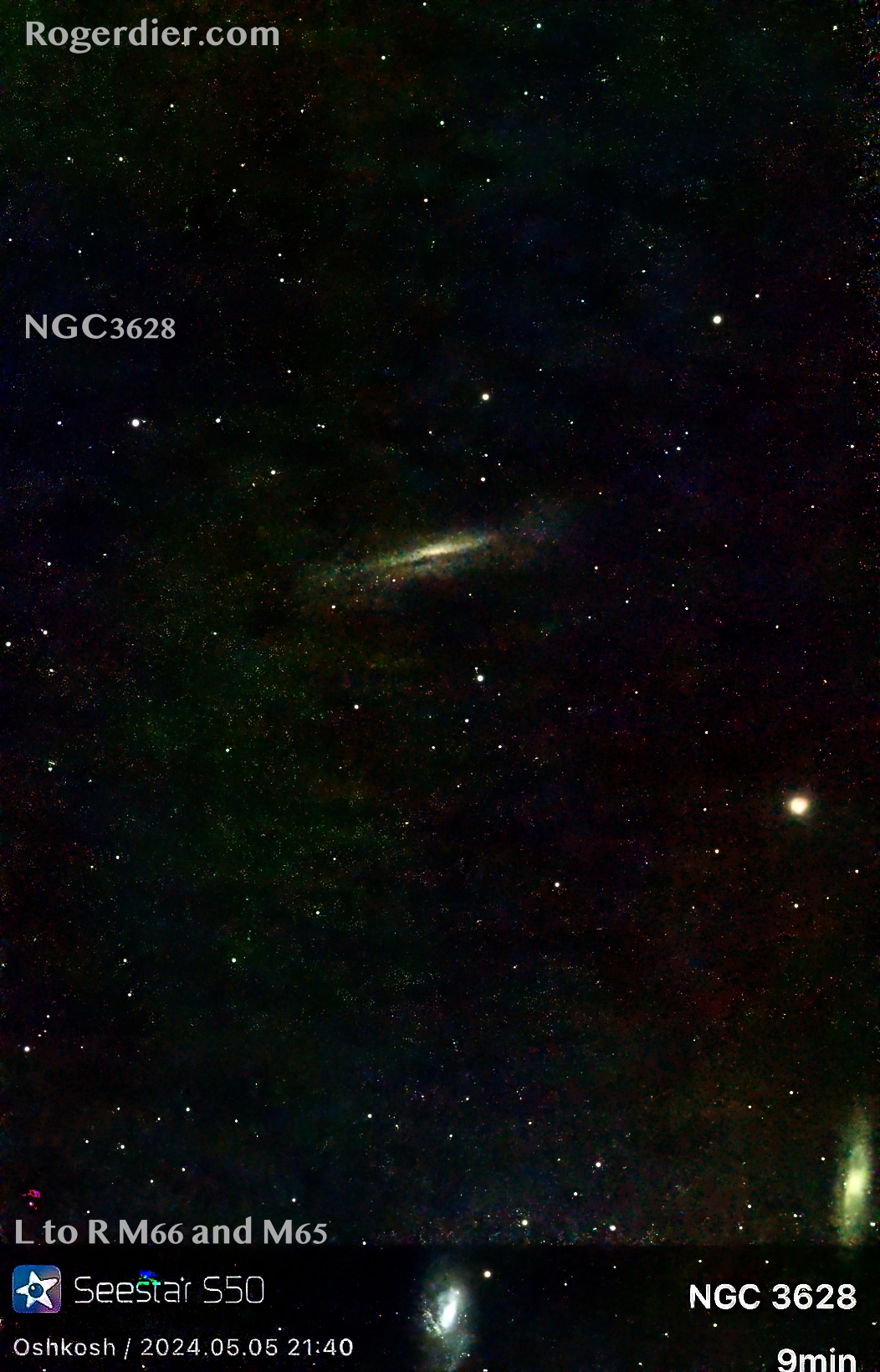
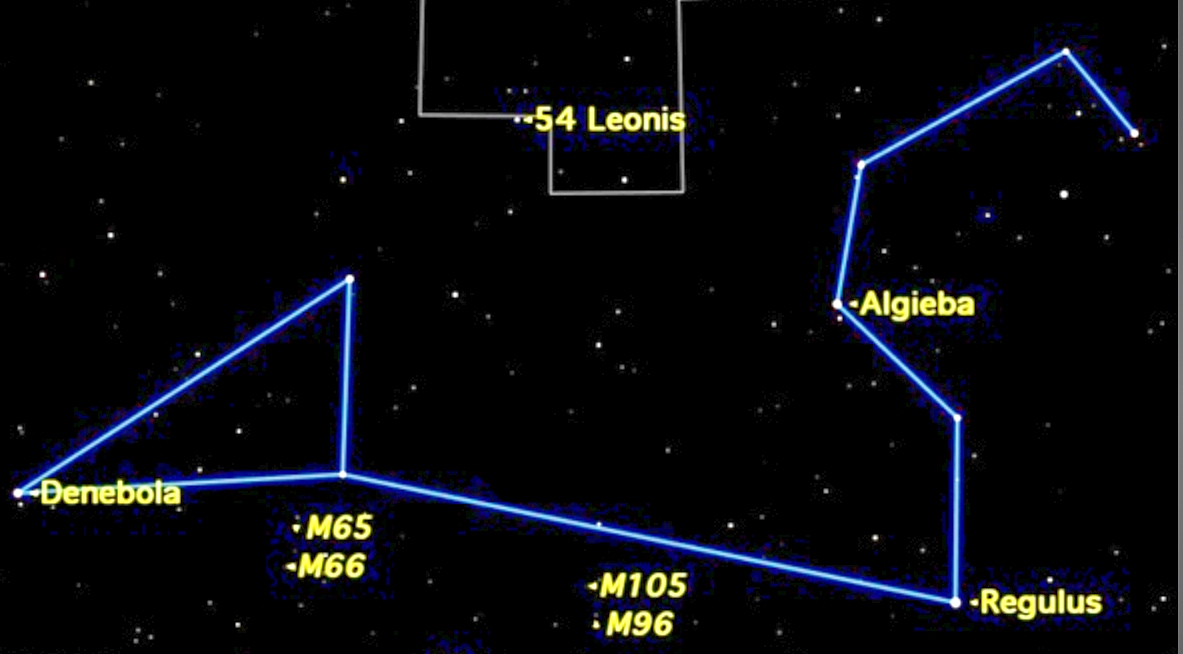
With Ursa Major and Leo high in the sky, I connected with the SeeStar. After helping it find north and aligning its platform, I asked the SeeStar to find Leo’s Trio, as it is affectionately known. The three elliptical galaxies–M’s 65 & 66 and NGC3628– took a while to show up in the my phone, which serves as the SeeStar’s eyepiece. I planned to shoot Leo’s Trio longer than nine minutes, but the atmosphere got in the way: A splotch of low clouds, looking like thin pancake batter drifted toward Leo’s hindquarters. The operator aborted the exposure.
The dimensions of the SeeStar’s field of view is about three-quarters of a degree wide and a degree-and-a-quarter long. I’ll do a better job of centering Leo’s Trio in the future, but all three galaxies–NGC 3628 and M65 and M66– are before you.
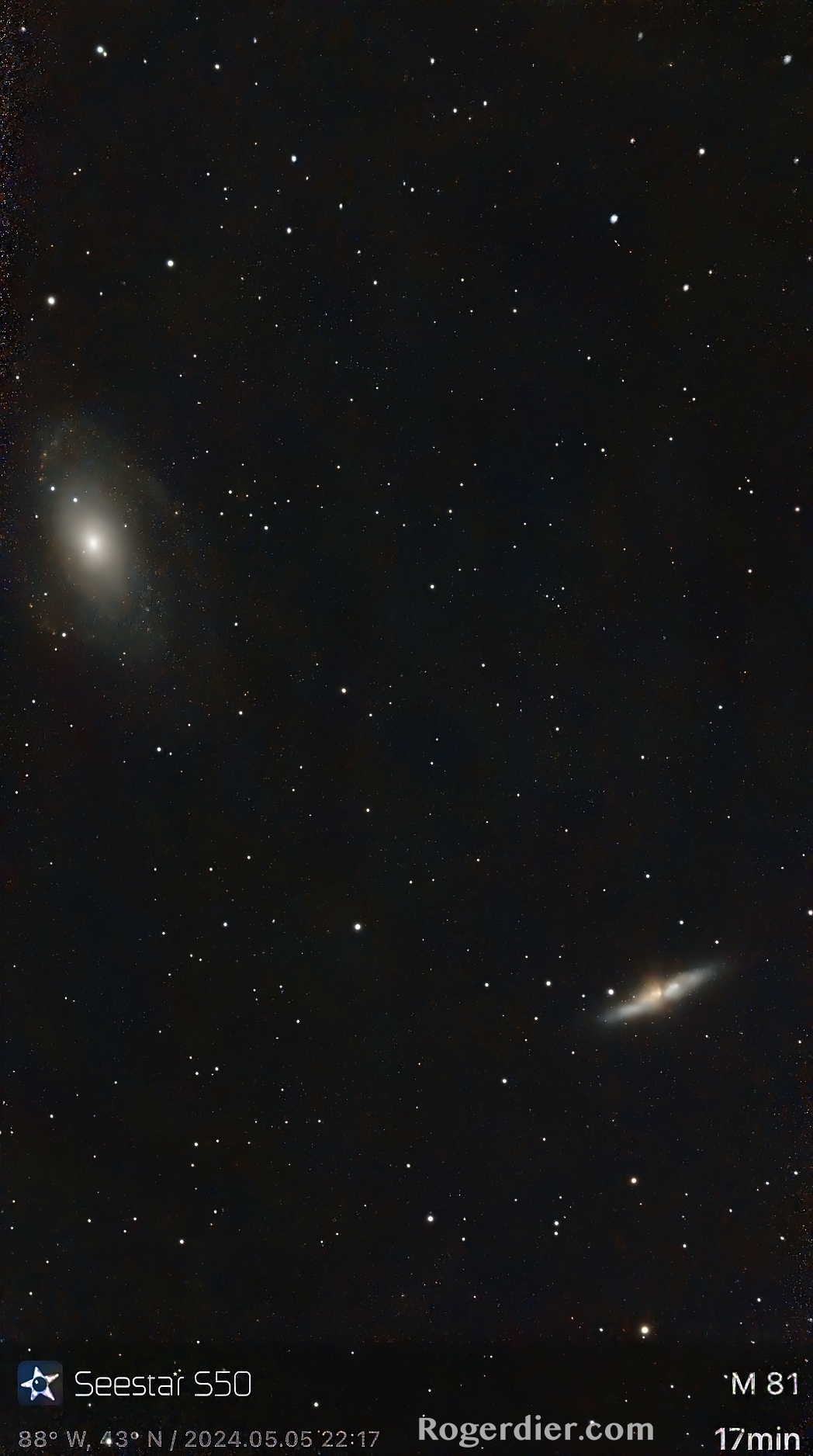
The Great Bear’s M&Ms
From there I ordered the SeeStar to find two companion galaxies in Ursa Major. It took moments for the telescope to bring Messier 81 and Messier 82 into the field. About seven minutes into the exposure, the telescope informed me it was having problems tracking. I clicked back from the shooting screen to the screen holding “Advanced Features.” I re-adjusted the level and returned to the shooting screen. Your intrepid astronomer told it to continue what it was doing. I think this seventeen-minute exposure is the longest I’ve ever done.
M81 and M82 are impressive. The light I saw Sunday night left those galaxies 12 million years ago. If something catastrophic occurs to one or both of those galaxies today, we won’t know about it for 12 million years, assuming we survive as a species.
Think about that. Not the surviving as a species part, but of all the nothingness between us and that pair of galaxies. It takes millions of years for the fastest form of energy to travel that far. And even more absurd is that M81 and M82 are in the “local group” of galaxies, which includes our pinwheel-shaped Milky Way.
Astronomy isn’t just about looking, it’s about peering back into time and distance. Even the sunlight on my shoulder is not oven fresh; sunshine needs eight minutes travel 93 million miles to Earth. If the sun blew up three minutes ago, it would take five minutes for me (and you) to know about it.
I’m optimistic, however, so I’ll post this and hope the sun continues shining on all of us.
Thank you for reading. Subscribe for free at the bottom of this page.
 Cosmic
3 responses to “The May Galaxy Hunt Continues ”
Nice captures! I’ve been wondering about the performance level of the Seestar. Some of my fellow society members have bought this model, with mixed early results so far but it seems that in the right hands you have shown that it can deliver.
LikeLike
You are making the Seestar adventure all the more interesting to me. Thank you.
LikeLike
You are correct; it is an adventure. I’m happy to share this SeeStar adventure with you and the readers. Thank you for reading and sharing your impressions.
LikeLike