It’s been a while.
My wife, Michelina, and I purchased a home high on a cliff in Rochester, Minnesota a month ago. We have been bouncing back and forth getting our current home—My daughter, Courtney, calls it Home No. 1—ready to sell. Once it is sold, we’ll be able to move into Home No. 2, which will automatically become Home No. 1 forever after.
So we’ve been busy. This spring it’s been mostly cloudy in these parts before Midnight. Now, six weeks before the summer solstice, the length of the night sky is shrinking like George Costanza just out of the pool.
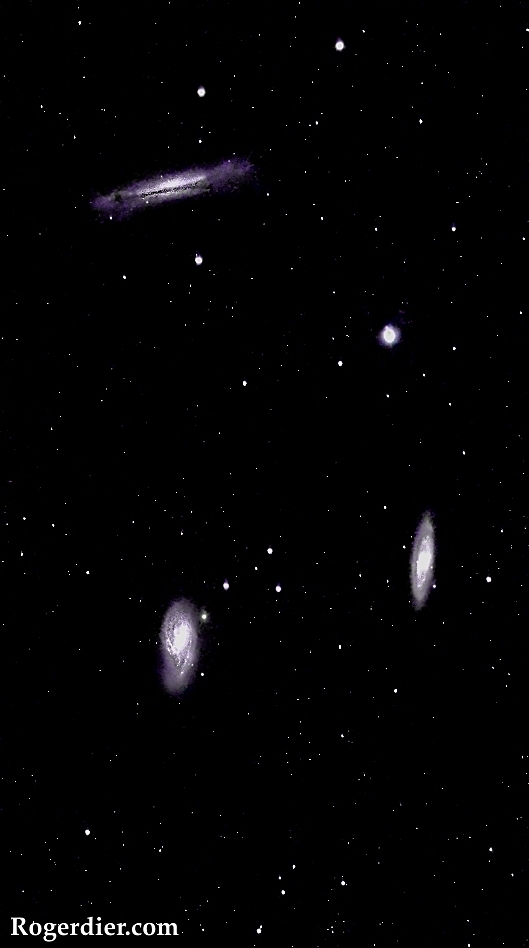
On the 9th evening of this month, we finally got a break in the cloud patterns. I ventured out five miles west of town to shoot Leo’s Trio: M65, M66 and NGC 3628.
Most SeeStar users refer to this trio of galaxies as “Leo’s Triplett.” It sort of sounds pretentious, like we’re all sipping tea from tiny cups with our pinky’s in the air chatting about the scandalous goings on in the Leo family two towns over. Leo’s Trio is easier to say; slides right out of the lips. The trio of galaxies in Leo was informally introduced that way to me way back when by Willy Groebner, a notable astronomer who lives in New Ulm, Minnesota.
The Three Galaxies
M66 is the main story of the three, in my opinion. In Burham’s Celestial Handbook, the author cites the observations of 130 years ago, when photographic exposures were first being made of twinkling things overhead. “Isaac Roberts, on plates made with his 20-inch reflector in the 1890’s, described it as spiral ‘with a well-defined stellar nucleus, forming the pole of the convolutions, in which I have counted 14 nebulous star-like condensations.’”
M66, the galaxy on the lower left of my 60-minute exposure, is known for rapid star formation, supernovas and asymmetric formations within its huge boundaries. Those spiral deformations are believed to be caused by the unrelenting gravitational pull within its boundaries and from the weak but relentless tugs of the other two galaxies of the trio. At magnitude 8.9, M66 is about 100,000 light years wide and 35 million light years distant.
In the lower right of the photo is M65. We view it nearly edge on, but we can see the undercarriage of the operation as it is tilted 14 degrees to our plane of view. Though M65 and M66 made Messier’s catalog, he did not discover them. According to Burnham, that honor goes to P.Mechain in March 1780; it seems that Messier’s Comet of 1773 passed directly through the field on November 2, 1773, but the two galaxies were not noted by that diligent observer; Mechain theorized that Messier “no doubt missed them because of the light of the comet.”
Interesting stuff. Like M66, the sister galaxy is also about 35 million light years distant but is dimmer from our point of view with an apparent magnitude of 10.8. M65 is dimmer because we see less of it.
If you like dust lanes, NGC 3628 is at the top of the photo and is near the top of most lists. We see this marvelous concentration of dust and light edge on. I love a great dust lane. NGC 3628’s dust stretches for tens of thousands of light years. It’s about the same distance from us as the other two members of the trio, and features visible tidal forces warping its body, and star streams stretch across 300,000 light years toward its stellar siblings. M65 and M66 just can’t get enough of NGC 3628–they want all of it within their systems.
Could all three galaxies converge into one massive system of stars? It’d be a peach of a show.
At magnitude 9.5, NGC 3628 is known by a few bubble gum names invented by imaginative amateurs. All three galaxies began to become galaxies 13.6 billion years ago, way before elements of our sun became a first generation star, let alone achieving second generation status it has currently.
Unveiling the Veils
I awoke after three hours sleep on Monday, May 11. I planned to write this missive before heading to Milwaukee today, and once up at 2 a.m. I could not return to dreamland. I took a peek out of the window and saw stars. It took me 10 minutes to set the scope up and lock it in on the Western Veil Nebula.
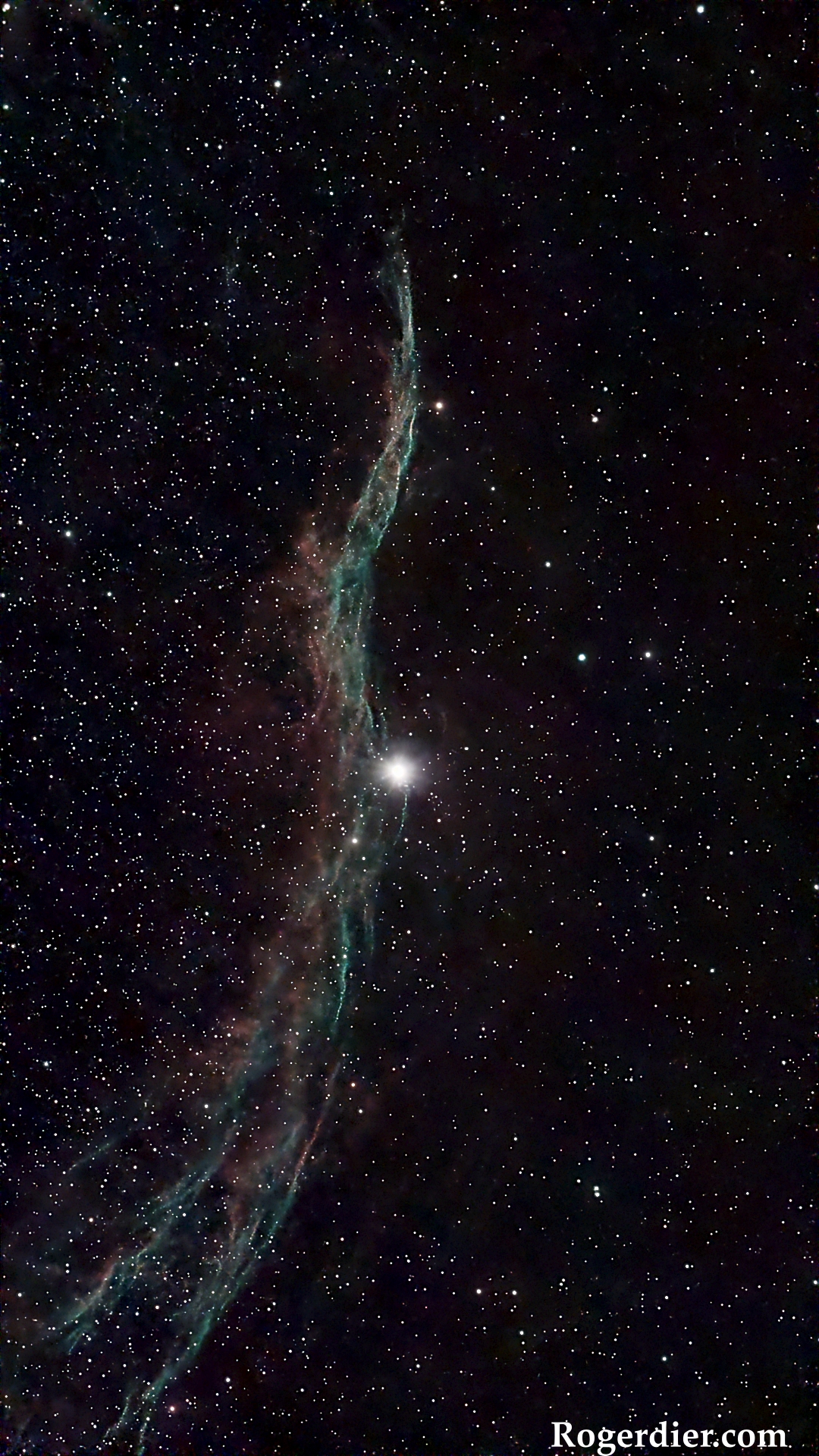
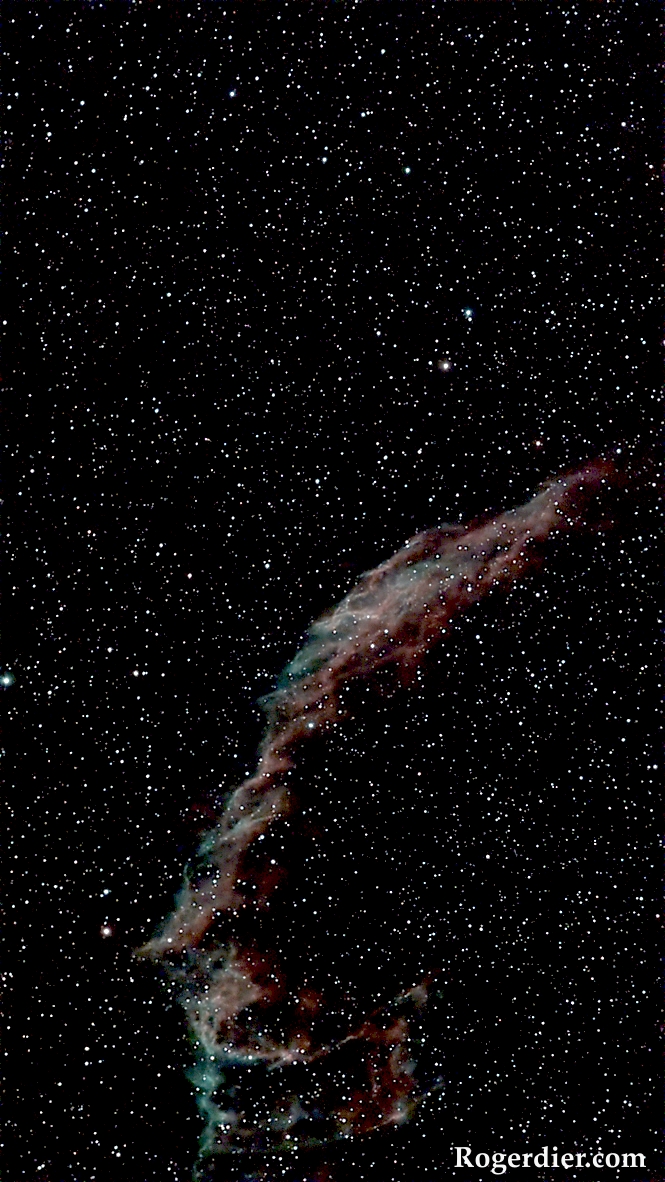
The Veil Nebula in Cygnus the Swan was a star that decided it had enough and exploded about 12,000 years ago, give or take. At 20 times the size of our sun, when that star exploded, it was so bright it could be seen on Earth in the daytime.
To the right, the Western part of the Veil is a one hour SeeStar S50 exposure. The reason for the nebula’s name is self-evident. It is one of the most beautiful things in the night sky.
Not to be outdone is the eastern edge of the Veil. The exposure to the left is a half an hour, cut short by the coming dawn.
Thank you for reading. Share with your friends. Keep looking up.
 Cosmic
7 responses to “Leo’s Trio”
Excellent content, as always! Wishing you & Michellina the very best in your “forever” move. It’s reasonable that your final resting place is atop a cliff, looking up… 🌖 💫
LikeLike
Thanks, Barb, and know that we will miss you and your husband.
LikeLike
Hi Roger
Thanks for the share of your impressive shoots and more importantly the story and history behind them – Very inspiring.
I saved your Leo Trio picture to remind me of future shooting targets with my S50 from a Bortle 6 sky in NJ.
Please reply or call with some answers so that I can shoot with similar outcome if possible
I was not sure if this was shot by your S50 or another scope?
Can I get these Trio in my S50 FOV?
What post processing software did you use to make them so bright.?
Did you use the EQ mode or Alt/Z
Did you use Mosaic mode which I have not done so far?
Frank 9082271850
LikeLike
Here you go, Frank. Tried calling you but your Google answering service blew me off.
I was not sure if this was shot by your S50 or another scope?
These photos were shot with a SeeStar S50.
Can I get these Trio in my S50 FOV?
Of course you can get Leo’s Trio. It’s high in the sky this time of year. I don’t know when it’s completely dark where you live in N.J., but this is probably the best time of the year to photograph it after sunset.
What post processing software did you use to make them so bright.?
If you expose something long enough, the brightness emerges. Since you asked, I used PixInsight to lightly process the image. But there are other less expensive image processing products out there–some are even free–that will do the kind of job you want.
Did you use the EQ mode or Alt/Z
I used to be an Alt/Z with my SeeStar, but about a year ago I started experimenting with the EQ mode and it’s really the way to go. Two things will be helpful to you in getting accurate tracking. First, determine how far off in degrees you are from true north. Me, I’m about 3 degrees to the east of north. Set one leg of your tripod in line with the arrow of your iPhone compass. The other thing you’ll need is an open chunk of sky so the SeeStar can calibrate itself when it sets itself up.
Here are the steps I follow:
Pre-Start: See above with using your phone’s compass to find your deviation from true north and lining up the north-facing leg of your tripod on that imaginary line. Now you’re ready to go.
1. Mount the Seestar so it tilts over the north-facing direction. The SeeStar’s on-off button should be on the top of your mount, facing straight up.
2. Adjust your wedge to your local latitude. I’m at 44 degrees north here, more or less. Actually, it’s slightly less at 43.96 North Latitude.
3. Power on the SeeStar and connect it to your mobile device.
5. In the SeeStar App, find and select “EQ Mode.”
6. Select an open area of sky on the SeeStar EQ page. Be patient. Ask for a deviation reading. It may take a few moments to give you one.
7. Use the fine tuning knobs on your wedge to get within the green in the App–left and right and up and down.
8. Once aligned, back out and select what you’d like to look at. The SeeStar will take you there.
Did you use Mosaic mode which I have not done so far?
No, I did not use mosaic mode for Leo’s Trio. The just fit in the FOV without having to expand it. You can make adjustments in the FOV if one of the three objects is outside the FOV. There’s a pointer function on the app. Set it on slow and nudge the field to where you want it to be. That’s all you have to do. SeeStar takes over and tracks like a bloodhound.
That’s it, Frank. Good luck.
LikeLike
Hi Roger
Thanks for your detailed comments – lots to learn from you
Sorry my phone did not go thru
Will share the shot i take for your valuable feedback
Frank
LikeLike
May you have many happy years in your new home!
LikeLike
Thank you Mary.
LikeLike