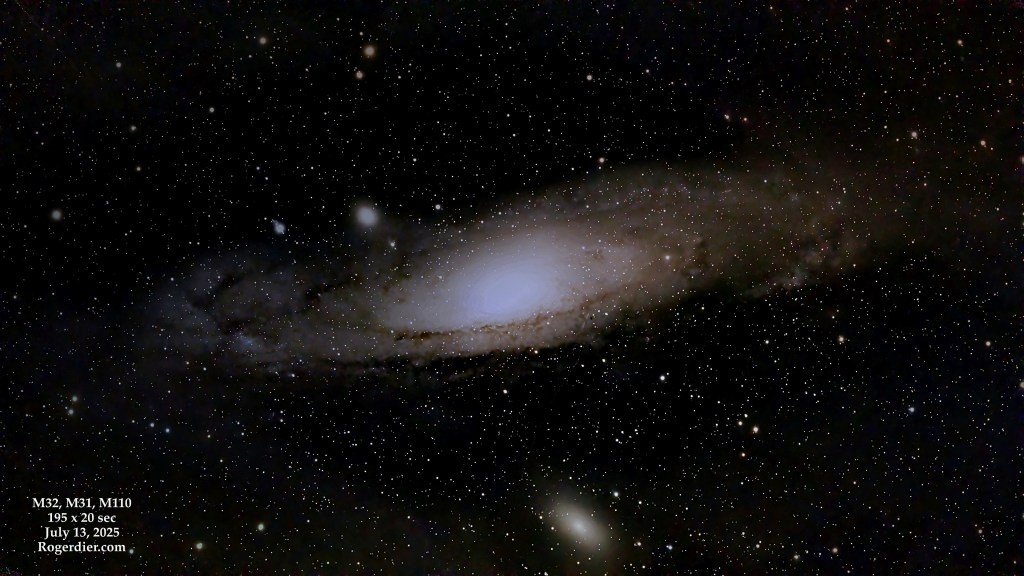
July 13. It’s 2:15 a.m. and I’m wide awake. A quick peek out the window shows stars. Go to my goto App for astronomical sky conditions. Fantastic sky, despite the heat dome under which Rochester Minnesota bakes. Ten minutes later I’m on the deck aligning my SeeStar. It’s 71 degrees, the sky is black as hot tar. Heaven on Mother Earth.
The great galaxy in the constellation Andromeda (known as M31 and a half dozen other astronomical identifiers) never sinks below the horizon in fall and winter from 44 degrees north latitude. Amateur astronomers who go to bed at a decent hour usually start viewing it in October after sunset. But on a mid-summer morning, I noticed the constellation Andromeda marching up the Northeast sky. Why not?
My SeeStar found it quickly, but my field of view couldn’t contain all of M31; It’s the Hindenburg of celestial objects. So I tapped an icon on the SeeStar platform and went into mosaic mode, generating as big a field of view the SeeStar allows. I asked the camera to take 20-second exposures and stack ’em all.
Long nighttime story short, the SeeStar stacked 195 of the 20-second shots before I shut it down, nervous about approaching astronomical twilight.
Those who take post-production a lot more seriously than I do often ask the photographer what tools in what software were used to polish their online images. Every human visual taste is unique, and what’s the point of saying I used PixInsight Histogram, Dynamic-X-tractor, RC Astro’s Blur and Noise terminators, and PhotoScape X? Most everyone has the same tools, or imaging software they prefer. A ciascuno il suo.
Light Pollution
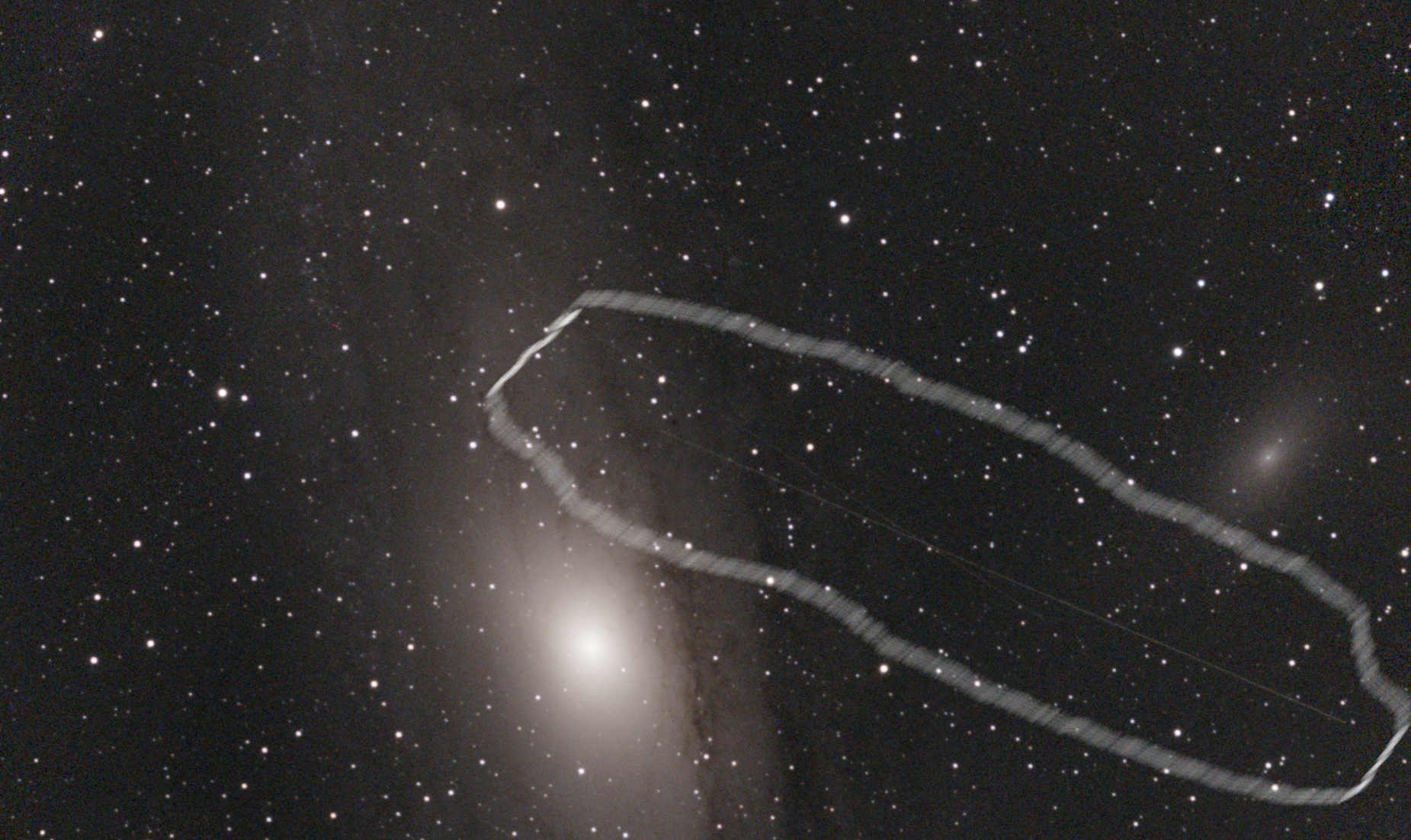
One blemish on the raw data is a streak that emerged from the core of M31 and zipped across one-half of the galaxy. I noticed it about 25 minutes before shutdown. Usually, as images stack up, satellites passing in the night will be overlapped by ensuing images and disappear, but this was a light trail that hung around like a toothache.
It was either human-made or an early Perseid meteor. Below is the section of the image where it appeared. I scrubbed it out of the final image. The wonders of imaging science.
That’s all for now. Share, comment, copy (with attribution) or get a totally and forever free subscription by clicking something somewhere on this platform.

