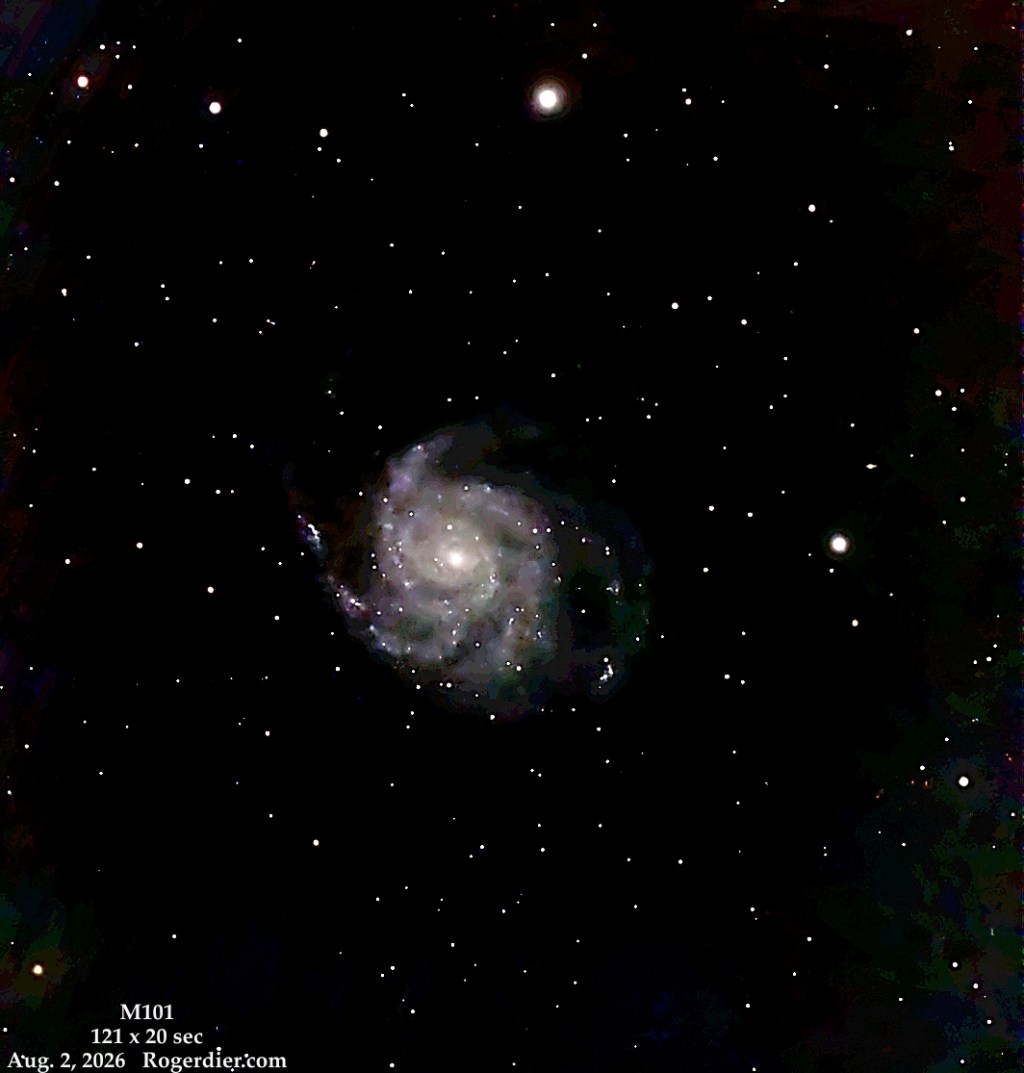
I went bear hunting on a couple of fairly clear nights in early August. Ursa Major, aka The Great Bear, aka The Big Dipper, aka The Plough and several other aka’s, is the third largest constellation in size and is home to several galaxies that made Chuck Messier’s famous list of non-comets.
M101 is a beauty. Classic water-circling-the-drain design featuring pronounced limbs chasing each other for eons in its unmistakable silent symphony, 21 million light years distant. Known across the globe by star hunters as The Whirlpool Galaxy, a nickname that is self-evident.
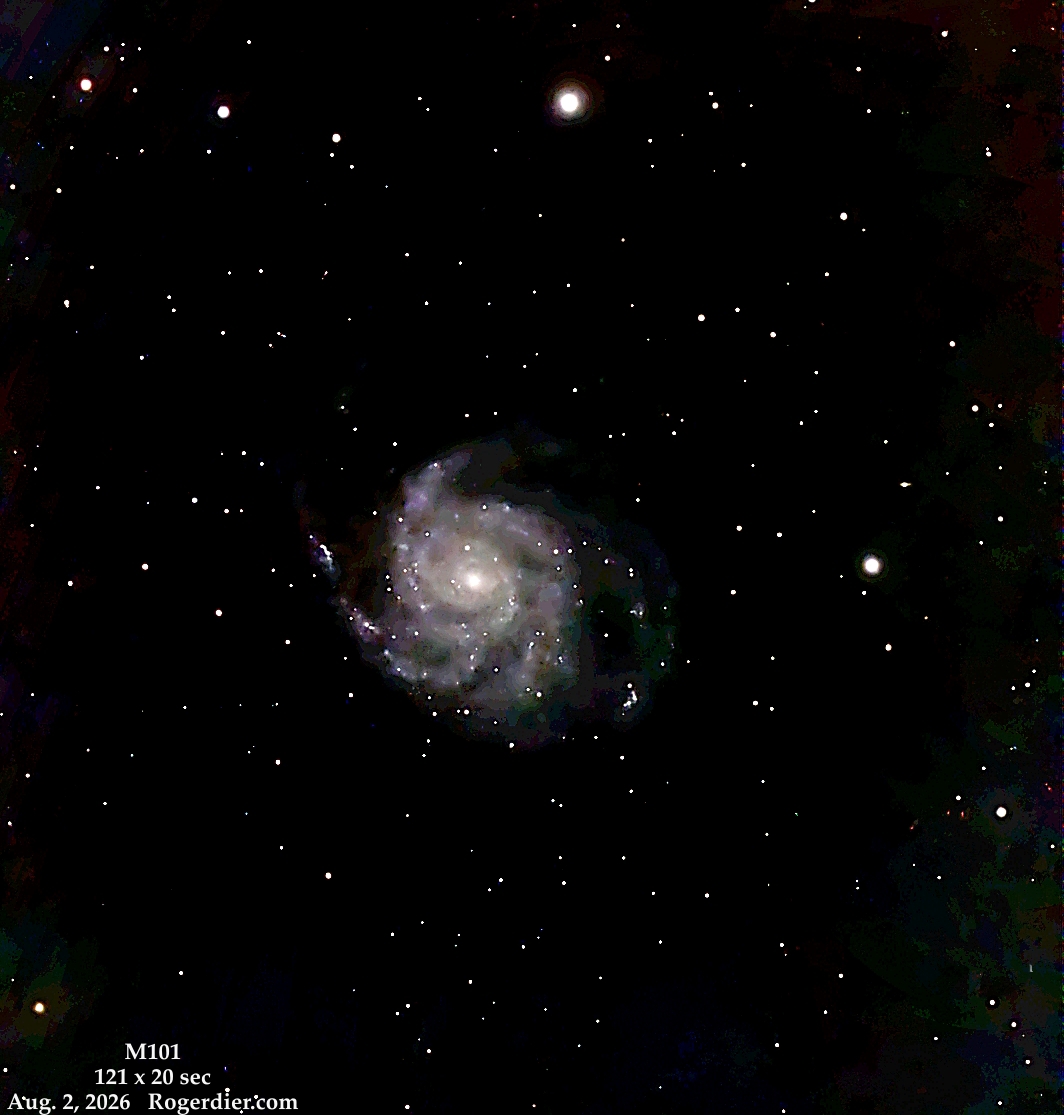
On the night of March 27, 1781, Pierre Mechain spotted the 7.9 magnitude gassy dust disk and announced it to the world. Messier decided to add it to his burgeoning list of stuff that looks cometary but probably isn’t, and Messier said it was a “nebulae without a star, pretty obscure and pretty large, of 6 or 7 minutes (of arc) in diameter …”
It’s true: M101 is a fat bastard, 252,000 light years wide, more than three times the width of our Milky Way, which is 87,400 light years wide. The rotund M101 is estimated to contain a trillion stars. Somewhere, someone is still counting.
M101 appears to have succumbed to a cosmic Coriolis force that set it spinning counterclockwise around the galactic core, where the heavy stuff rules. It would be beautiful to look at if it wasn’t spinning at all. The photo is a collection of 20-second exposures made just over 40 minutes with my little magic machine that is the SeeStar S50.
M81 and M82
The sky was not as transparent or quiet on the evening that I took a picture of M81 and M82, but it was good enough.
These galaxies look impressive both in a visual field of view and in composite digital images made by a happy amateur from an elevated deck northeast of downtown Rochester, Minnesota.
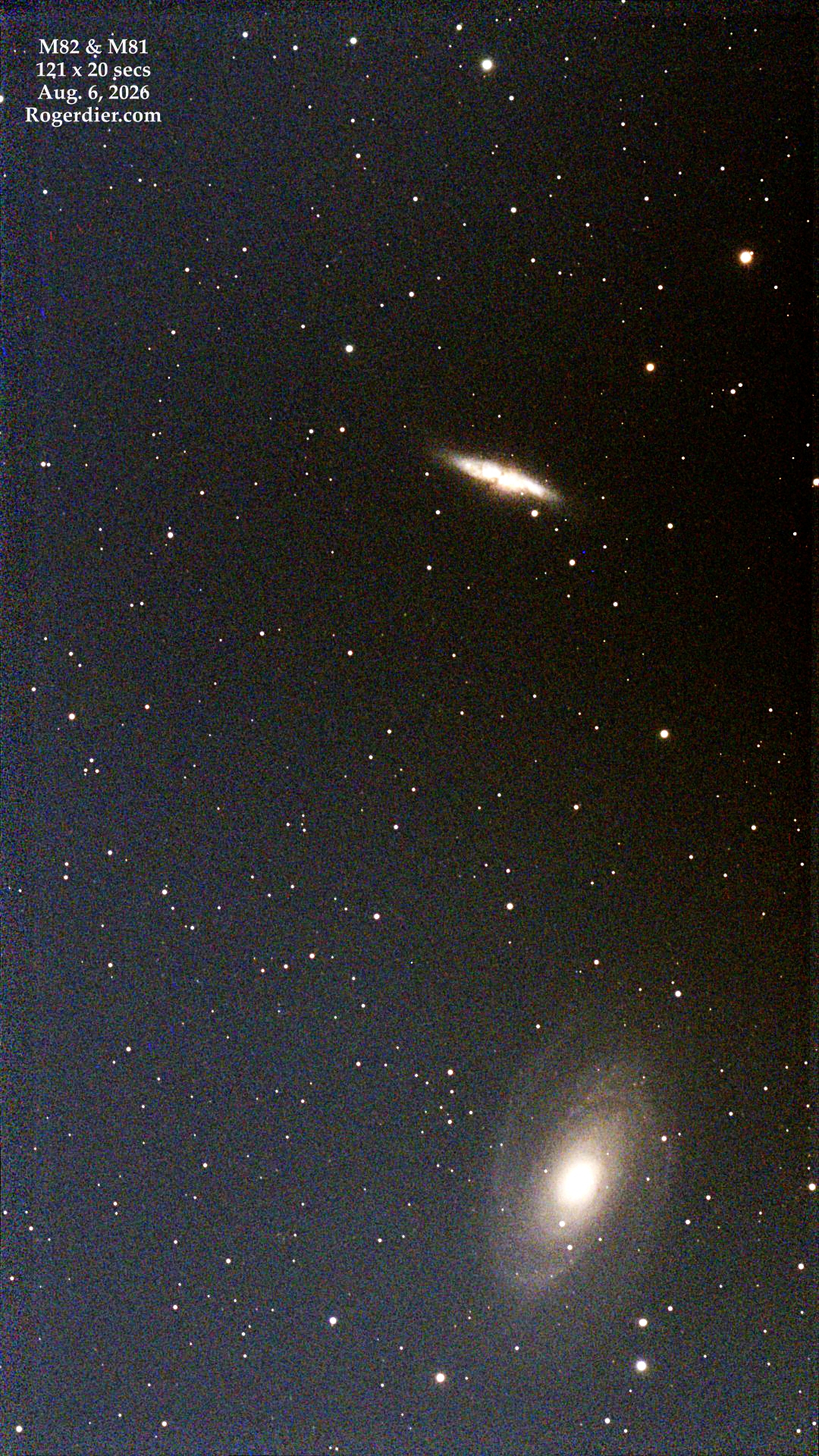
M81, the galaxy at the bottom of the image, takes the beauty prize, as it’s a classic spiral galaxy that like a proud peacock, shows all of its feathers. M82, the mottled, irregularly shaped group of stars at the top of the image, has and is losing the gradational battles with M81. Its splendid sister galaxy has spent millions of years pushing and pulling on the mass of M82, torturing its shape. Both galaxies are about 11.3 million light years away.
M81 is about 90,000 light years across and is fairly bright at 6.9 magnitude. M81 was in the mainstream news in 1993 when a supernova blew up 11.3 million years ago and the 11.2 magnitude light of the event showed up on the Earth-evening of March 28, 1993, the same night I ran out of gas on Minnesota state Highway 68. The events were not related.
M82 is loaded with torment. There are all kinds of radiation and new star forming energy banging around in the galaxy. We’d see more of it but there’s so much black dust surrounding the galaxy we only get to glimpse the PG version of what’s going on. It’s been theorized that there is a black hole at M82’s center. Plus, all the steady-but-violent tugging from M81 creates star formation at least ten times the rate of normal galaxies. M82 is a genuine hot mess, but it’s a sizzle-mess worth watching.
That’s it for now. Thank you for reading. The staff at rogerdier.com wishes you good health and good luck.


One response to “Three Bear Beauties”
Thanks for posting these images Roger. Ursa Major is mostly beyond my northern horizon but I know it’s high in your sky in the northern hemisphere. I remember scanning it with binoculars last time I was in England.
M101 technically rises above my (theoretical) horizon but I will never see it from here in Sydney.
Despite this contradictory evidence, some people like to tell us that the Earth is flat.
LikeLike