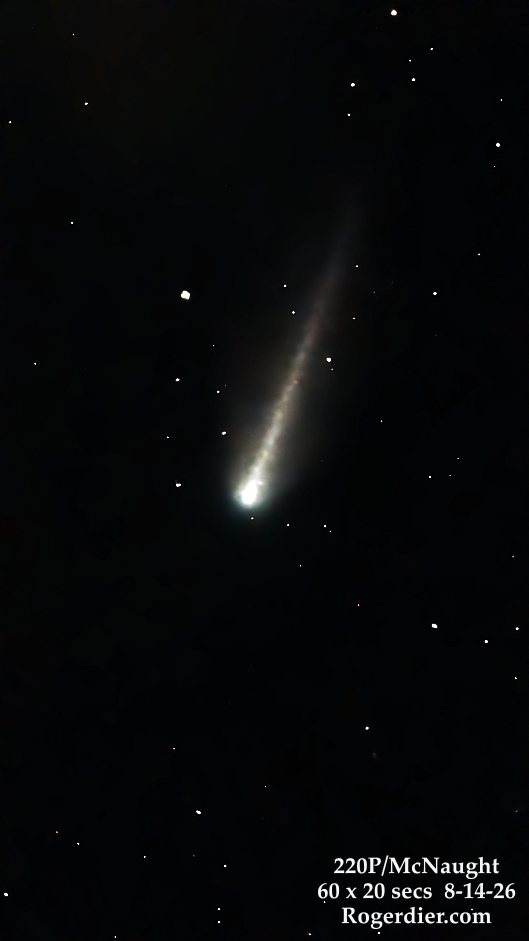
Hearing reports of an unexpectedly bright comet in the morning sky, I woke close to 4 a.m. and stepped out of our south-facing front entrance to gauge the sky conditions.
I knew the air quality was bad as soon as I stepped out—the Air Quality Index was 97, ashes on the tongue territory—but I saw stars fighting to be seen in the less-than-favorable transparency sky. By the time I had my SeeStar ready to roll, astronomical twilight had already begun.
If you are new to all of this, astronomical twilight precedes nautical twilight and civil twilight, the latter is generally recognized as pre-sunrise and post-sunset periods of time when it’s dark but not dark enough to need artificial light to meander around Mother Earth.
Astronomical twilight is the time of night that is no longer the deepest and darkest time of the night.
The comet of the morning, 220P/McNaught, was discovered on May 8, 2004 by Australian astronomer Robert H. McNaught. He’s found a few of these puppies, 26 to be precise.
My feature photo has had some interesting moments during this gassy ride toward the sun. On June 1, it brightened dramatically from magnitude 18 to Magnitude 11, an 8,000 fold increase. It quieted down and dimmed some, but brightened again to 8.2 magnitude on August 5th, about 10 days ago. It shined at magnitude 8.6 this morning, August 14 when this photo was taken.
What causes the sudden bursts of brightness? Likely, some heated gasses from within the comet’s interior broke through the crust and sprayed out and away from the solar plasma that heats comet interiors with more intensity as they approach perihelion, which for the record, occurred on June 10 of this year.
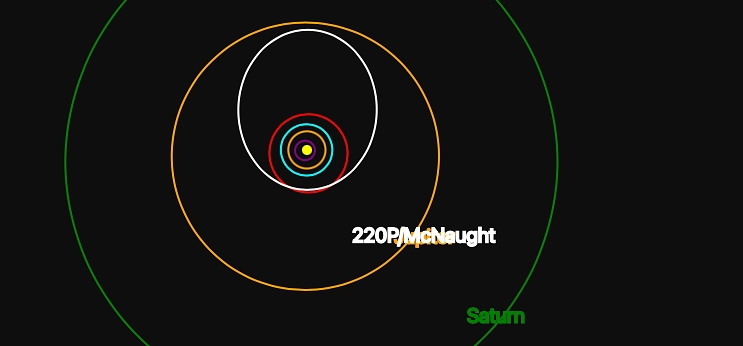
Now on its way out to the farthest parts of its 2,010 day orbit–Jupiter Junction–it is still riled up enough for amateur astronomers to view it or photograph it. The featured image is a collection of 60, 20-second exposures made by the magic machine, the SeeStar S50.
I love comets. There are many we know about and have plotted their orbits through or within the solar system. We’ve known about 220P/McNaught for 21 years. We didn’t expect it to act out like it has during its swing around the sun. Comets that misbehave are delights in this life.
Thank you for reading.
 Cosmic
2 responses to “A Misbehaving Comet”
I don’t understand how these comets don’t burn up but just keep circling for millennia.
LikeLike
My mom was celebrating her birthday in heaven that day.
LikeLike